

When you're starting your search for a property, especially an investment or multi-family home, it’s easy to get lost in the numbers. The Gross Rent Multiplier, or GRM, is a simple tool designed to help you quickly compare properties. It gives you a fast, straightforward way to see which ones might offer more value for their price.
Think of it like this: you're at the grocery store comparing two bags of apples. One is cheaper, but the other one is bigger. To find the real value, you’d check the price per pound. The GRM does the same thing for rental properties, helping you spot the better bargain before you spend hours on a deep financial analysis.
Breaking Down the Gross Rent Multiplier
The Gross Rent Multiplier (GRM) is a simple calculation that estimates how many years it would take for a property's total annual rent to pay back its purchase price. It’s a back-of-the-napkin metric designed for quick, initial screening.
What Is the GRM Formula?
The beauty of the GRM is its simplicity. You only need two pieces of information to figure it out: how much the property costs and how much rent it brings in each year.
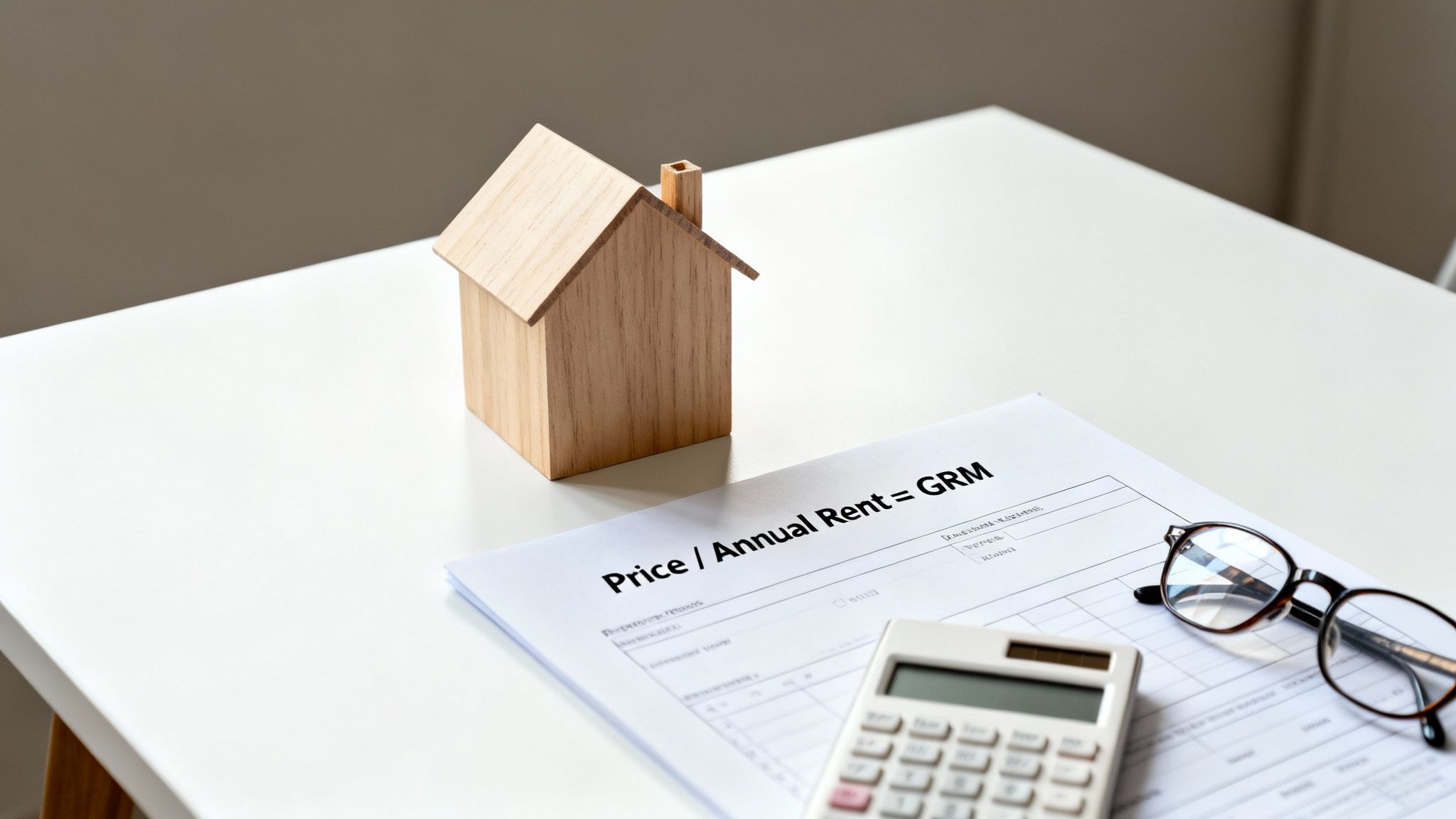
GRM = Property Price / Gross Annual Rent
To make this crystal clear, let's unpack the formula's components.
GRM At a Glance: Key Concepts
This table breaks down the core components of the Gross Rent Multiplier formula for easy understanding.
| Component | What It Means | Example |
|---|---|---|
| Property Price | This is the asking price or current market value of the property you're looking at. | A duplex listed for $500,000. |
| Gross Annual Rent | This is the total potential rental income for one year, before subtracting any expenses like taxes or repairs. | The duplex brings in $50,000 a year. |
So, using our example, a $500,000 property that generates $50,000 in gross rent would have a GRM of 10. This means it would take 10 years of gross rental income to equal the property's price.
Why Gross Rent Matters
It’s crucial to remember that the GRM uses gross rent, not net profit. This is both its biggest advantage and its most significant limitation. Because it completely ignores operating expenses, it only gives you a high-level snapshot.
But that’s exactly what makes it such a great first-pass metric.
When you're comparing a dozen similar properties, you can quickly weed out the ones that seem overpriced for their income potential. It helps you build a shortlist of promising investments that are actually worth a deeper dive. This approach is similar to how investors use the rent-to-value ratio, a concept we cover in our guide on the rent-to-value ratio for rental properties.
How to Calculate GRM With Real-World Examples
Ready to crunch some numbers? The best part about the Gross Rent Multiplier is its simplicity. You don’t need a finance degree or fancy software to figure it out—just two key pieces of information: the property's price and its total yearly rent.
The formula is as straightforward as they come:
GRM = Property Price / Gross Annual Rent
Let's walk through the steps to make sure you get an accurate calculation every single time.
Step 1: Find the Property Price
This one’s easy. The property price is just the asking price or what you expect to pay for the building. For our examples, we'll just use the listed sale price.
Step 2: Calculate the Gross Annual Rent
This is a simple but important step. Most rental listings advertise the monthly rent, but the GRM formula needs the annual number.
To get the gross annual rent, just multiply the monthly rent by 12.
- Monthly Rent x 12 = Gross Annual Rent
It’s crucial to use the gross rent here—that’s the total income before you subtract any expenses like taxes, insurance, or maintenance. If you want a deeper dive, you can learn more about how to calculate rental income for any property.
Example 1: Single-Family Home
Let's put this into practice. Imagine you're eyeing a single-family home on the market.
- Property Price:$350,000
- Monthly Rent:$2,500
First, figure out the gross annual rent: $2,500 (Monthly Rent) x 12 = $30,000 (Gross Annual Rent)
Now, just plug those numbers into the GRM formula: $350,000 (Price) / $30,000 (Gross Annual Rent) = 11.67 GRM
The GRM for this house is 11.67. In plain English, this means it would take almost 12 years of gross rental income just to cover the purchase price.
Example 2: Small Duplex
Now, let's run the numbers on a small duplex to see how it stacks up.
- Property Price:$450,000
- Monthly Rent (Total for Both Units):$4,000
Again, let's find the gross annual rent: $4,000 (Total Monthly Rent) x 12 = $48,000 (Gross Annual Rent)
Next, we’ll apply the GRM formula: $450,000 (Price) / $48,000 (Gross Annual Rent) = 9.38 GRM
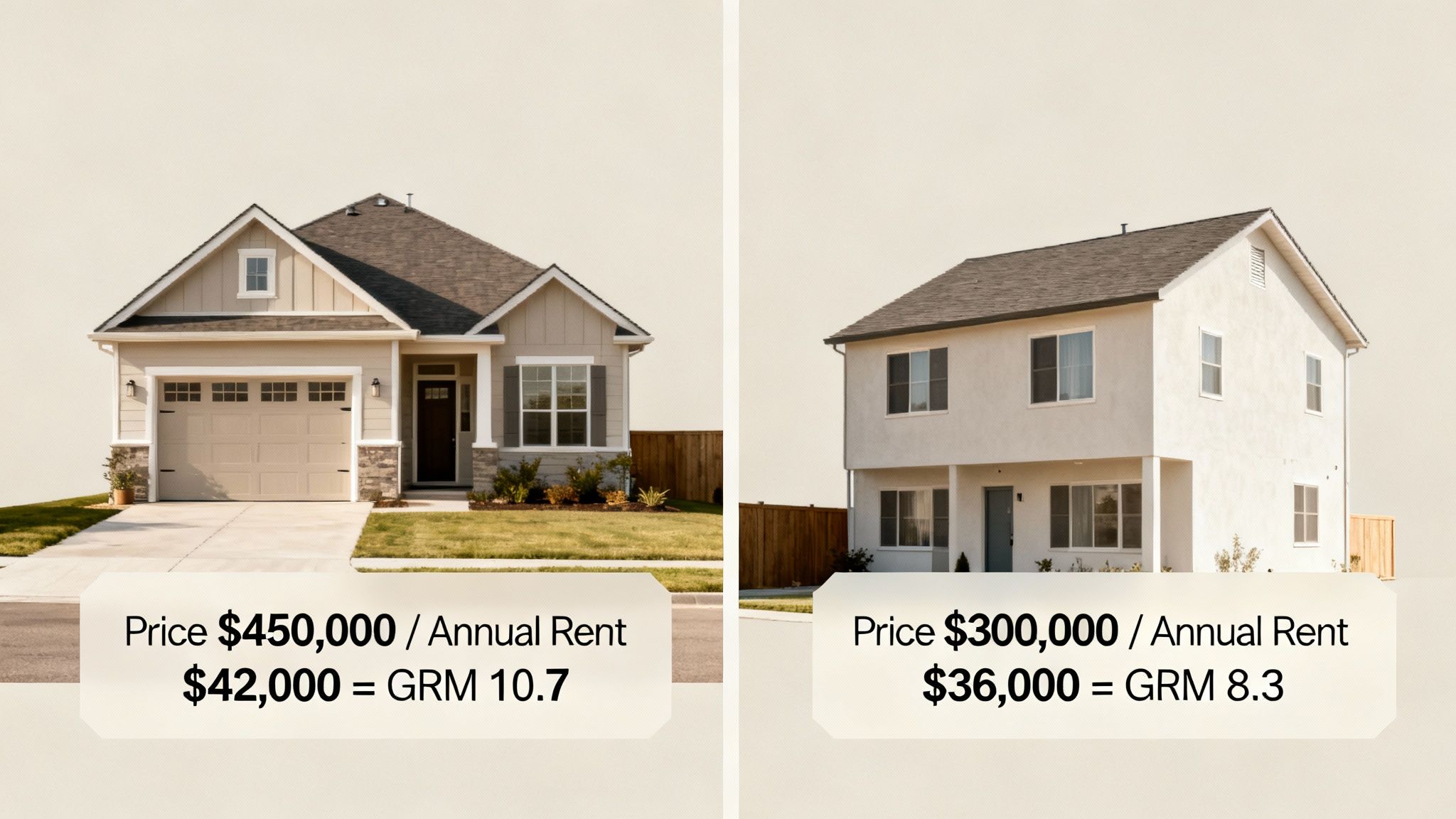
The duplex has a GRM of 9.38. At a glance, this property seems to offer a much quicker payback on its purchase price compared to the single-family home. This is exactly the kind of fast comparison that makes the Gross Rent Multiplier such a handy tool for your home search.
What a Good Gross Rent Multiplier Looks Like
So, you’ve run the numbers and have a Gross Rent Multiplier in hand—but what does that number actually tell you? Is it good, bad, or just average?
The honest answer is: it depends entirely on the market. There's no magic number for a "good" GRM because what’s considered a fantastic deal in one city might be completely unremarkable just one town over.
That said, there is a general rule of thumb: a lower GRM is almost always more attractive. A lower number means the property’s gross rent will cover its purchase price in fewer years. Think of it as a quicker payback period on your initial investment.
For instance, a property with a GRM of 7 will, in theory, pay for itself with gross rental income in just seven years. Another property with a GRM of 12 would take twelve years. All else being equal, the first property looks like the smarter buy.
Finding Your Market’s Baseline
The real secret to making GRM useful is context. You can't just pluck a number out of thin air; you need to know the going rate for your specific area. A GRM of 15 might be a steal in a hot, appreciating urban market, while a GRM of 8 could be the norm in a stable, cash-flowing suburban neighborhood.
To figure out what’s normal in your target area, you’ll need to do a little homework:
- Analyze Comps: Look at recent sales data for similar rental properties in the neighborhood. Calculate the GRM for each one to establish a benchmark range for your market.
- Talk to the Pros: Connect with local real estate agents, property managers, and other investors. Their on-the-ground knowledge is invaluable for understanding what a competitive GRM looks like right now.
Using Comps to Spot a Bargain
This process of comparing your potential deal to others is the heart of smart investing. It’s what professionals call a real estate comparative market analysis, or CMA. By looking at similar, recently sold properties, you can get a clear picture of what constitutes fair market value and performance.
Once you've established a baseline GRM for your market, you can quickly spot deals that stand out from the crowd. If you find a property with a GRM of 8 in a market where the average is 11, that's a huge signal to dig deeper. It could be the hidden gem you’ve been looking for.
Comparing GRM and Cap Rate For Deeper Insights
While the Gross Rent Multiplier is a fantastic first-pass tool for quickly sifting through a pile of listings, it has one major blind spot: it completely ignores expenses.
To get a true picture of a property's profitability, you need to bring in its more detailed cousin, the Capitalization Rate, or Cap Rate. Think of it this way: GRM is your quick scan from across the street, while Cap Rate is the magnifying glass you use once you're inside.
The core difference is that GRM is based on gross rent—the total income a property brings in before a single bill is paid. In contrast, Cap Rate uses Net Operating Income (NOI), which is the cash left over after you've paid all the necessary operating expenses.
Why Expenses Change Everything
Operating expenses are the unavoidable, ongoing costs of owning a rental property. They can absolutely make or break a deal and include things like:
- Property Taxes
- Insurance
- Maintenance and Repairs
- Property Management Fees
- Utilities (if not paid by tenants)
Because GRM overlooks these costs, two properties can look identical on paper but deliver wildly different financial results. This is where Cap Rate shines, giving you a much sharper view of an investment's actual performance.
A Tale Of Two Properties
Let's see this in action. Imagine two similar duplexes, both listed for $400,000 and each generating $48,000 in gross annual rent.
At first glance, their GRM is identical: $400,000 / $48,000 = 8.33 GRM
Based on this metric alone, they seem like equally good deals. But let's peek under the hood at their expenses.
- Duplex A (Newly Renovated): This place is in great shape. Its operating expenses are low, totaling just 30% of its gross rent.
- Duplex B (Older Building): This one has some deferred maintenance. Its operating expenses are much higher, eating up 50% of its gross rent.
This is exactly why understanding the rental property Cap Rate is so critical. The numbers don't lie. Take two buildings priced at $1,500,000 with the same gross rent of $252,000. Both have a GRM of 6.0. But if Building A's expenses are 30% of gross rent while Building B's are 50%, their NOI and resulting cap rates are drastically different: 11.76% for Building A versus 8.40% for Building B. For a deeper dive, check out the analysis on the Corporate Finance Institute's website.
This concept map helps visualize how different factors come together to determine what makes a "good" GRM.
As the diagram shows, a lower GRM is generally what you're looking for, but its quality is always relative to the local market and specific property type.
GRM vs. Cap Rate: Side-by-Side Comparison
To make the choice clearer, here’s a table breaking down the key differences between GRM and Cap Rate.
| Metric | What It Measures | Calculation | Best For |
|---|---|---|---|
| GRM | Speed of payback based on gross rent | Property Price / Gross Annual Rent | Quick, initial screening of many properties; comparing similar properties in the same market. |
| Cap Rate | Annual return based on net income | Net Operating Income / Property Price | Deeper analysis of profitability; comparing properties with different expense structures. |
In short, use GRM to quickly filter a long list of potential deals down to a few contenders. Then, switch to Cap Rate to do your serious financial homework before making an offer.
Strengths and Weaknesses of Using GRM
Every tool has a specific job, and the Gross Rent Multiplier is no different. It’s not the final word on whether a property is a good investment, but it’s an incredibly effective first step in your analysis. Knowing when to lean on it—and when to switch to a more detailed metric—is a key skill.
The Strengths of GRM
The biggest advantage of the GRM is its sheer simplicity and speed. When you're scrolling through dozens of listings, you don't have time to build a complex spreadsheet for each one. The GRM gives you a quick gut check with just two numbers.
Here’s where it really shines:
- Speedy Comparisons: You can calculate the GRM for ten properties in the time it takes to dig up the full expense report for just one.
- Initial Screening: It lets you immediately spot properties that are obviously overpriced compared to their income, so you can discard them and focus on the real contenders.
- Market Benchmarking: By calculating the average GRM in a neighborhood, you can instantly tell if a new listing is a potential bargain or a pricing outlier.
The Limitations of GRM
For all its speed, the GRM has one massive, undeniable blind spot: it ignores operating expenses. This is the single most important thing to remember about this metric.
The GRM only looks at gross rent. It tells you nothing about property taxes, insurance, maintenance costs, vacancy rates, or management fees. These expenses can vary wildly from one building to the next and have a huge impact on your actual profit.
Relying only on GRM can paint a dangerously rosy picture. A property with a fantastic GRM might have a 20-year-old roof, sky-high property taxes, or outdated plumbing, making it a far worse deal than a property with a slightly higher GRM but lower, more predictable costs.
The takeaway is simple: treat the GRM as a powerful first filter, not your final decision-making tool. Use it to build your shortlist of promising deals. After that, it's time to switch to more detailed metrics like Cap Rate and cash-on-cash return to do your real due diligence.
Frequently Asked Questions (FAQ)
Here are answers to some common questions new buyers have about using the Gross Rent Multiplier.
1. Where do I find the gross rent for a property?
The easiest place to start is the property listing itself, where the agent often includes the current or projected rent. If the information isn't there, ask the seller for a "rent roll," which is a simple document that lists the rent for each unit. Always double-check these numbers by looking at "rental comps"—what similar properties nearby are actually renting for on sites like Zillow or Rentometer. This ensures your calculation is based on realistic market data.
2. Does a low GRM always mean a good investment?
Not necessarily. A low GRM is a great sign that a property might be undervalued and is worth a closer look, but it isn't an automatic green light. Sometimes, a suspiciously low GRM can be a red flag for hidden problems, like significant deferred maintenance (e.g., an old roof), unusually high property taxes, or a location with high tenant turnover. Think of a low GRM as a signal to start asking more questions, not as a final decision.
3. Should I use GRM when buying a home just for myself?
The Gross Rent Multiplier is specifically designed for income-producing properties, so it isn't a useful metric if you're buying a primary residence that you don't plan to rent out. For a personal home, you'll focus more on factors like the home's condition, location, school district, and your personal mortgage affordability. However, if you're considering buying a duplex to live in one side and rent out the other, the GRM can be a very helpful tool for evaluating the investment potential.
4. What is the difference between annual and monthly GRM?
While you can calculate a GRM using either monthly or annual rent, the annual GRM is the industry standard. When real estate agents, lenders, or investors discuss a property's GRM, they are almost always referring to the annual number. This ensures everyone is making a true apples-to-apples comparison. If you calculate a monthly GRM, simply multiply it by 12 to get the standard annual figure.
Analyzing properties shouldn't feel like a guessing game. With Flip Smart, you can screen deals in seconds, not hours. Our platform gives you instant access to valuations, renovation costs, and profit potential for any property, so you can stop wondering and start investing with confidence. Find your next deal with Flip Smart today!