
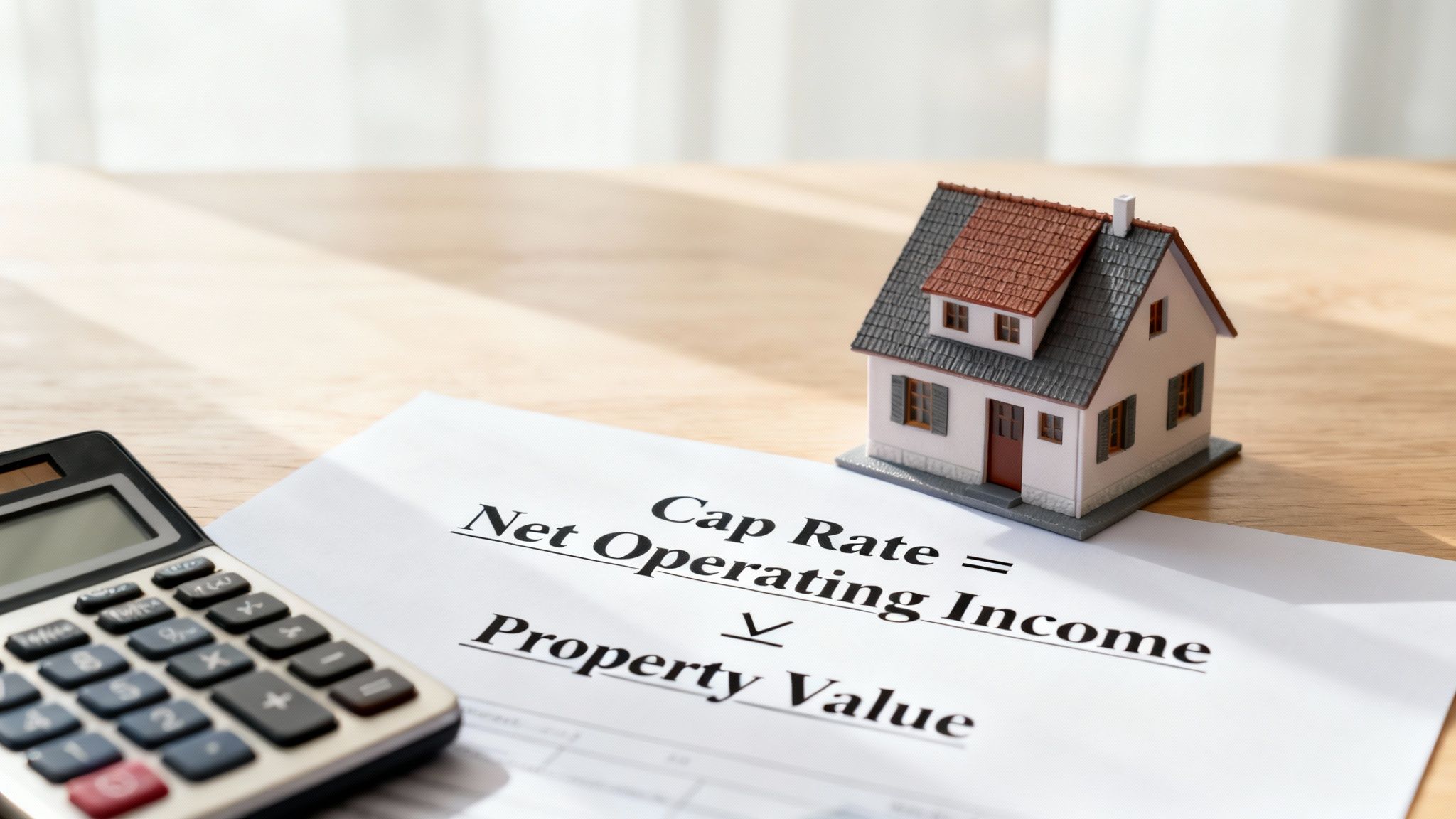
To determine the cap rate on a rental property, you divide its Net Operating Income (NOI) by its current market value. This simple calculation gives you a quick, unleveraged snapshot of the property's potential return, making it a vital starting point for any real estate investor.
What Cap Rate Tells You About a Rental Property
When you're evaluating potential investment properties, the capitalization rate—or cap rate—is one of the most useful tools you'll find. Think of it as a universal yardstick that helps you compare different investment opportunities fairly.
It cuts through the noise of varying price points and financing options. This allows you to evaluate a duplex in one city against a small apartment building in another on an apples-to-apples basis. At its core, the cap rate answers one simple question: “How much income does this property generate relative to its price?”
This single percentage reveals the raw, unleveraged rate of return you could expect if you paid for the property entirely in cash. It’s a pure measure of the asset's performance, completely separate from your personal financing.
Why This Metric Matters
At its heart, the cap rate helps you quickly weigh risk against potential return. A higher cap rate might point to a higher return, but it could also signal greater risk—maybe the property is in a less desirable neighborhood or needs significant repairs.
On the flip side, a lower cap rate often indicates a lower-risk investment in a stable, high-demand area. In these cases, you might be counting on the property's value increasing over time (appreciation) as a larger part of your overall return. For a deeper look, this is a great resource on What Is Cap Rate in Real Estate for investors.
Understanding this balance is crucial. As a new investor, you need a reliable way to vet opportunities without getting bogged down in complex spreadsheets. The cap rate acts as that initial filter, helping you decide which properties deserve a closer look. We also cover this in more detail in our guide on what the capitalization rate is and how it works.
To make this even clearer, let's break down the components of the formula.
Cap Rate at a Glance: Key Components
| Component | What It Is | Why It Matters |
|---|---|---|
| Net Operating Income (NOI) | Gross rental income minus all operating expenses (like taxes, insurance, and maintenance). It excludes mortgage payments. | This shows the property's ability to generate profit from its own operations, independent of your loan. |
| Current Property Value | The price the property would likely sell for on the open market today. | This is the other half of your equation; an accurate value is critical for a meaningful cap rate. |
| Cap Rate (%) | The final percentage you get by dividing the NOI by the property value. | It provides a standardized metric to compare the profitability and risk of different investment properties. |
This table helps simplify the concept, showing that it’s all about the property's earning power versus its price tag.
Cap Rates in the Real World
The formula to determine the cap rate on a rental property is straightforward: Cap Rate = Net Operating Income (NOI) ÷ Current Property Value × 100.
Remember, NOI is your gross rental income minus all the true operating expenses—things like taxes, insurance, and maintenance—but it specifically excludes your mortgage payments.
For instance, in Charlotte, North Carolina, multifamily cap rates in early 2025 ranged from 4.84% for high-end properties to 6.71% for more modest buildings. This shows how location and property condition directly impact expected returns. This simple number is your first step toward making a confident investment decision.
Calculating Net Operating Income: The Heart of Your Cap Rate
Your cap rate calculation is only as good as the numbers you use. The most important figure here is the Net Operating Income (NOI). This is where you have to be a bit of a detective and dig into a property's real financial performance.
Think of NOI as the property's annual profit before you account for mortgage payments or income taxes. It's the pure, unfiltered earning power of the asset itself. Getting this number right is everything. If you overestimate it, an average deal might look fantastic on paper. If you underestimate it, you might pass on a great opportunity.

Start with All Income Sources
First, let's figure out the property's Gross Potential Income (GPI). This is the absolute maximum amount of money the property could bring in over a year if every unit was rented out and every tenant paid on time.
Of course, rent is the main source of income, but don't stop there. Smart investors look for other revenue streams.
Common add-on income sources include:
- Parking Fees: Charging for covered or assigned spots.
- Laundry Facilities: Coin-operated washers and dryers can add up.
- Storage Units: Renting out small on-site storage closets.
- Pet Fees: A one-time fee or monthly "pet rent."
- Utility Reimbursements: Billing tenants back for services like water or trash.
Add every dollar from all these sources to get the full picture of the property's earning potential. For a deeper dive, check out our guide on how to accurately calculate rental income on any property.
Subtracting True Operating Expenses
Now for the costs. An operating expense is any cost necessary to keep the property running and generating income. This is where many new investors make mistakes—they either forget key expenses or include costs that don't belong in an NOI calculation.
Here's a checklist of what you must subtract from your gross income:
- Property Taxes: The annual bill from your local government.
- Property Insurance: Your policy covering liability, fire, and other potential damages.
- Utilities: Any gas, electric, water, or trash bills that you (the landlord) pay.
- Routine Maintenance and Repairs: This covers the small stuff like leaky faucets, landscaping, and pest control. A good rule of thumb is to budget 5-10% of your rental income.
- Property Management Fees: Even if you plan to manage it yourself, you should still account for this cost. It’s typically 8-10% of collected rent and ensures you're measuring the property's performance, not your own free labor.
Key Takeaway: The single biggest mistake investors make is including the mortgage payment (principal and interest) in their NOI calculation. Remember, NOI measures the property's profitability, completely separate from your financing.
Accounting for Vacancy and Reserves
A property is almost never 100% occupied all year. Tenants move out, and big things eventually break. To build a realistic NOI, you have to plan for empty units and major repairs.
Vacancy Allowance: This is a percentage of your gross income you set aside to cover the rent you'll lose when a unit is empty between tenants. A 5-8% vacancy rate is a common starting point, but research your local market to be sure.
Capital Expenditures (CapEx) Reserves: This is your "rainy day" fund for big-ticket items like a new roof, HVAC system, or water heater. Smart investors set aside 2-4% of their income for future CapEx.
Subtracting these allowances gives you a much more conservative—and trustworthy—NOI.
A Duplex NOI Example
Let's walk through how this works with a duplex.
Calculate Gross Potential Income:
- Unit A Rent: $1,500/month
- Unit B Rent: $1,500/month
- Annual Gross Potential Rent: ($3,000 x 12) = $36,000
Account for Vacancy:
- Let's use a 5% vacancy rate: $36,000 x 0.05 = $1,800
- Effective Gross Income (EGI): $36,000 - $1,800 = $34,200
Total Annual Operating Expenses:
- Property Taxes: $4,500
- Insurance: $1,200
- Maintenance (5% of EGI): $1,710
- Property Management (8% of EGI): $2,736
- CapEx Reserves (3% of EGI): $1,026
- Total Expenses:$11,172
Calculate Net Operating Income (NOI):
- NOI = Effective Gross Income - Total Expenses
- NOI = $34,200 - $11,172 = $23,028
That final number, $23,028, is the real-world NOI you'd use to calculate the cap rate for this duplex. It’s a number you can trust because it accounts for the true costs of owning the property.
Finding an Accurate Property Value for Your Calculation
Once you've nailed down your Net Operating Income (NOI), you're only halfway there. The other critical piece of the puzzle is the property's value—the second number in your cap rate formula. If you get this wrong, your cap rate will be misleading.
An inaccurate property value can make a bad deal look good, so it's important to get it right.
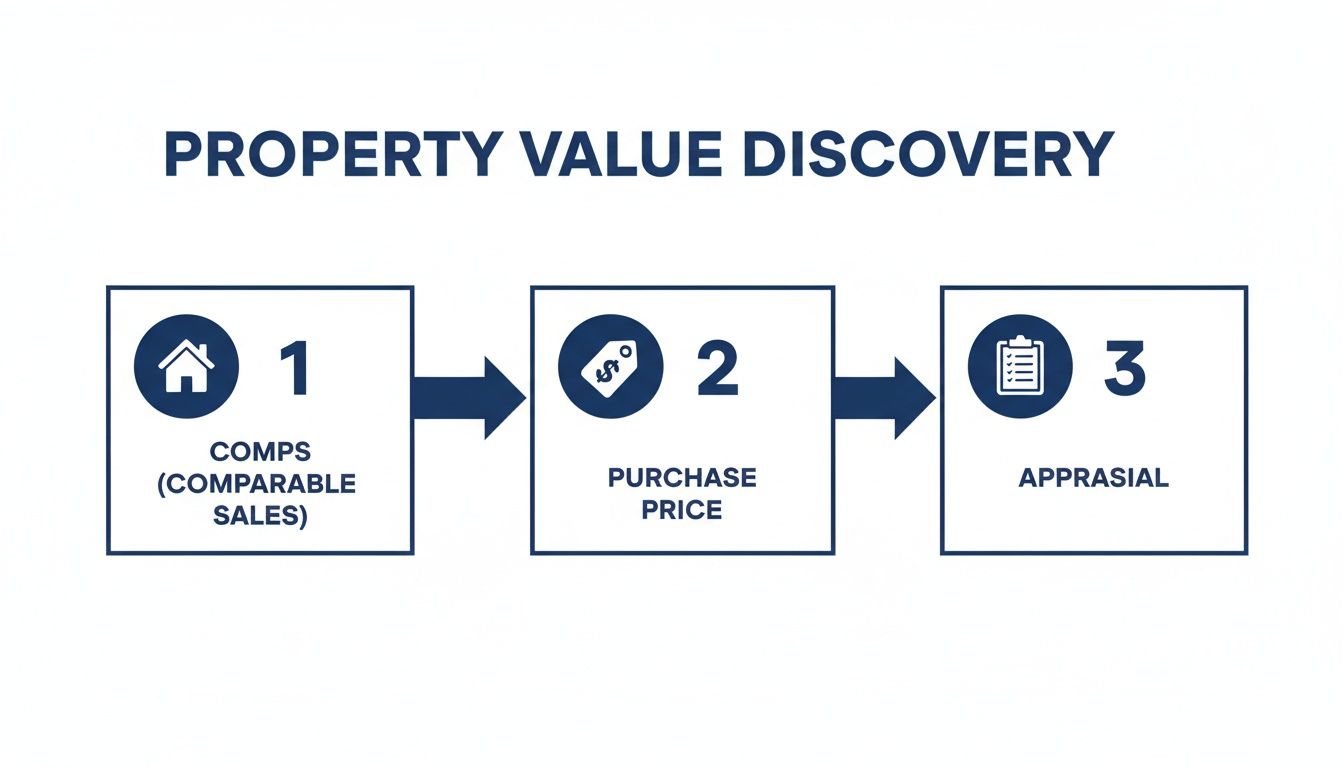
Analyzing Comparable Sales or "Comps"
For residential properties like single-family homes or small multi-family buildings, the most reliable way to determine market value is by analyzing comparable sales, or "comps." This means finding recently sold properties that are as similar to your target property as possible.
Here’s what to look for in a good comp:
- Location: In the same neighborhood, ideally within a half-mile radius and sharing the same school district.
- Property Type: Compare a duplex to other duplexes, not single-family homes.
- Size and Layout: Look for similar square footage and the same number of bedrooms and bathrooms.
- Age and Condition: A renovated historic home should be compared to other renovated historic homes, not a brand-new build.
- Recency: The market moves fast. Only use properties sold within the last three to six months to get an accurate idea of what buyers are willing to pay right now.
By averaging the sale prices of three to five solid comps, you can arrive at a realistic estimate of your property's current market value.
When to Use the Purchase Price
If you're analyzing a property you are about to buy or one that's currently listed, using the purchase price as the "value" is a great starting point. It's a real number that reflects what the market is demanding at that moment.
However, a common mistake is using a purchase price from years ago. Real estate markets change. The price you paid for a property five years ago is history; it doesn't reflect its current worth. Using an old number will give you a completely distorted cap rate.
Investor Tip: If you're planning a renovation, use the After-Repair Value (ARV)—what the property will be worth after you've fixed it up. This is the only way to accurately project the returns on a "fix-and-flip" or similar value-add project.
Seeking a Professional Appraisal
When comps are hard to find, the property is unique, or you just want a professional opinion, it’s time to call a licensed appraiser. An appraiser provides an unbiased, legally defensible opinion of value based on a thorough inspection and deep market analysis.
An appraisal is especially smart when:
- The property has unusual features.
- The market is changing quickly.
- You're getting a loan, as your lender will require one anyway.
An appraisal costs a few hundred dollars, but it gives you a rock-solid valuation you can rely on. For a deeper dive into how pros value properties, our guide on real estate valuation methods breaks it all down.
Putting It All Together With Real-World Examples
Theory is helpful, but seeing the numbers in action makes it all click. To really understand how to determine the cap rate on a rental property, let’s walk through two different scenarios: a suburban single-family home and a small multi-family property.
This will show you why one property might have a higher cap rate than another and what that means for your investment.
First, a solid cap rate calculation starts with an accurate property value. You can use a three-pronged approach: checking recent comparable sales, considering the purchase price (if it’s a recent buy), and sometimes getting a formal appraisal.
Now, let's put this into practice.
Example 1: The Suburban Single-Family Home
Imagine you’re analyzing a standard three-bedroom, two-bathroom house in a good suburban neighborhood. It's the kind of area that attracts families, which usually means stable, long-term tenants.
After reviewing similar homes sold in the last four months, you determine a current market value of $400,000.
Now for the income and expenses:
- Monthly Rent: $2,500
- Annual Gross Potential Income: ($2,500 x 12) = $30,000
- Vacancy Allowance (5%): -$1,500
- Effective Gross Income (EGI):$28,500
Next, we add up the annual operating expenses.
- Property Taxes: -$5,000
- Insurance: -$1,200
- Repairs & Maintenance (8% of EGI): -$2,280
- Property Management (8% of EGI): -$2,280
- CapEx Reserves (3% of EGI): -$855
- Total Annual Expenses:$11,615
With these numbers, we can find our Net Operating Income (NOI).
NOI = Effective Gross Income - Total Expenses
NOI = $28,500 - $11,615 = $16,885
And finally, the cap rate.
Cap Rate = NOI / Property Value
Cap Rate = $16,885 / $400,000 = 0.0422 or 4.22%
A 4.22% cap rate is on the lower side. This typically points to a less risky property in a high-demand area. Investors buying at this cap rate are often betting on long-term appreciation, not just immediate cash flow.
Example 2: The Urban Duplex
Now, let's look at a duplex in a denser urban neighborhood valued at $500,000. It has two identical two-bedroom units.
Here’s the income breakdown:
- Unit 1 Monthly Rent: $1,800
- Unit 2 Monthly Rent: $1,800
- Annual Gross Potential Income: ($3,600 x 12) = $43,200
- Laundry Income (Coin-Op): +$600
- Total Gross Income:$43,800
- Vacancy Allowance (7% for higher turnover): -$3,066
- Effective Gross Income (EGI):$40,734
Expenses for a multi-family property are often a bit more involved.
- Property Taxes: -$6,500
- Insurance: -$1,800
- Utilities (Water & Trash): -$1,500
- Repairs & Maintenance (10% of EGI): -$4,073
- Property Management (8% of EGI): -$3,259
- CapEx Reserves (4% of EGI): -$1,629
- Total Annual Expenses:$18,761
Let's calculate the duplex's NOI.
NOI = Effective Gross Income - Total Expenses
NOI = $40,734 - $18,761 = $21,973
Now for the cap rate.
Cap Rate = NOI / Property Value
Cap Rate = $21,973 / $500,000 = 0.0439 or 4.39%
At 4.39%, the duplex has a slightly better cap rate. This reflects the higher income potential from two units but also hints at the trade-offs: more management, potentially higher tenant turnover, and more things that can break.
Recent reports show that through Q2 2024, average single-family rental cap rates climbed to 6.8%. This shift was largely driven by higher interest rates, which forced investors to look for deals with better immediate returns. This proves why you can't just learn the formula; you have to constantly check market-specific cap rate trends to make smart, timely decisions.
To make the comparison even clearer, let's look at these two properties side-by-side.
Sample Cap Rate Calculation: Single-Family vs. Multi-Family
| Metric | Single-Family Home Example | Multi-Family (Duplex) Example |
|---|---|---|
| Property Value | $400,000 | $500,000 |
| Annual Gross Income | $30,000 | $43,800 |
| Effective Gross Income | $28,500 | $40,734 |
| Total Annual Expenses | $11,615 | $18,761 |
| Net Operating Income (NOI) | $16,885 | $21,973 |
| Cap Rate | 4.22% | 4.39% |
This table shows how the duplex generates more income and has higher expenses, ultimately leading to a slightly higher cap rate. Neither is definitively "better"—it all comes down to your investment strategy. The lower-cap-rate single-family home might be a slower, steadier appreciation play, while the duplex offers better cash flow from day one.
How to Interpret Cap Rates in Today's Market
Figuring out the cap rate is just step one. The real skill is knowing what that number means for your investment in today's market.
Let's be clear: there's no magic "good" cap rate. A 5% cap rate in a prime downtown neighborhood could be a great deal, while an 8% cap rate in a declining area might be a huge risk. The number itself is meaningless without context.
Think of cap rate as a comparative tool, not a final grade. Your goal is to see how a potential property stacks up against similar rentals in the same area.
Benchmarking Against the Local Market
Before you can judge a property's cap rate, you need a baseline. What's normal for that specific neighborhood? Research the average cap rates for similar properties in your target market. A good real estate agent who specializes in investments can be invaluable here.
Pay attention to local trends:
- Compressing Cap Rates (Going Down): This usually means you're in a hot market where property values are climbing faster than rents.
- Expanding Cap Rates (Going Up): This could be a sign of a cooling market, where property values are flat or falling relative to the income they produce.
If you find a property with a cap rate that’s 1-2% higher than the neighborhood average, you may have found a fantastic deal. On the other hand, a property with a much lower cap rate than its neighbors is likely overpriced.
The Influence of Economic Factors
Cap rates don't exist in a vacuum. They're tied directly to the bigger economic picture, especially interest rates. When interest rates rise, borrowing becomes more expensive. This often puts downward pressure on property prices, causing cap rates to go up as investors demand a better return to compensate for higher financing costs.
Strong local job growth can have the opposite effect. More jobs mean more demand for rentals, allowing landlords to raise rents. This can boost NOI and increase the cap rate if property values don't rise as quickly.
The relationship between cap rates and the economy is cyclical. Historically, cap rates for rental properties fluctuate with economic conditions. Data shows these cycles clearly, with cap rates rising and falling based on economic health and interest rates. To see a detailed breakdown, you can explore the full analysis on real estate cycles.
Understanding this context is key. What seems like a normal cap rate today could look very different in a few years. Smart investors learn to read these economic signs to stay ahead of market shifts.
Aligning Cap Rate with Your Goals
Ultimately, what makes a cap rate "good" comes down to your personal investment strategy. Are you hunting for immediate cash flow, or are you playing the long game for appreciation?
High Cap Rate Strategy (e.g., 8%+)
- Focus: Maximizing monthly cash flow.
- Location: Often found in secondary markets or up-and-coming neighborhoods.
- Risk Profile: Generally higher. These deals might require more hands-on management or offer less price appreciation.
Low Cap Rate Strategy (e.g., 4-6%)
- Focus: Long-term appreciation and wealth preservation.
- Location: Typically found in prime, high-demand areas.
- Risk Profile: Generally lower. These are often "set it and forget it" investments in stable markets where property values are expected to climb steadily.
There’s no right or wrong approach. A new investor might need the immediate income from a higher cap rate, while an investor nearing retirement may prefer the stability of a lower-cap-rate property.
Looking Beyond Cap Rate for a Complete Analysis
Knowing how to determine the cap rate on a rental property gives you a powerful snapshot, but it doesn't tell the whole story. Relying on a single metric is a classic rookie mistake. To get a truly complete picture, you need to pair the cap rate with other key indicators.
Think of it like a doctor’s check-up. The cap rate is your temperature—a quick and vital sign. But to understand your overall health, the doctor also checks your blood pressure. For investors, those other vital signs are the metrics that account for financing and long-term gains.
Cash-on-Cash Return
This is arguably the most practical metric for an investor. Cash-on-Cash Return measures the annual pre-tax cash flow you receive relative to the actual cash you invested. In other words, it answers the real question: "For every dollar I put into this deal out of my own pocket, how much am I getting back each year?"
It's different from cap rate because it directly includes your mortgage payments and focuses only on your initial cash investment (down payment, closing costs, upfront repairs), not the total property value.
Gross Rent Multiplier
The Gross Rent Multiplier (GRM) is a simpler, back-of-the-napkin tool for quickly screening properties. You just divide the property’s price by its annual gross rental income. It’s rough, but it’s fast.
- When to Use It: GRM is perfect for quickly filtering a long list of potential deals.
- Limitations: This metric completely ignores operating expenses, so it’s never a substitute for a real NOI and cap rate analysis. It's a filter, not a final verdict.
By combining these different metrics, you build a multi-dimensional understanding of a property's financial health. You get the operational view from the cap rate, the personal return view from cash-on-cash, and the long-term perspective from ROI.
Return on Investment
While cap rate is king for comparing properties, don't forget the bigger picture. It's crucial to understand other measures like how to calculate return on investment (ROI) for real estate to get a comprehensive view.
ROI is the ultimate measure of total profitability. It factors in not just your annual cash flow but also the equity you build and the property’s appreciation over time. It gives you the full story of your investment's success, from the day you buy to the day you sell.
Frequently Asked Questions (FAQ)
What is a good cap rate for a rental property?
There’s no single "good" number, as it depends entirely on the location, property type, and your investment goals. Generally, lower cap rates (4-6%) are found in high-demand, low-risk areas, while higher cap rates (8%+) are common in markets with higher perceived risk but greater cash flow potential. The best approach is to compare a property's cap rate to the average for similar properties in the same neighborhood.
Should I use the purchase price or current market value to calculate cap rate?
Use the purchase price when you are initially analyzing a property to buy—this tells you the return on your potential investment. Use the current market value for a property you already own to understand its current performance and decide if it's a good time to hold or sell.
Why are mortgage payments excluded from cap rate calculations?
Mortgage payments are excluded to create a standardized metric that measures the property's performance, not the owner's financing. Since every buyer's loan terms are different, excluding the mortgage allows you to compare different properties on an equal, apples-to-apples basis. It isolates the asset's pure earning power.
Can a cap rate be too high?
Yes. A very high cap rate (e.g., 12%+) might seem attractive, but it can also be a red flag. It could indicate that the property is in a high-crime area, needs extensive repairs, has unreliable income, or that the seller's financial numbers are unrealistic. Always investigate why the cap rate seems unusually high compared to the local market average.
Tired of crunching numbers in a spreadsheet? Flip Smart automates the entire analysis process. Get accurate property valuations, renovation cost estimates, and key metrics like cap rate and cash-on-cash return in seconds. Make smarter, faster investment decisions by visiting https://flipsmrt.com.