
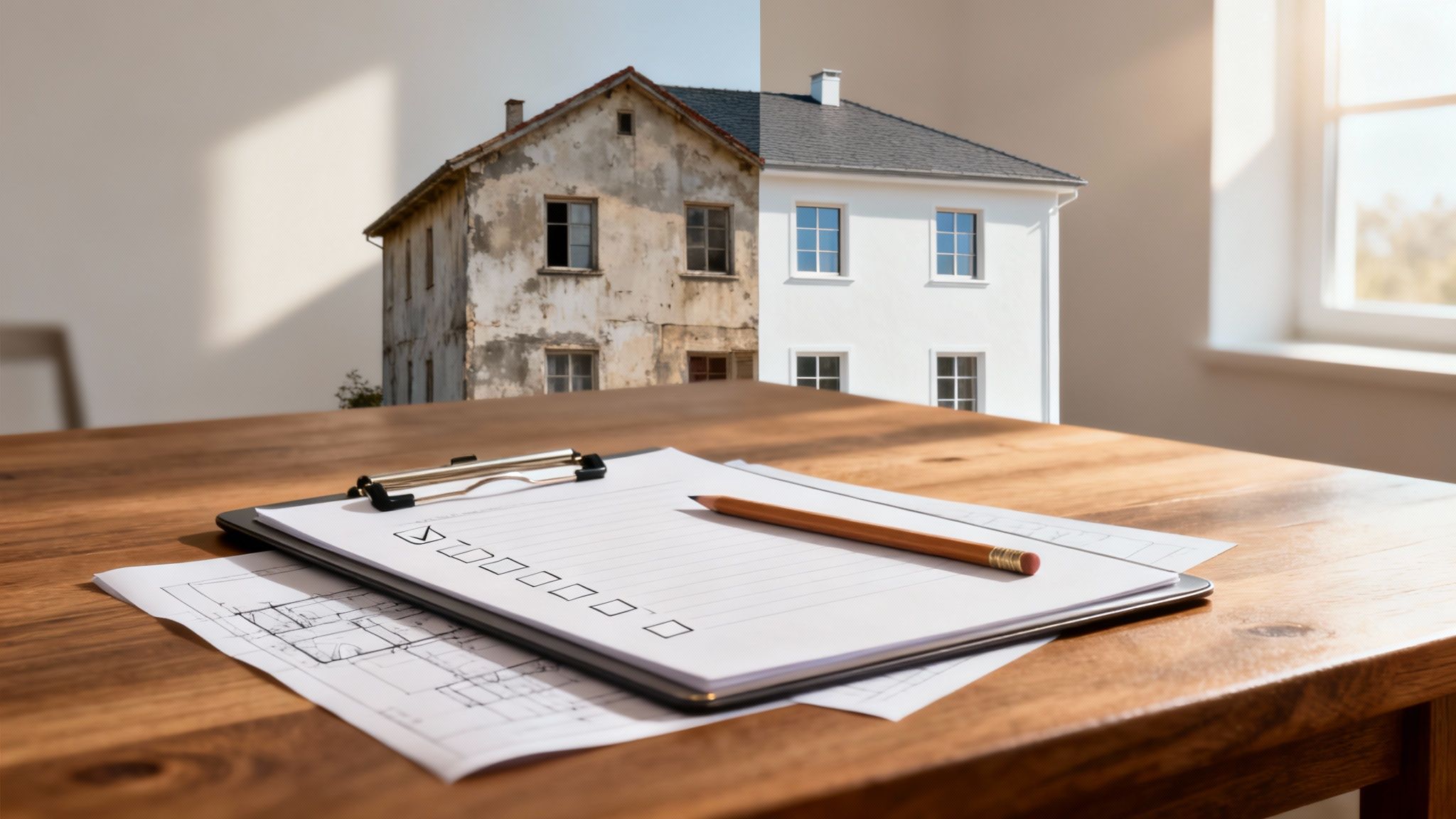
Flipping houses appears deceptively simple on television, but behind every profitable project is a meticulous plan. The margin between a significant return on investment and a costly failure often boils down to one critical tool: a comprehensive flip house checklist. If you're new to this, it's easy to underestimate all the moving parts—from analyzing the initial deal and securing financing to managing contractors and navigating permits. A single missed step can cascade into budget overruns, schedule delays, and eroded profits.
This guide provides the ultimate blueprint, breaking down the entire process into ten actionable stages. We'll walk you through everything from the initial property analysis all the way to staging, marketing, and closing the final sale. For each stage, we’ll outline the critical tasks and common pitfalls to avoid.
Think of this not just as a list, but as a strategic framework. We'll show you how to integrate modern tools to sharpen your decision-making. For instance, a platform like Flip Smart can give you instant After Repair Value (ARV) calculations and reliable rehab estimates, turning hours of manual guesswork into minutes of confident action. Forget gut feelings and television drama. This checklist is your business plan for a predictable and profitable house flip.
1. Property Analysis & Investment Evaluation
The very first and most critical item on any flip house checklist is analyzing the deal before you buy. This is where you determine if a potential property is a smart investment or a financial pitfall. It involves a close look at the purchase price, estimating repair costs, and diving into the local market to determine the After-Repair Value (ARV)—what the house will be worth after you fix it up. Essentially, you’re running the numbers to ensure the deal meets your target profit margin before you ever make an offer.

This step helps you avoid emotional decisions and grounds your business in solid data. A successful flip is often "bought," not "sold." This means your profit is locked in through a smart purchase, which is impossible without careful upfront analysis.
How to Execute Your Analysis
A common starting point is the 70% Rule, which suggests your offer price should be no more than 70% of the ARV minus the estimated repair costs. While a useful guideline, a thorough analysis goes deeper.
- Calculate ARV: Find at least three to five recent "comps" (comparable sold properties). These should be similar in size, age, and style, and located as close to your target property as possible.
- Estimate Rehab Costs: Create a detailed list of needed repairs and get preliminary quotes if you can. Always add a contingency buffer of 10-20% for surprises like hidden water damage or electrical problems.
- Factor in All Costs: Beyond the renovation, account for holding costs (insurance, taxes, utilities, loan payments), buying costs (closing fees, inspections), and selling costs (realtor commissions).
Key Takeaway: A detailed budget is non-negotiable. Missing even one significant expense can erase your profit. Meticulous real estate investment property analysis is what separates seasoned investors from gamblers.
2. Secure Financing & Funding
Once you've found a promising property, the next step on your flip house checklist is arranging the money to buy it and fund the renovation. Your financing choice isn't just a logistical step; it's a strategic decision that directly impacts your costs, cash flow, and overall profit. The wrong loan can eat into your margins with high interest rates, while the right funding partner can provide the flexibility needed for a complex project.
This stage determines your ability to act quickly. In competitive markets, having your financing pre-arranged is a major advantage. It shows sellers you're a serious buyer who can close the deal without delays.
How to Secure Your Funding
Your financing options range from traditional to specialized, each with pros and cons. Understanding these is key to choosing the right one for your deal.
- Hard Money Lenders: These are private lenders specializing in short-term, asset-based loans for investors. They fund quickly but have higher interest rates. They're ideal if you need to close fast and have a solid exit plan.
- Private Money Lenders: This means borrowing from individuals in your network, like family or friends. Terms can be flexible, but you need a strong foundation of trust and a clear, written agreement.
- Conventional & Portfolio Loans: Traditional bank loans may offer lower rates but have stricter requirements and slower closing times, which can be a disadvantage in a hot market. A critical part of your flip house project will be securing an investment property loan.
- Cash or Lines of Credit: Using your own cash or a Home Equity Line of Credit (HELOC) eliminates loan costs and provides speed, but it also puts your personal capital at greater risk.
Key Takeaway: Always have a cash reserve of 15-20% of the total project cost. This contingency fund is your safety net for unexpected repairs, project delays, or market shifts. Learn more about how to finance a flip to explore these options in greater detail.
3. Hire & Manage Contractors & Tradespeople
Once you've secured funding and bought the property, the next critical item on your flip house checklist is assembling a reliable team. The success of your renovation depends almost entirely on the quality, speed, and cost-effectiveness of your contractors. Poor contractor management is a primary reason why many flips fail, leading to budget overruns, extended timelines, and subpar work that hurts your final sale price.
This stage is about more than just finding the cheapest labor; it's about building a professional team that can execute your vision on schedule and within budget. Successful investors know that their crew is their most valuable asset and invest time in vetting professionals to build a roster of trusted partners.
How to Execute Your Vetting and Management
Finding and managing the right team is an active process. Simply handing over the keys and a check is a recipe for disaster. Effective management requires clear communication, detailed agreements, and regular oversight.
- Gather Multiple Bids: For any big job (like roofing or plumbing), get at least three detailed bids. Don't just compare the final price; compare the itemized scope of work to ensure you're evaluating equivalent proposals.
- Verify Credentials: Before hiring, verify their license and insurance (general liability and worker's compensation). Ask for at least three recent references and call them to discuss their experience.
- Insist on a Written Contract: Your contract should detail the scope of work, a payment schedule tied to project milestones, a firm timeline, and the specific materials to be used.
- Manage Payments and Progress: Never pay for the entire job upfront. A common structure is a small deposit, with later payments made as specific phases are completed. Hold back a final 10% payment until all punch-list items are finished to your satisfaction.
Key Takeaway: A well-vetted contractor provides more than labor; they offer crucial expertise that helps you refine your budget and timeline. Their input is invaluable when you are trying to learn more about how to estimate renovation costs.
4. Obtain Permits & Pass Inspections
A frequently overlooked but critical item on your flip house checklist is navigating permits and inspections. This involves getting all necessary building permits from your local city or county before work begins and ensuring the completed renovations pass all required inspections. Ignoring this can lead to stop-work orders, hefty fines, and major problems when you try to sell the property.
Unpermitted work is a major red flag for potential buyers and their lenders, often causing deals to fall apart at the last minute. Properly permitted work, on the other hand, provides official validation of the quality and safety of your renovations, adding value and peace of mind for the next owner.
How to Execute Your Permitting and Inspection Process
Successfully managing this requires proactive research and organization. Your licensed general contractor typically handles the paperwork, but you must oversee the process to prevent costly delays.
- Research Local Requirements Early: Before you even buy the property, find out which types of work require a permit in that specific area. Structural changes, new electrical wiring, and major plumbing work almost always do.
- Submit Plans in Advance: The permit approval process can take weeks or even months. Submit your plans and applications as early as possible to avoid having your crew wait around.
- Schedule Inspections Strategically: Inspections happen at key project milestones, such as after framing but before drywall goes up. Coordinate these with your project timeline to keep things moving.
- Document Everything: Keep copies of all submitted plans, approved permits, and passed inspection reports in a safe place. This documentation will be essential when you sell.
Key Takeaway: Never try to hide unpermitted work. Savvy buyers and diligent home inspectors will likely find it, jeopardizing your sale and reputation. Handling permits correctly from the start protects your investment and streamlines the entire house flipping process.
5. Create Detailed Scope of Work & Budget
After closing on the property, the next crucial item on your flip house checklist is to transform your initial repair estimates into a master blueprint. This involves creating a comprehensive Scope of Work (SOW) and a detailed, line-item budget. This document moves beyond guesstimates and becomes the definitive guide for your renovation, outlining every task, material, and cost from demolition to the final coat of paint.
This meticulous planning is what separates professional flippers from amateurs. A well-defined SOW and budget prevent costly scope creep (when project requirements expand beyond the initial goals), ensure everyone is aligned on the project goals, and are essential for keeping the renovation on schedule.
How to Build Your Project Blueprint
Building an effective SOW and budget requires a systematic, room-by-room approach. Start by walking the property and listing every single task required.
- Categorize Everything: Break down the budget into major categories like demolition, framing, electrical, plumbing, HVAC, kitchen, bathrooms, flooring, and finishes. Then, create specific line items within each category.
- Get Granular Bids: When getting quotes from contractors, provide them with your detailed SOW and ask for bids broken down by task. This lets you compare apples to apples.
- Factor in Soft Costs: Your budget must include more than just labor and materials. Account for overhead, including permits, dumpster rentals, insurance, and utilities during the holding period.
- Build a Contingency Fund: Even the best plans encounter surprises. Always build a contingency of 15-20% into your budget to cover unforeseen issues like hidden structural damage or a termite infestation.
Key Takeaway: Your budget is a living document. Track every expense in real-time against your initial projections using a spreadsheet or software. Reviewing your budget weekly is the only way to catch potential overages before they derail your flip.
6. Perform Strategic Renovations & Upgrades
With a solid plan in hand, it's time for the renovation. This stage is about transforming the property, but it requires more than just making things look new. Strategic renovations focus on improvements that maximize the return on investment (ROI) and appeal to buyers in your specific market. This is where your detailed scope of work and budget are put into action.

The key is to avoid over-improving for the neighborhood or indulging in personal preferences. Successful projects prioritize upgrades that generate the highest value. A $50,000 kitchen in a neighborhood of starter homes won't see a full return, whereas a well-done $15,000 kitchen update might.
How to Execute Renovations Strategically
The goal is to choose upgrades that provide the biggest impact for the least cost. This part of the flip house checklist is about smart spending.
- Focus on High-ROI Areas: Prioritize kitchens and bathrooms, as these consistently offer the highest ROI. Simple cosmetic updates like fresh paint, new flooring, and modern landscaping can also offer excellent returns.
- Match Neighborhood Standards: Research local comps to understand the level of finishes buyers expect. Installing high-end quartz countertops is a wise investment in an upscale area but may be an unnecessary expense where laminate is the norm.
- Prioritize Curb Appeal: First impressions are crucial. Invest in landscaping, a new front door, fresh exterior paint, or updated lighting. These relatively low-cost improvements can significantly boost perceived value.
- Choose Neutral, Durable Finishes: Select popular and timeless materials like light-colored quartz, classic subway tile, and neutral paint colors (greige, off-white). These appeal to the broadest audience.
Key Takeaway: Always consult with a local real estate agent before finalizing your design choices. They have direct insight into what today's buyers want in your specific market and can prevent costly mistakes.
7. Manage Timeline & Track Progress
Once the rehab begins, your main role shifts to that of a project manager. This critical item on the flip house checklist involves establishing a detailed project timeline and diligently tracking progress to prevent costly delays. Every extra day you own the property, carrying costs like loan payments and insurance eat directly into your profit margin.
Unlike the condensed one-hour renovations on TV, a typical home flip takes three to six months. Delays are common, which is why professional investors build buffers into their schedules. Failing to manage your timeline can cause you to miss peak selling seasons, leading to a longer hold time.
How to Execute Timeline Management
A proactive approach starts with breaking the project into sequential phases and scheduling trades accordingly to prevent a domino effect of delays. A common mistake is not ordering items with long lead times, like custom windows or cabinets, early enough.
- Establish a Realistic Schedule: Break the project into major phases: demolition, framing, rough-ins (plumbing, electrical), insulation/drywall, and finishes (flooring, paint, fixtures).
- Add a Contingency Buffer: Always add a 15-25% time buffer to your contractor’s initial estimate. If they quote eight weeks, plan for ten. This accounts for weather, supply chain issues, or subcontractor delays.
- Hold Regular Progress Meetings: Conduct weekly on-site meetings with your general contractor. Review what was completed against the schedule and identify any potential roadblocks for the upcoming week.
- Use Project Management Tools: Utilize software like Trello or a simple shared spreadsheet to track tasks, deadlines, and material orders. This creates a central source of truth for everyone.
Key Takeaway: Your timeline is just as important as your budget. Consistent communication and active monitoring are the only ways to keep a project from derailing. Don't be a passive observer; be an engaged project manager who ensures every part of the renovation stays on track.
8. Address Hidden Issues & Cost Overruns
Even the most meticulously planned flip can be derailed by what lies behind the walls. Addressing hidden issues and managing the resulting cost overruns is a critical item on any flip house checklist, as this is where profitability is often lost. These are unexpected problems like foundation cracks, mold, or faulty electrical systems that aren't visible during an initial walkthrough.
The ability to anticipate and manage these expensive surprises separates successful investors from those who abandon projects. As any seasoned contractor will tell you, it's not a matter of if you will find unexpected issues, but when and how prepared you are to handle them.
How to Mitigate Unexpected Problems
The key to managing hidden issues is proactive risk mitigation, starting long before demolition. Your primary defense is a robust contingency fund and a clear plan of action.
- Budget a Strong Contingency: Set aside 15-20% of your total renovation budget specifically for unforeseen expenses. This is non-negotiable and should not be used for planned upgrades.
- Conduct Phase Inspections: After key demolition phases (e.g., after drywall is removed), walk the property again with your contractor to identify problems that are now exposed.
- Specialized Testing: For older homes (pre-1980s), proactively test for asbestos, lead paint, and mold before starting work. The cost of testing is minimal compared to the cost of uncontained abatement.
- Document and Re-Quote: When an issue is found, immediately document it with photos. Get at least two quotes from specialized contractors to understand the full scope and cost before proceeding.
Key Takeaway: Your contingency fund is your project's life raft. Many flips fail because this fund is either non-existent or gets absorbed into the planned budget. Protecting this reserve is paramount to surviving the inevitable surprises of a house flip.
9. Stage, Market & Prepare Property for Sale
Once the renovation is complete, the final sprint begins: presenting the property in a way that maximizes buyer appeal and minimizes time on the market. This phase is about transforming a repaired house into a desirable home. It involves professional staging, high-quality photography, and a strategic sales plan to attract qualified buyers and command the highest possible price.

Skipping this step is a critical error that leaves money on the table. A beautifully renovated but empty house can feel cold, making it difficult for buyers to envision themselves living there. Effective staging and marketing create an emotional connection, which is often the deciding factor in a home purchase.
How to Execute Your Marketing & Sales Strategy
A successful sale is a direct result of a well-executed marketing plan. Investing in professional services at this stage can yield a significant return, as professionally staged homes often sell for 5-15% more than their unstaged counterparts.
- Professional Staging: Hire a professional stager to furnish and decorate the home. They are experts at highlighting a property's best features and making spaces feel larger. To maximize your sale price, consider implementing these essential home staging tips.
- High-Quality Visuals: Invest in professional real estate photography and consider a video or 3D tour. In today’s digital market, the first showing happens online, and compelling visuals are non-negotiable.
- Strategic Listing: Work with a real estate agent to write a compelling listing description that highlights key upgrades. Price the property competitively based on fresh comps to generate immediate interest.
Key Takeaway: Your renovation only pays off when a buyer sees its value. Staging and professional marketing are not expenses; they are crucial investments in realizing the property's full After-Repair Value (ARV) and a key component of a complete flip house checklist.
10. Close Sale & Calculate Final Profit/Loss
The final, and most rewarding, item on any flip house checklist is closing the sale and calculating your net profit. This is the culmination of months of hard work, where the property officially transfers to the new owner, all project-related debts are settled, and you receive your proceeds. This is the moment of truth that determines the financial success of your investment.
This step transitions your project from an asset into liquid capital. It’s where you meticulously account for every dollar spent versus every dollar earned, moving from estimated figures to hard numbers. An accurate final accounting is what truly measures your return on investment.
How to Finalize the Sale and Calculate Profit
Successfully navigating the closing process and accurately calculating your profit requires careful attention to detail. This involves working with the title company or attorney to ensure a smooth transaction and then compiling all your financial records.
- Navigate the Closing Process: Work closely with your real estate agent and the closing agent to resolve any last-minute issues, like buyer repair requests. Review the final settlement statement line by line to verify all charges are correct before signing.
- Calculate Final Net Profit: The formula is straightforward: Final Sale Price - (Original Purchase Price + All Buying/Holding/Selling Costs + All Rehab Costs). This calculation reveals your true pre-tax profit.
- Analyze Your Performance: Go beyond the profit number. Calculate your Return on Investment (ROI) by dividing the net profit by your total cash invested. This analysis is critical for refining your strategy for the next project.
Key Takeaway: Understanding your tax obligations is crucial. Your profit is subject to capital gains tax. Consult with a CPA to explore strategies like a 1031 exchange to potentially defer taxes on your gains if you plan to reinvest.
10-Point Flip House Checklist Comparison
| Task | Complexity 🔄 | Resources & Cost ⚡ | Expected Outcomes ⭐ / 📊 | Ideal Use Cases 💡 | Key Advantages ⭐ |
|---|---|---|---|---|---|
| Property Analysis & Investment Evaluation | Medium 🔄🔄 — requires market data and comps | Low–Medium ⚡ — data access (MLS/Zillow), time (1–2 weeks) | High ⭐⭐⭐ 📊 — validates profitability; avoids overpaying | Pre-purchase screening; ARV and repair estimation | Prevents bad deals; sets realistic budgets |
| Secure Financing & Funding | Medium–High 🔄🔄🔄 — lender underwriting & structuring | High ⚡ — down payment, credit, lender fees; 2–4 weeks | High ⭐⭐ — enables purchase/leverage; impacts ROI via interest | Quick closings, large projects, scaling portfolios | Leverages OPM; accelerates acquisitions |
| Hire & Manage Contractors & Tradespeople | High 🔄🔄🔄 — vetting, contracts, oversight | High ⚡ — labor costs, bid process, ongoing management | High ⭐⭐⭐ 📊 — quality work meets codes and raises value | Major renovations requiring specialists | Professional quality, time saved vs DIY |
| Obtain Permits & Pass Inspections | Medium 🔄🔄 — paperwork and inspections | Medium ⚡ — permit fees (0.5–2% of cost), time delays | High ⭐⭐ 📊 — legal compliance; required for sale/financing | Structural/electrical/plumbing work; resale | Avoids fines, ensures marketable title |
| Create Detailed Scope of Work & Budget | Medium 🔄🔄 — detailed estimates and line items | Medium ⚡ — estimating time, software, contractor quotes | High ⭐⭐⭐ 📊 — controls costs; improves bidding and financing | Project planning, contractor selection, lender submissions | Prevents scope creep; accurate profitability forecasting |
| Perform Strategic Renovations & Upgrades | Medium–High 🔄🔄🔄 — sequencing and quality control | High ⚡ — materials & labor (often 40–60% of ARV) | High ⭐⭐⭐ 📊 — significant value lift when ROI-focused | Kitchens/bathrooms, curb appeal, systems upgrades | Maximizes resale value and buyer appeal |
| Manage Timeline & Track Progress | Medium 🔄🔄 — scheduling and monitoring | Low–Medium ⚡ — PM tools, meetings; 3–6 month horizon | High ⭐⭐ 📊 — reduces carrying costs; flags delays early | Multi-trade projects; time-sensitive markets | Minimizes holding costs; improves coordination |
| Address Hidden Issues & Cost Overruns | High 🔄🔄🔄 — discovery, specialist coordination | High ⚡ — inspections, remediation, contingency 15–20% | Variable ⭐ 📊 — mitigates catastrophic losses but may reduce profit | Older homes, post-demolition, high-risk properties | Risk management; protects investment and buyers |
| Stage, Market & Prepare Property for Sale | Low–Medium 🔄🔄 — staging and listing prep | Medium ⚡ — staging, pro photos, marketing ($2k–$5k) | High ⭐⭐⭐ 📊 — faster sale and higher price (5–15% uplift) | Final sale phase; competitive buyer markets | Increases sale price and reduces days on market |
| Close Sale & Calculate Final Profit/Loss | Medium 🔄🔄 — settlement and accounting | Low–Medium ⚡ — closing costs (3–5%), taxes, escrow fees | High ⭐⭐ 📊 — realizes return and informs future strategy | Project completion; capital redeployment | Confirms net profit; lessons learned for next flip |
From Checklist to Closing: Your Next Steps
You've navigated the entire journey, from initial analysis to the final profit calculation. This comprehensive flip house checklist isn't just a list; it's a strategic framework designed to turn a high-risk venture into a calculated, repeatable business process. The difference between a profitable flip and a financial drain often comes down to following such a system.
By breaking down the process into distinct phases, you can focus on what matters at each critical stage. The pre-offer analysis prevents you from buying a bad deal. The detailed budget stops costs from spiraling. Proactive management keeps the project on schedule, while strategic staging ensures you capture the highest possible sale price.
Mastering the Process, Not Just the Project
The most successful real estate investors are masters of project management. They understand that emotion has no place in financial calculations and that assumptions are the enemy of profit. They lean on data, processes, and tools to make informed decisions.
This checklist is your foundational tool. The key takeaways are clear:
- Numbers First, Always: Your profit is made when you buy. Overpaying or underestimating rehab costs are the two most common mistakes. Rigorous financial analysis is non-negotiable.
- The Team is Everything: A reliable contractor can make your project, while a bad one can break it. Vetting, clear contracts, and consistent communication are paramount.
- Contingency is Not Optional: The unexpected will happen. A well-funded contingency plan is the buffer that protects your investment from unforeseen circumstances.
- Execution is a System: Don't reinvent the wheel. Use this flip house checklist to create a standardized workflow. This allows you to move faster, make fewer errors, and scale your business more effectively.
Key Insight: A checklist moves you from a reactive mindset ("What do I do next?") to a proactive one ("I know exactly what comes next and I am prepared for it."). This shift is fundamental to long-term success in property flipping.
Ultimately, the goal is to create a predictable outcome. By diligently working through each phase in this guide, you replace guesswork with a clear roadmap. This methodical approach doesn't just increase your chances of a profitable sale on this project; it builds the skills and discipline for a sustainable and successful real estate investment career.
Ready to replace spreadsheets and guesswork with a powerful, all-in-one platform? The Flip Smart app integrates every step of this flip house checklist, from ARV analysis and rehab estimating to project management and profit tracking. Stop juggling multiple tools and start making faster, smarter investment decisions with Flip Smart today.
Frequently Asked Questions (FAQ)
What is the 70% rule in house flipping?
The 70% rule is a guideline to help investors determine the maximum price they should pay for a property. The formula is: (After-Repair Value) x 0.70 - (Estimated Repair Costs) = Maximum Offer Price. It's a quick way to account for potential profit margin and holding costs, but it should be used as a starting point, not a strict rule.
How much money do I need for my first flip?
The amount varies greatly depending on your market, the type of financing you get, and the scope of the renovation. You'll typically need funds for the down payment (often 15-25% for investment loans), closing costs, the full renovation budget, and a contingency fund of 15-20% of the renovation costs for unexpected issues.
How do I find a good contractor for my flip?
Finding a reliable contractor is crucial. Start by getting referrals from other local investors, real estate agents, or property managers. Always get at least three detailed bids, check their license and insurance, and call their references. A clear, written contract that outlines the scope of work, timeline, and payment schedule is non-negotiable.