

Financing a house flip comes down to one key decision: picking a funding source that matches the speed and risk of your project. The most common paths are hard money loans for speed, private money for flexibility, and traditional bank loans for lower rates—if you can wait. The right choice always depends on your timeline, your experience, and the specific numbers of the deal you're considering.
Your Blueprint For Financing A House Flip
Securing the right funding is the engine that powers any successful house flip. Unlike buying a home to live in, flipping demands speed and agility—two qualities traditional mortgage lenders often lack.
When a great deal appears, you might only have days to close, not the weeks or months a bank requires. This is why seasoned investors lean on specialized financing designed for quick turnarounds and properties that need significant work.
The financing world for flippers is surprisingly diverse, with solid options for different experience levels and project sizes. Your goal is to match the funding source to the opportunity.
Here’s what you need to keep in mind:
- Speed is Non-Negotiable: The best deals are often found off-market and require a quick, cash-like offer to be considered. Lenders who specialize in flips understand this and are built for speed.
- Asset-Based Lending is Key: Most lenders for flips care more about the property's potential value (the After-Repair Value, or ARV) than your personal income. This is a huge advantage for investors.
- Flexibility for Renovations: Your loan needs to cover more than just the purchase price; it also has to fund the renovation. Many flip loans are structured to release construction funds in stages as you hit key milestones.
A critical piece of your financing plan that often gets overlooked is mastering construction cash flow management. Mismanaging your funds can cause even a great deal to fail.
Comparing House Flip Financing Options At A Glance
To give you a bird's-eye view, here's a quick comparison of the most popular financing methods for fix-and-flip projects. This table highlights the key differences to help you choose the right path for your next deal.
| Financing Type | Typical LTC/LTV | Interest Rate Range | Closing Speed | Best For |
|---|---|---|---|---|
| Hard Money Loan | 85-90% LTC | 10-14% | 7-14 Days | Speed and funding for investors with less experience or capital. |
| Private Money Loan | 80-100% LTC | 8-12% | 10-21 Days | Flexible terms, often relationship-based; good for complex deals. |
| Bank/Credit Union | 75-80% LTV | 7-9% | 45-60+ Days | Experienced investors with strong financials and time to spare. |
| Line of Credit (LOC) | Varies | 9-13% | Instant Access | Quick, smaller purchases or covering rehab costs for experienced investors. |
| Partnership/JV | Up to 100% | Equity Split | Varies | New investors needing capital and expertise, or large, complex projects. |
| Seller Financing | Varies | 6-10% | 14-30 Days | Creative deals where the seller acts as the bank, often with flexible terms. |
Each of these options has its place in an investor's toolkit. The trick is knowing which tool to pull out for which job. The infographic below visualizes the most common progression investors take as they scale.
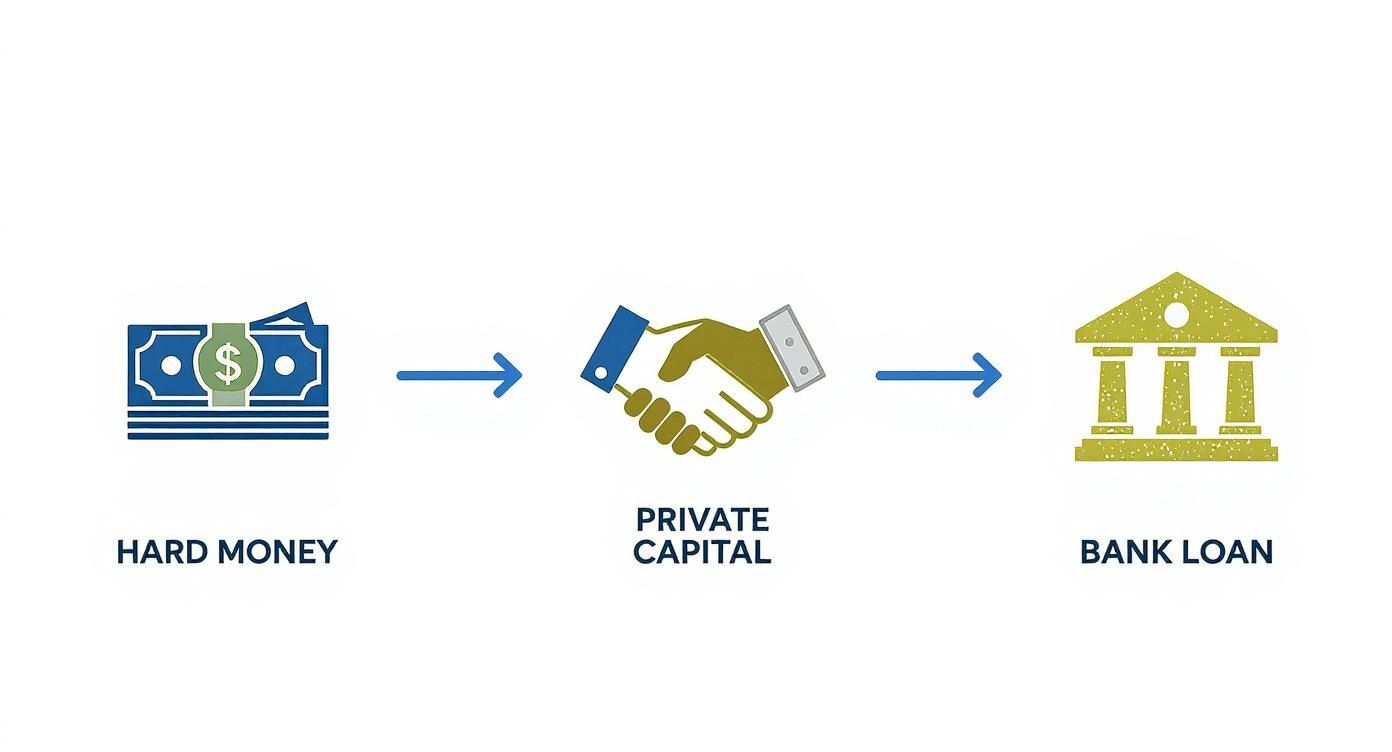
As the graphic shows, your financing choice often depends on how fast you need to move and your relationship with the person providing the capital.
The entire process, from finding a deal to wrapping up the project, demands meticulous organization. For a detailed guide on managing every single stage, our comprehensive flipping houses checklist is an invaluable resource you'll want to bookmark.
Key Takeaway: The best financing option isn't just about the lowest interest rate. It's about finding a funding partner who can close on your timeline and understands the unique demands of a fix-and-flip project.
Calculating Your Capital Needs and Profit Margins
Before you even think about borrowing money, you need to understand a simple truth: successful flips are won or lost on a spreadsheet. Lenders won't give your deal a second glance without a clear, data-driven plan. More importantly, mastering these numbers is how you protect yourself from a bad investment.
The first number you absolutely have to nail is the After-Repair Value (ARV). This is the estimated market value of the property after you’ve finished all your work. ARV isn’t a gut feeling; it’s a conclusion you draw from rock-solid comparable sales ("comps")—homes that have recently sold in the immediate area and are similar in size, age, and style to your finished product.

The 70% Rule: A Critical First Test
A classic guideline every flipper should know is the 70% Rule. It’s a quick, back-of-the-napkin test that says you should pay no more than 70% of a property's ARV, minus the repair costs. This simple formula helps you instantly see if a deal is even worth a deeper look.
Formula: (ARV x 0.70) – Estimated Repair Costs = Maximum Purchase Price
Let's run a quick scenario. A property has an ARV of $400,000 and needs $60,000 in renovations.
- $400,000 (ARV) x 0.70 = $280,000
- $280,000 - $60,000 (Repairs) = $220,000
Based on this rule, your maximum purchase price should be $220,000. That remaining 30% is your buffer. It's designed to cover all your financing, closing, and carrying costs—and, of course, your profit.
Pro Tip: The 70% Rule is a guideline, not a strict law. In very competitive markets, investors might push it to 75% or even 80%. Just know that every percentage point you go up dramatically increases your risk. If you decide to deviate, you better have a very good reason.
Building a Realistic Renovation Budget
A vague rehab budget is a massive red flag for any lender and a personal recipe for disaster. You need to get specific with a detailed, line-item scope of work. A simple guess won't cut it.
Your budget absolutely must account for:
- Labor Costs: Don't just get one quote. Get written bids from at least two or three qualified and vetted contractors.
- Material Costs: Price everything out. Flooring, paint, light fixtures, appliances—every single item.
- Permits and Fees: Never forget the cost of dealing with the city or county for permits, especially on major work.
- Contingency Fund: This is non-negotiable. Always, always add a 10-15% contingency fund to your total budget. You will find hidden water damage or an old electrical panel. Plan for it.
Accounting for All The Hidden Costs
This is where many new flippers get into trouble. They focus on the purchase price and the big renovation number, forgetting about the other expenses that can slowly drain a project's profit. These carrying and transaction costs add up fast.
Make sure your numbers include:
- Financing Costs: Loan origination fees (often called points), monthly interest payments, and appraisal fees.
- Carrying Costs: Property taxes, insurance, and utilities (water, electric, gas) for every single day you own the property.
- Closing Costs (Buying & Selling): Think title insurance, attorney fees, transfer taxes, and the big one—real estate agent commissions when you sell.
Missing these costs can turn what looked like a home run into a break-even deal or, even worse, a loss. To avoid manual errors, seasoned investors rely on a good fix and flip calculator to ensure every single expense is tracked.
In today's market, getting these numbers right is more critical than ever. Recent data shows that margins are tightening, with gross profits taking a serious hit. In Q2 2025, the typical gross return on investment dropped to 25.1%—the lowest it's been since 2008. This squeeze is happening because the median purchase price for flipped homes climbed to a record $259,700.
And once you've calculated your potential profit, don't forget taxes. Your tax bill will have a huge impact on your final take-home earnings. For a full breakdown, check out this excellent guide to house flipping taxes. In a market with tight margins, a solid understanding of your numbers is the only way to come out ahead.
Exploring Your Primary Funding Sources
Alright, you’ve got your numbers figured out. Now it’s time to find the money.
Let's be clear: financing a flip isn't like getting a mortgage for your family home. The rules are different. We're talking about a world where speed, flexibility, and the deal's potential matter far more than your regular income.
Understanding your options here is everything. It's how you match the right type of capital to the right deal, ensuring you can close fast and protect your profits.

Hard Money Loans: The Flipper's Go-To Tool
There's a reason hard money is so popular in the fix-and-flip world. These are asset-based loans from private lenders, and their entire business model is built for speed.
A traditional bank might take 45-60 days to close a loan. A hard money lender can often get you funded in 7-14 days. That speed is your superpower, allowing you to make aggressive, cash-like offers that motivated sellers love.
Their approval process is also different. Instead of focusing on your personal debt-to-income ratio, hard money lenders look at the deal itself. Their main question is: does the property's After-Repair Value (ARV) make sense? If the deal is solid, your chances of approval are high, even if your credit isn't perfect.
Of course, this speed and convenience come at a price. Hard money loans typically come with interest rates in the 8% to 14% range. You'll also pay origination fees, called "points," which usually run 1-3% of the loan amount. It’s a classic trade-off: you pay more for the speed and leverage you need to secure profitable deals. You can dive deeper into these trends and discover more house flipping statistics on Resimpli.com.
Private Money Loans: Flexibility Through Relationships
Private money is similar to hard money, but it's all about relationships. Instead of going to an established lending company, you're borrowing directly from an individual—maybe a friend, a family member, or another investor in your local network.
The biggest advantage here is pure flexibility. Since you’re dealing with one person, almost every part of the loan is negotiable.
- Interest Rates: You might be able to secure a rate that’s much friendlier than what a hard money lender offers.
- Loan Terms: The repayment schedule can be tailored specifically to your project's timeline.
- Loan-to-Cost (LTC): A private lender who knows and trusts you might be willing to fund 100% of the project, covering both the purchase and the rehab budget.
Building a trusted circle of private money lenders is one of the most powerful ways to grow a flipping business. But it demands professionalism. Always treat these as formal business deals. That means getting everything in writing with a proper promissory note and securing the loan with a mortgage or deed of trust.
Key Insight: Private money is built on trust. Protect your relationships by providing professional loan packages, regular project updates, and, most importantly, by always paying your lenders back on time. One bad deal can ruin your reputation and shut off a valuable source of capital.
Conventional Bank Loans And HELOCs: The Slower, Cheaper Path
So, do traditional banks and credit unions have a role? Absolutely, but it’s a specific one. They are almost always too slow for acquiring a distressed property, but they can be a strategic tool for investors with a strong financial track record.
A Home Equity Line of Credit (HELOC) on your primary residence is a fantastic source of cheap capital. The rates are low, and you can draw funds as you need them, which is perfect for covering renovation costs or even buying a low-priced property outright. Just remember, the approval process can still take a few weeks.
Conventional investment property loans are another option, but the requirements are tough. Lenders will put your credit score, income, and cash reserves under a microscope. More importantly, they often refuse to lend on properties needing major work, which disqualifies most true fix-and-flip deals.
The best-case scenario for a bank loan is for a seasoned investor who has time to spare and the strong financials to get approved. The upside is a significantly lower interest rate compared to hard or private money, which can seriously boost your profit margins.
Creative Financing Strategies for House Flipping
Hard money and private loans are the workhorses of the flipping world, but sometimes the best deals require more creative thinking. In a competitive market, you need more than just cash—you need an edge.
The most successful investors don't rely on a single funding source. They have a whole playbook of financing strategies they can use when a standard loan won't work. When you know how to structure these kinds of deals, you become a problem-solver, which is far more valuable to a seller.
Structuring Partnerships and Joint Ventures
One of the fastest ways to get a deal done, especially if you're light on cash, is to bring in a partner. This is typically done through a Joint Venture (JV), a formal agreement to tackle a project together. It’s the classic "you find the deal, I'll fund the deal" scenario.
A typical fix-and-flip JV usually has two key players:
- The Operating Partner: This is you. You find the property, manage the rehab, and sell the house. You bring the expertise and the hustle.
- The Capital Partner: This person provides the money for the purchase, renovations, and holding costs. They're often a passive investor who wants a solid return without getting their hands dirty.
Never do this on a handshake. A solid JV agreement is essential. It needs to spell out everything: how profits are split (a 50/50 split after the capital partner gets their money back is common), who has the final say on big decisions, and how the partnership will end.
Leveraging Seller Financing for a Win-Win
What if you could cut out the lender entirely? That's the power of seller financing. Here, the property owner effectively becomes your bank. Instead of getting a loan and paying the seller a lump sum, you make monthly payments directly to them.
This can be a game-changer. You can often negotiate better terms and a lower interest rate than you'd get from a hard money lender, and your closing costs will be much lower.
So, why would a seller agree to this?
- It gives them a steady income stream from your payments.
- They can often sell the property for a higher price because they're offering flexible terms.
- It’s a great solution for properties that are hard to finance, like a house that's in poor condition.
Pitching seller financing is an art. You have to show the seller how it solves a problem for them.
Expert Insight: Frame your seller financing offer as a solution to their specific needs. If the seller is a retiree looking for income, your monthly payments are their answer. If they're worried about a massive tax bill from the sale, an installment sale (which is what seller financing is) can help them spread out those capital gains.
Using Self-Directed Retirement Accounts
This is a more advanced strategy, but it's an incredibly powerful tool. A Self-Directed IRA (SDIRA) is a special retirement account that lets you invest in assets other than stocks and bonds—including real estate. You can use your SDIRA funds to buy a flip, and all the profit goes right back into your retirement account, either tax-deferred or completely tax-free.
But you have to be extremely careful. The IRS has very strict "prohibited transaction" rules. The biggest one is that you cannot do any of the work on the property yourself, nor can you pay yourself to manage it. All work must be done by third-party contractors, and every expense must be paid directly from the SDIRA.
Breaking these rules comes with massive tax penalties. While it's a fantastic strategy, it requires careful planning and a great SDIRA custodian to keep you compliant.
How to Get Your Flip Approved by Lenders
Securing a loan for a flip isn't about finding a perfect deal; it’s about presenting a professional, confidence-inspiring investment plan. Lenders, especially in the hard and private money space, are betting on you just as much as they're betting on the property.
Your job is to make that bet feel like a sure thing.
This means your loan application needs to be more than just a stack of papers. It needs to tell a compelling story—one that clearly shows you’ve done your homework, understand the risks, and have a credible plan to turn a profit.

Building Your Professional Loan Package
A sloppy, incomplete application is the fastest way to get a "no." Lenders see dozens of deals a day, and a well-organized package immediately signals you're a serious professional. Think of it as your business pitch.
Your loan package should be a comprehensive folder (digital or physical) that anticipates every question a lender might have. This is where a detailed flipping business plan becomes invaluable, as it forces you to think through every component lenders will scrutinize.
Here’s what every strong loan application must include:
- Executive Project Summary: A one-page overview of the entire deal. Include the property address, purchase price, rehab budget, projected ARV, and your estimated profit. Make it concise and clear.
- Detailed Scope of Work (SOW): Don't just say "kitchen remodel." Provide a line-item budget breaking down costs for materials and labor, ideally supported by written bids from your contractors. This shows you're not guessing.
- ARV Substantiation: Back up your numbers. Provide at least three strong, recent comparable sales ("comps") that justify your projected After-Repair Value. Include photos and details for each comp.
- Personal Financial Statement: A clear snapshot of your assets and liabilities. Be honest and thorough.
- Your "Flipper Resume": A list of your past projects, complete with before-and-after photos and the final numbers. If you're new, highlight any relevant construction or real estate experience you have.
Proving You Have Skin in the Game
Lenders need to see that you're personally invested in the project's success. This is what the industry calls having "skin in the game," and it’s usually demonstrated through your cash reserves.
Even if you’re chasing a loan that covers 100% of your purchase and rehab costs, lenders will still want to see that you have liquid funds available. This cash proves two critical things: you can cover unexpected costs or delays, and it shows you're financially responsible.
Lender's Perspective: A borrower with no cash reserves is a massive red flag. It suggests they are overextended and that any minor hiccup—a surprise plumbing issue or a permit delay—could jeopardize the entire loan. They want to see you have the financial cushion to handle the inevitable challenges of a renovation.
Your Fix-and-Flip Loan Application Checklist
Getting your documents in order before you talk to a lender is a sign of a professional. It shows you respect their time and know what you're doing. Use this checklist to build a complete package that anticipates their every question.
| Document/Information Category | What to Include | Why It Matters |
|---|---|---|
| Project Overview | Executive Summary, Purchase Agreement, Detailed Scope of Work (SOW) with contractor bids. | This is the "story" of your deal. It shows the lender the opportunity and proves you have a concrete plan. |
| Value & Profit Substantiation | After-Repair Value (ARV) analysis with at least 3 strong comparable sales ("comps"). | This is the most critical piece. It justifies the loan amount by proving the property's future value. |
| Personal Financials | Personal Financial Statement (PFS), 2 years of tax returns, recent bank statements (2-3 months). | Lenders need to see your financial stability and that you have the cash reserves to handle surprises. |
| Experience & Credibility | "Flipper Resume" with past project details, photos, and outcomes. If new, list relevant experience. | This builds confidence in you. It shows you're not just a person with a deal, but an operator who can execute. |
| Entity & Legal | LLC Operating Agreement, Articles of Organization, Certificate of Good Standing. | Proves your business is a legitimate, properly structured entity ready to take on the investment. |
Having these items organized and ready to go will dramatically speed up the underwriting process and immediately set you apart from less-prepared borrowers.
The Power of Lender Relationships
In real estate investing, your network is your net worth. This is especially true when it comes to financing. Don't just be a faceless application—make an effort to build real relationships with potential lenders.
Start by attending local real estate investor meetups or connecting with lenders online. Schedule a call to introduce yourself and your investment strategy before you even have a deal under contract. Let them get to know you.
When you find a good lender, treat them like a partner.
- Be Responsive: Answer their questions quickly. Provide requested documents promptly.
- Be Transparent: If a problem comes up during the project, tell them early and present your plan to solve it.
- Deliver Results: The best way to build trust is to successfully complete a project and pay them back on time.
A lender who knows and trusts you is far more likely to fund your next deal, offer you better terms, and be a valuable source of guidance as you grow your business.
Answering Your Toughest Flip Financing Questions
Even the most well-planned financing can hit a snag. When you're in the middle of a project, real-world questions pop up that can make or break a deal. This is where experience really counts. Let's walk through some of the most common hurdles investors face when financing a flip.
What Do Lenders Look For in a First-Time Flipper?
Lenders are often cautious with new investors. Without a proven track record, they rely on other signals to feel confident about your project.
First, they need to see you have "skin in the game," which almost always means having your own cash reserves. This shows them you're personally invested and can handle unexpected costs.
Next, they'll look closely at your team. Who are you working with? Bringing a vetted, experienced general contractor to the table is a massive confidence booster for a lender. It tells them the project will be managed professionally.
Finally, the deal itself has to be a slam dunk. Your loan package needs to be airtight, with conservative numbers, solid comps to justify your ARV, and a detailed scope of work. A great deal, presented professionally, can often make up for a lack of personal flipping experience.
What if Renovation Costs Go Over Budget?
This is a common fear for both new and experienced flippers, and it’s why a contingency fund is so important. Your first line of defense is always that 10-15% buffer you built into your budget from day one. That money is there for a reason—like hidden water damage or an unexpected electrical issue.
If you burn through your contingency, you still have options:
- Value Engineering: Take a hard look at your finishes. Can you swap that expensive flooring for a high-end alternative that looks just as good? Are there more affordable but still stylish light fixtures?
- Talk to Your Lender: If you've been communicating well, your lender might be open to increasing the loan, especially if the extra cost adds to the property's value.
- Tap Other Capital: This is where a business line of credit or even bringing in a short-term partner can save a project that's gone off track.
Can You Finance 100% of a Fix-and-Flip Project?
The short answer is yes, getting 100% financing is possible. But it’s not the standard and is usually reserved for specific scenarios. Some hard money and private lenders will fund 100% of the purchase and rehab, but there are always strings attached.
Typically, this kind of leverage is only offered to seasoned investors with a long, successful track record. The deal itself also has to be a certified "home run"—think huge profit margins and a very low loan-to-ARV ratio. Another route is partnering with someone who funds everything in exchange for a large share of the profits.
Even though it sounds great, remember that cash is still king. As of Q1 2024, roughly 63.8% of all house flips were all-cash purchases. This shows how much sellers and lenders value liquidity and the certainty of a quick close. You can dig into more house flipping statistics on Resimpli.com.
Key Takeaway: Even if you're pursuing a 100% financing deal, having your own cash is non-negotiable. Lenders need to see that you can cover closing costs, carrying costs, and surprise expenses the loan doesn't cover.
What Are Typical Closing Costs on a Hard Money Loan?
This is a common surprise for new investors. Closing costs on a hard money loan are different—and usually higher—than what you see with a conventional mortgage. You must budget for these upfront costs because they directly impact how much cash you need to bring to the table.
Here’s a realistic breakdown of what you can expect:
- Origination Points: This is the lender's main fee, usually ranging from 1-3% of the total loan amount.
- Processing & Underwriting Fees: These are fixed fees to cover the lender's administrative work.
- Appraisal or BPO Fee: The cost to get a third-party opinion on the property's current and after-repair value.
- Title & Escrow Fees: Standard costs for title insurance and settlement services.
- Attorney Fees: Many hard money lenders have their attorney draft and review the loan documents, and you'll cover that cost.
When it's all said and done, you should plan on budgeting between 2% and 5% of the total loan amount just for closing costs.
Frequently Asked Questions (FAQ)
1. What's the easiest way for a beginner to finance their first flip?
For most beginners, a hard money loan is the most accessible option. Lenders focus more on the property's potential value (ARV) than your personal income, and they can close quickly. Another great strategy is partnering with an experienced investor who provides the capital while you manage the project.
2. How much cash do I actually need to flip a house?
Even if your loan covers the purchase and renovation, you'll still need cash for a down payment (typically 10-20%), closing costs (2-5% of the loan), and a contingency fund (10-15% of the renovation budget) to cover unexpected expenses. Don't forget carrying costs like insurance and utilities.
3. Can I use a regular home loan to finance a flip?
It's very difficult. Conventional mortgages from banks are designed for move-in-ready homes and have a slow approval process. Most properties that are good for flipping need significant repairs and won't qualify for this type of financing.
4. What is the difference between a hard money loan and a private money loan?
A hard money loan comes from an established, professional lending company that specializes in short-term, asset-based loans. A private money loan comes from an individual—like a friend, family member, or another investor. Private money loans can be more flexible on terms, but they are built on personal relationships.