

Think of your business plan for flipping houses as more than just a document—it’s your strategic roadmap. It lays out everything from your core mission and market analysis to how you'll handle financing, renovations, and sales. It's the professional blueprint that turns a side hustle into a real, scalable business by defining your goals and guiding every single decision you make.
Laying The Foundation Of Your Flipping Business

Before you start hunting for properties or calling contractors, you need to define the "why" behind your business. A well-crafted mission statement isn't just corporate jargon; it's the anchor for your entire business. This is what separates serious investors from hobbyists and shows potential lenders you have a clear, long-term vision.
Your mission should be concise but powerful, getting to the heart of what you're trying to achieve. For example, you might focus on revitalizing historic neighborhoods, one beautiful restoration at a time. Or perhaps you want to create stylish, affordable homes for first-time buyers. Whatever your goal is, writing it down solidifies your purpose and keeps you on track.
Define Your Unique Value Proposition
The house-flipping market can be competitive. So, what makes you different? Your unique value proposition (UVP) is the specific edge you bring to the table. It's what might convince a motivated seller to accept your offer or make a buyer fall in love with your finished home.
Your UVP could be anything that sets you apart. For instance:
- Design-Centric Flips: You might focus on high-end, modern designs that command a premium price and appeal to a specific type of buyer.
- Speed and Efficiency: You could build a reputation for closing deals fast and finishing renovations ahead of schedule—a huge plus for sellers and agents.
- Neighborhood Specialization: Become the go-to expert in a particular community. When you know the local architecture and what buyers in that area want, you can make smarter, more profitable decisions.
- Sustainable Building: Attract eco-conscious buyers by using reclaimed materials and energy-efficient upgrades.
Quick Takeaway: A strong mission and a clear UVP are your business's compass. When you're facing a tough decision—like whether to take on a borderline deal or splurge on high-end finishes—these foundational pieces will guide you toward the choice that aligns with your core strategy.
Set Clear and Actionable Goals
With your mission in place, it’s time to get specific. Vague goals like "make a lot of money" aren't helpful. You need tangible targets. A great way to structure these is by using SMART goals (Specific, Measurable, Achievable, Relevant, Time-bound).
For example, a new flipper’s goal might be: "Successfully complete and sell two properties within the first 18 months, achieving a minimum gross profit margin of 20% on each flip."
This goal works because it’s specific (two properties), measurable (20% profit), achievable (a realistic start for a new investor), relevant (to the business of flipping), and time-bound (18 months). Setting these kinds of benchmarks from day one gives you something concrete to aim for and makes it easy to track your progress.
Finding the Right Market and Defining Your Deal
The most profitable decisions in house flipping happen long before you ever make an offer. Success comes from a disciplined, data-driven approach to picking your market and knowing exactly what kind of property you're looking for. This isn't about gut feelings; it's about building a reliable system to spot winning opportunities.
Your first step is to analyze the local market. A "good deal" in a declining market is almost always a bad investment. You need to find neighborhoods with strong vital signs—like job growth and good schools—that point to stability and ensure there will be buyers when you're ready to sell.
Pinpointing Your Ideal Flipping Territory
Not all zip codes are created equal. To build a solid business plan, you must become a student of the local market, digging into the trends that signal strong buyer demand.
Focus your research on these key data points:
- Local Sales Velocity: How fast are homes selling? Look at the Average Days on Market (DOM). A low number means it's a "seller's market," where a well-renovated home won't sit for long.
- School District Ratings: Good schools are a huge draw for families, who are often the target buyers for a 3-bedroom, 2-bathroom flip. Homes in top-rated districts tend to sell faster and hold their value better.
- Job Growth and Local Development: Are new companies moving in? Do you see new shopping centers, parks, or construction? These are signs of a growing, vibrant community.
- Inventory Levels: This is simple supply and demand. A low supply of homes for sale creates more competition among buyers and pushes prices up, which is great for your profit margin.
To simplify your research, here’s a checklist of what to look for when evaluating a potential market.
Checklist: Key Metrics for Market Analysis
| Metric | What to Look For | Why It Matters |
|---|---|---|
| Average Days on Market (DOM) | Consistently under 60 days, ideally under 30. | A low DOM indicates strong buyer demand and reduces your holding costs. |
| Median Home Price Trend | Steady appreciation over the last 1-3 years. | Shows a stable, growing market, not a speculative bubble. |
| Inventory Levels | Less than 3 months of supply. | Low inventory means more buyer competition and upward pressure on prices. |
| School Ratings | Above-average or top-tier ratings. | A major driver for family buyers, which expands your potential customer base. |
| Local Job Growth | Positive net job growth year-over-year. | A growing economy brings new residents who need housing. |
| Price-to-Rent Ratio | Moderate to high. | Indicates that owning is more attractive than renting, fueling buyer demand. |
Quick Takeaway: Market analysis isn't a one-time task. The best investors constantly watch these numbers, ready to adjust their strategy if the market shifts.
Establishing Your Non-Negotiable Acquisition Criteria
Once you’ve found a few promising areas, it's time to get clear on what you're buying. This is your acquisition criteria—a non-negotiable checklist that every potential deal must pass. Having this written down saves you from "deal creep," where you fall in love with a property that doesn't actually fit your business model.
Here’s an example of clear acquisition criteria:
- Property Type: Single-family homes only.
- Size:1,200 to 1,800 square feet, minimum 3 beds/2 baths.
- Condition: Needs cosmetic work (kitchen, baths, paint, flooring) but is structurally sound. No major foundation, roof, or electrical issues.
- Location: Inside target neighborhoods A, B, or C. Not on a busy main road or next to a commercial property.
- The Math: Purchase price plus rehab budget cannot exceed 70% of the After Repair Value (ARV). You can learn how to run these numbers with our comparative market analysis template.
A thorough inspection is mandatory before you close. Using a detailed pre-purchase inspection checklist helps you catch potential deal-breakers and refine your rehab budget with much greater accuracy.
With profit margins getting tighter in recent years, there is simply no room for error in your analysis. A data-backed approach is more crucial now than ever.
Nailing Down Your Financials and Funding Strategy
This is where your business plan gets real. A great neighborhood and a property that looks good are just theories until you prove the numbers work. Your financial projections are the core of your business plan, showing lenders, partners, and yourself that you have a profitable strategy.
A successful deal always follows a clear path: you understand the market, evaluate the property, and then run the numbers. Everything hinges on that final step.
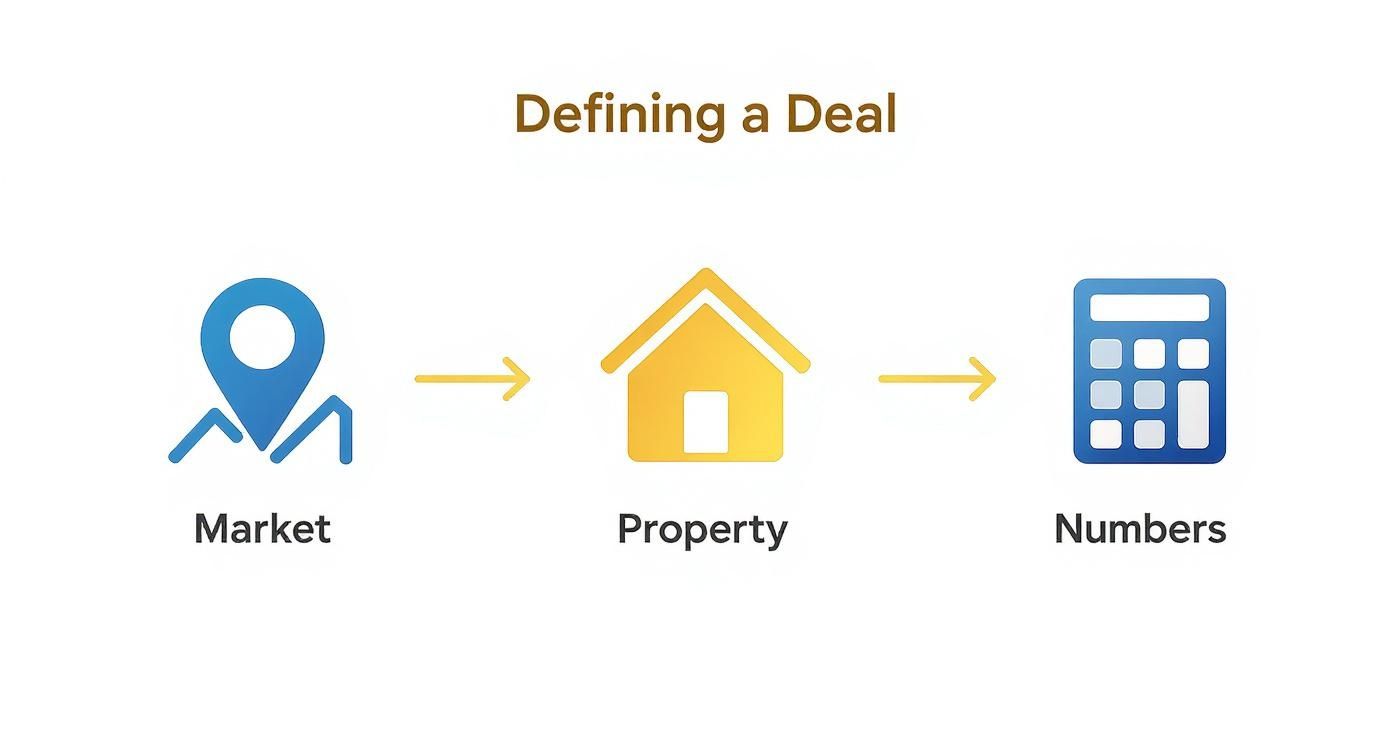
Think of your financial analysis as the final, most important filter for any potential flip. If the numbers don't work, nothing else matters.
Crafting a Realistic Rehab Budget
Your renovation budget is one of the biggest variables in any project. A wild guess here can erase your entire profit margin. You need a detailed, line-item budget, not a guesstimate.
Get a trusted general contractor to walk the property with you and give you real numbers for big-ticket items like the roof, HVAC, and electrical systems. For everything else, get specific:
- Kitchen: Cabinets, countertops, appliances, backsplash, flooring, fixtures.
- Bathrooms: Vanity, toilet, tub/shower, tile, and fixtures.
- General: Interior and exterior paint, all flooring, light fixtures, doors, and hardware.
- Exterior: Landscaping, siding, windows.
Pro Tip: Always add a contingency fund of 10-15% of your total rehab budget. This isn't optional. You will find hidden issues like old water damage. This fund keeps those surprises from derailing your project.
Calculating Your True Holding Costs
New flippers often underestimate this. They focus on the purchase price and rehab budget but forget about the costs that add up every single day you own the property. These are your holding costs, and they can eat into your profits quickly.
Your business plan must account for them:
- Loan Payments: Interest on your loans.
- Property Taxes: Prorated on a monthly basis.
- Insurance: You'll need a builder's risk or vacant dwelling policy.
- Utilities: Even in a vacant house, you’ll pay for water, electricity, and gas.
- HOA Dues: Don't forget these if the property is in a managed community.
You need to project these costs over your entire timeline—from the day you buy to the day you sell. If you think it's a six-month project, budget for at least seven months of holding costs to be safe.
Quick Takeaway: Lenders gain confidence when they see you understand all the associated costs, not just the obvious ones. A detailed holding cost analysis shows you're a serious operator.
Estimating ARV and Applying the 70% Rule
The After Repair Value (ARV) is the most important number in your deal analysis. It’s the estimated market value of the property after you’ve finished all the renovations.
To find the ARV, you or your real estate agent will pull "comps"—data on recently sold homes nearby that are in a similar updated condition. Once you have a solid ARV, you can apply the investor’s best friend: the 70% Rule. It's a quick formula to figure out the maximum you should pay for a property.
The formula is: (ARV x 0.70) – Estimated Rehab Costs = Maximum Allowable Offer (MAO)
Let's look at an example. If the ARV is $350,000 and your detailed rehab budget is $50,000:
($350,000 x 0.70) - $50,000 = $195,000
Your Maximum Allowable Offer is $195,000. The remaining 30% is a buffer that covers your holding costs, selling expenses (like agent commissions), and your final profit. While 70% is a common benchmark, you might need to adjust it to 75% in a very competitive market. Just make sure you define and justify your formula in your business plan.
Structuring Your Capital and Funding Sources
Finally, your plan must lay out exactly how you're going to pay for the deal. This is your capital stack. Very few flippers use only their own cash. Being transparent about your funding mix shows lenders you’ve thought everything through.
For a deep dive, check out our guide on how to finance a flip.
Here are the most common funding sources:
- Personal Capital: Your own cash for the down payment and reserves.
- Hard Money Loans: Short-term, asset-based loans that are popular for flipping because they fund quickly.
- Private Money Lenders: Individuals—like friends, family, or other investors—who lend you money for a set return.
- Conventional Loans: Less common for flips because the approval process is slow and banks often avoid lending on distressed properties.
Your plan needs to clearly identify your primary and secondary funding sources. Having a Plan B for financing is what separates the pros from the amateurs.
Assembling Your Professional Flipping Team
House flipping is a team sport. No one succeeds in this business alone. Your ability to find, finance, fix, and sell a property for a profit depends on the quality of the people you work with.
This is a critical piece of your business plan for flipping houses. It shows potential lenders and partners that you're not just a lone wolf with an idea—you're the leader of a well-oiled machine ready to execute.
Think of yourself as a general manager. You call the plays and set the strategy, but you need a solid roster of skilled players to win.
Checklist: Your Core Team Members
You don't need everyone hired on day one, but your business plan must identify the key roles you need to fill. This shows foresight and an understanding of what it takes to pull off a successful flip.
- Real Estate Agent: A great agent brings you off-market deals and provides accurate ARV calculations. Their local knowledge is priceless.
- General Contractor (GC): This might be the most important relationship you build. A reliable, licensed, and insured contractor keeps you on budget and on schedule.
- Real Estate Attorney or Title Company: These professionals handle the legal details, ensuring clean title transfers and smooth closings to protect you from legal headaches.
- Accountant (CPA): Find a CPA who understands real estate. They’ll help you structure your business (like an LLC) to protect your personal assets and maximize tax advantages.
- Hard Money Lender: Unless you’re using all cash, you need a lender who understands the speed and nature of the flipping business.
Vetting these professionals is essential. Always get references, check licenses, and look at their past work. One bad hire can wipe out your profit.
Quick Takeaway: A well-defined team structure in your business plan is a statement of operational readiness. It tells potential investors that you've thought through the execution and aren't just focused on the numbers.
Establishing Clear Operational Workflows
Once you have your team, how do you manage them? Your plan needs to outline the systems you'll use to keep every project running smoothly.
This section details your game plan for day-to-day operations.
Managing Your Renovation
A sloppy rehab process is the fastest way to blow your budget and timeline. You need a rock-solid workflow.
- Scope of Work (SOW): This document is your renovation bible. It must be brutally detailed, listing every single task, from demolition to the specific model numbers of light fixtures.
- Payment Schedule:Never pay a contractor 100% upfront. Structure payments in draws tied to specific, verifiable milestones (e.g., 10% after demo, 20% after rough-ins pass inspection). This keeps everyone accountable.
- Change Order Process: Define a formal, written change order process from the start. This prevents "verbal agreements" from adding thousands to your budget.
- Communication Cadence: Set a rhythm for communication. A weekly on-site walkthrough or a daily text update with photos can keep you in the loop without micromanaging.
To streamline your operations, consider hiring help for the administrative load. Using specialized construction virtual assistants can be a game-changer for coordinating schedules and handling paperwork, freeing you up to find the next profitable deal.
Planning Your Exit and Managing Potential Risks
A great deal isn't truly great until you've cashed the check. The final part of any flip is the exit. Your business plan has to prove you've thought just as hard about getting out of a deal as you have about getting into one.
Hoping for a quick, high-profit sale is the goal, but hope is not a strategy. What happens if interest rates rise mid-renovation? A professional plan anticipates these challenges by mapping out multiple exit strategies from day one.
Developing Your Primary and Backup Exit Plans
Your primary exit will almost always be a traditional sale on the Multiple Listing Service (MLS). This is where you'll find the largest pool of qualified buyers and typically get the highest price.
But markets can change. Relying on a single exit is a rookie mistake. That's why your business plan needs a Plan B and even a Plan C.
- Plan A: The Quick Flip: This is the ideal outcome. You list the beautifully renovated property on the MLS with a top agent, using professional staging and photography to get the best price in the shortest time.
- Plan B: The Rental Conversion (BRRRR Method): If the market softens and you can't hit your target price, you pivot. Instead of selling low, you can convert the property into a long-term rental. This strategy, known as Buy, Rehab, Rent, Refinance, Repeat (BRRRR), lets you start generating cash flow while you wait for market conditions to improve.
- Plan C: Seller Financing: In a slow market, offering to finance the sale for the buyer can be a game-changer. This opens up your buyer pool to people who might not qualify for a traditional mortgage, making your property more attractive.
Having these options defined shows lenders and partners that you're a savvy investor who knows how to protect capital. For more details, check out this guide on real estate investment exit strategies.
Implementing Robust Risk Management
Every flip has risks, from renovation surprises to economic downturns. A solid business plan anticipates these realities head-on. Protecting your investment requires a proactive approach to managing what can go wrong.
Your plan should detail a few key risk management tactics.
Quick Takeaway: Your contingency fund isn't an "if" you'll use it, but a "when." Treating it as a non-negotiable cost of doing business is one of the most important habits a flipper can develop.
Building Your Financial Safety Net
The most critical part of managing risk is your financial buffer. Unexpected problems are a guarantee. You need cash on hand to handle them without derailing the project.
Here's how to build that safety net into your plan:
- The Contingency Fund: This is your first line of defense. Every project budget must include a contingency line item of 10-15% of the total estimated renovation cost. This covers surprises like hidden termite damage or old wiring that needs replacement.
- Proper Insurance Coverage: Your standard homeowner's policy won't cover a vacant construction site. You need a Builder's Risk or Vacant Dwelling Policy. Your plan should also specify liability insurance to protect you from accidents on the job site.
- Market Headwind Analysis: Briefly outline potential market risks—like rising interest rates or a local economic slowdown. Then, connect these risks back to how your backup exit strategies (like renting) directly address them. This demonstrates foresight and proves you're thinking three steps ahead.
Frequently Asked Questions (FAQ)
Here are answers to some of the most common questions new investors have when creating their first business plan for flipping houses.
What's the minimum amount of cash I need to start flipping houses?
There's no single answer, as it depends heavily on your local market and the price of homes. However, you generally need enough cash to cover the down payment for your loan (often 10-20% of the total project cost for a hard money loan), all closing costs, your insurance policy, and a contingency fund of at least 10% of your renovation budget. Your business plan is where you'll calculate this exact figure for your specific goals.
How do I find a good contractor for my first flip?
Finding a reliable general contractor is crucial. Start by asking for referrals from your real estate agent, local investor meetups, or other real estate professionals. Always verify their license and insurance, check online reviews, and ask to see examples of their previous work. Get at least three detailed bids for your project and never make a final decision based on price alone; focus on communication, quality, and reliability.
Should I form an LLC before my first deal?
Yes, it is highly recommended. Forming a Limited Liability Company (LLC) is a critical step to protect your personal assets. It creates a legal separation between your personal finances (like your home and savings) and your business activities. If something goes wrong on the project, this structure helps ensure that only your business assets are at risk, not your personal ones. It's a foundational step for any serious real estate investor.
Stop guessing and start analyzing. Flip Smart gives you the data-driven insights you need to build a bulletproof business plan and find profitable deals in seconds. Analyze your first property for free at flipsmrt.com.