

Ever looked at a rental property listing and felt like you were just gambling with your savings? You're trying to guess if the numbers will actually work, but it’s all just a gut feeling. This is exactly where a rental property ROI calculator becomes your most important tool as a home buyer considering an investment.
Think of it as a strategic partner that forces you to look at the cold, hard facts of a deal—not just the glossy photos.
Your First Step To Smarter Rental Investing
Instead of relying on wishful thinking, a good calculator makes you systematically account for every piece of the financial puzzle. We're talking purchase price, renovation costs, property taxes, insurance, and all the other ongoing expenses that can sink an investment if you're not prepared.
This structured approach is what separates seasoned pros from beginners. It helps you avoid costly and surprisingly common mistakes, like underestimating maintenance costs or forgetting to factor in vacancy periods (times when you don't have a tenant).
Moving Beyond Guesswork
Sure, you could try to crunch all these numbers in a spreadsheet. Many people do. But it’s slow, tedious, and incredibly easy to make a mistake. A single misplaced decimal or a forgotten expense can turn what looked like a home run into a serious financial drain.
Using an automated calculator is like switching from a paper map to a GPS. One is clunky and leaves you open to wrong turns, while the other is fast, reliable, and helps you see the roadblocks ahead. The goal here is simple: move from investment uncertainty to data-driven confidence.
Quick Takeaway: A great investment opportunity isn't found by luck; it's found by calculation. A reliable ROI calculator ensures your decisions are based on solid financial analysis, not just hope.
By using a calculator, you can:
- Accurately forecast profitability: Get a clear picture of your potential monthly cash flow and long-term returns.
- Compare properties objectively: Line up multiple deals side-by-side using the same metrics to see which one is truly the better investment.
- Identify potential risks early: Quickly pinpoint properties where the expenses are too high or the rental income is too low to meet your financial goals.
This guide will walk you through the essential metrics you need to know, the data you'll need to gather, and how to make sense of the results. We’ll show you the clear path to building a profitable portfolio, one calculated decision at a time.
Understanding the Core Metrics of a Rental Investment
To really trust a rental property ROI calculator, you have to understand what's going on under the hood. The numbers it spits out aren't magic; they're powerful metrics that tell the financial story of a property. Think of them like the vital signs a doctor checks—each one tells you something different, but they're all crucial.
Let's pull back the curtain on the three main metrics you'll see everywhere. We'll ditch the jargon and use simple language so you can see exactly how these numbers affect your bank account.
Capitalization Rate (Cap Rate): The Property's Raw Power
First up is the Capitalization Rate, or Cap Rate. Imagine you’re comparing two cars based purely on their engine performance, without thinking about loans or financing. That's what Cap Rate does for a property. It measures the raw, unleveraged earning potential.
It shows the return you’d get if you bought the place with a suitcase full of cash. This makes it the perfect tool for comparing different properties on an apples-to-apples basis, stripping away the complexities of anyone's personal mortgage situation.
The formula is pretty straightforward:
Cap Rate = Net Operating Income (NOI) / Property Purchase Price
Net Operating Income (NOI) is just the total income a property brings in (rent, fees, etc.) minus all the operating expenses (taxes, insurance, maintenance). Critically, it does not include your mortgage payment.
- Example: A property costs $250,000 and has an annual NOI of $20,000.
- Calculation:$20,000 / $250,000 = 0.08
- Result: The Cap Rate is 8%.
That 8% gives you a clean benchmark to stack up against other deals in the same market.
Cash-on-Cash Return: Your Personal Profit Engine
While Cap Rate is great for comparing properties, Cash-on-Cash Return makes it personal. It answers the question every investor really wants to know: "For every dollar I put in out of my own pocket, how much am I getting back each year?"
This metric zooms in on the actual cash you invested—your down payment, closing costs, and any upfront repair money. It compares that number to the annual cash flow you pocket after all bills are paid, and yes, that includes the mortgage.
Here’s what the formula looks like:
Cash-on-Cash Return = Annual Pre-Tax Cash Flow / Total Cash Invested
- Example: You’re buying a $300,000 property. Your total cash out-of-pocket (down payment plus closing costs) is $65,000.
- After collecting all the rent and paying every single expense (mortgage included), you have $6,000 left at the end of the year.
- Calculation:$6,000 / $65,000 = 0.092
- Result: Your Cash-on-Cash Return is 9.2%.
This is one of the most important numbers because it shows you how hard your money is actually working for you.
This is the exact journey from guesswork to confidence that a solid calculator provides.
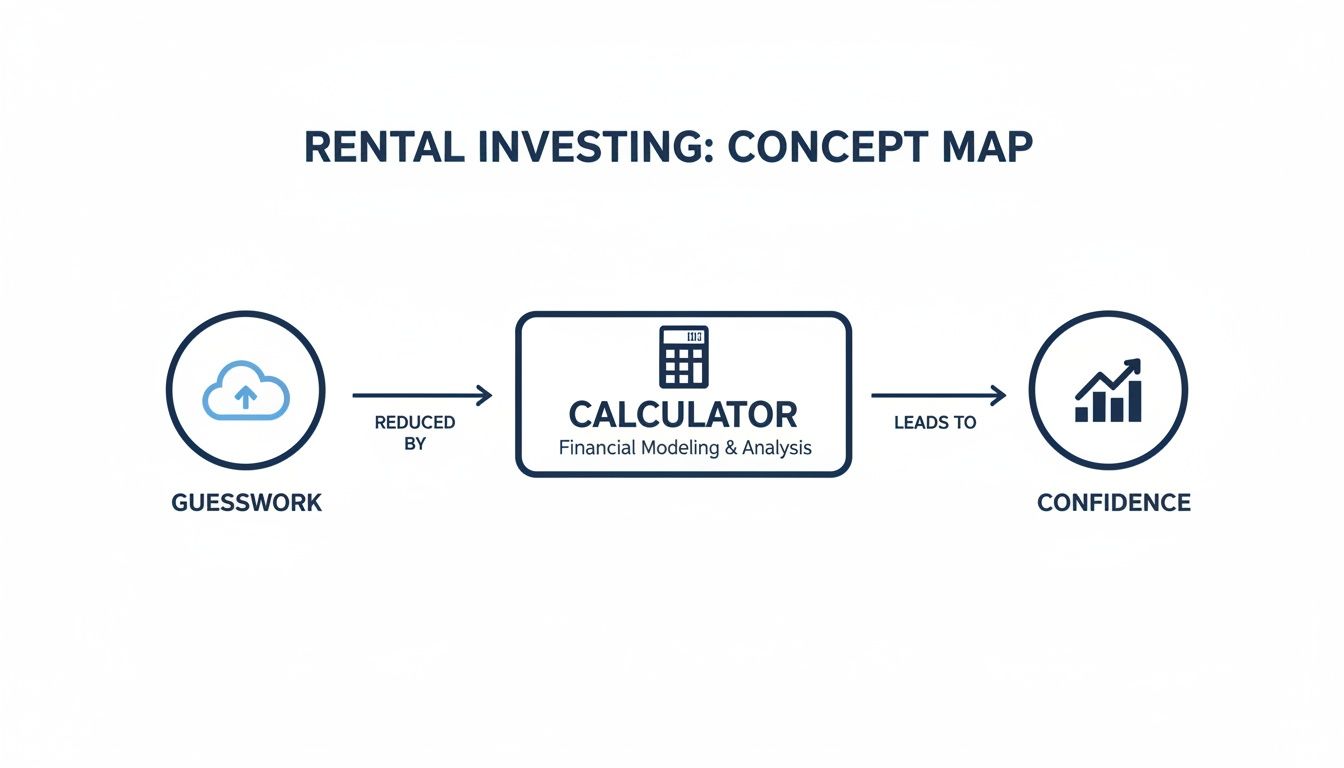
By swapping gut feelings for a structured calculator, investors get the clarity they need to make smart financial moves.
Return on Investment (ROI): The Complete Picture
Finally, there’s the big one: Return on Investment (ROI). This metric gives you the most complete view because it tracks not just your cash flow, but also the equity you’re building in the property. Every mortgage payment you make grows your ownership stake, and that’s a huge part of your total return.
ROI combines your cash profits with your equity gains to give you a total performance score for your investment. While there are a few ways to calculate it, a common formula for a financed property is:
ROI = (Annual Cash Flow + Equity Built) / Total Cash Invested
- Example: Let's stick with our last scenario. You've got $6,000 in annual cash flow.
- In that first year, your mortgage payments also chipped away $4,000 of the loan principal (that's your equity gain).
- Your total return for the year is $6,000 + $4,000 = $10,000.
- Calculation:$10,000 / $65,000 = 0.153
- Result: Your total ROI for the year is 15.3%.
Getting a handle on these formulas is key. For anyone who wants to go deeper, we break down all the numbers in our guide to essential real estate math formulas.
Gathering the Right Data for Your Calculator
A rental property ROI calculator is a fantastic tool, but it lives by one simple rule: garbage in, garbage out. The accuracy of your entire analysis hinges on the quality of the numbers you feed it. Think of it like a chef following a gourmet recipe—if you use spoiled ingredients, the final dish is doomed no matter how good the instructions are.
To get a realistic picture of a property's potential, you need to hunt down accurate and complete numbers. This might seem like a lot, but you can break it down into four simple categories. When you collect this information systematically, you're building a foundation for your calculations that’s grounded in reality, not wishful thinking. This is how you start making confident, data-driven investment decisions.

Purchase Information
First up, let's nail down all the upfront costs to actually get the keys to the property. These numbers make up the "cost" side of your investment and are absolutely essential for figuring out how much cash you really have in the deal.
- Purchase Price: This one's the biggie—the price you and the seller agree on.
- Closing Costs: These are the silent killers that many new investors underestimate. Budget for 2% to 5% of the purchase price to cover lender fees, title insurance, appraisal fees, and attorney costs.
- Renovation or Repair Budget: Be brutally honest with yourself here. Does the property need a new roof before it's rentable? An updated kitchen? Get real quotes from contractors so this is a firm estimate, not just a ballpark guess.
Financing Details
If you’re not paying all cash, these details are non-negotiable for calculating your monthly mortgage payment and, ultimately, your cash flow. This is where you really see how leverage (using borrowed money) can work for you (or against you).
Quick Takeaway: Your financing structure directly impacts your cash flow and Cash-on-Cash Return. A smaller down payment can boost your ROI on paper, but the higher monthly mortgage payment that comes with it can seriously squeeze your actual cash flow.
You'll need these key inputs:
- Down Payment: The cash you're putting into the deal upfront. For an investment property, this is typically 20-25%.
- Loan Amount: The total amount you're borrowing from the lender.
- Interest Rate: The rate the bank is charging you. Even a fraction of a percent here makes a huge difference over the life of the loan.
- Loan Term: How long you have to pay it back, which is usually 15 or 30 years for most investors.
Income Projections
Now for the fun part—the money coming in. This is the "return" side of your cash flow equation. It's critical to get this right, and it's also where new investors tend to get a little too optimistic. Ground your estimates in hard market data.
- Monthly Rent: Don't just take the seller's word for it or pull a number out of thin air. Jump on Zillow or Apartments.com and see what truly comparable units are renting for right now, in that specific neighborhood. A local property manager is another great resource for a reality check.
- Other Income: Do you plan on charging extra for parking spots, coin-operated laundry, or pet fees? Make sure to include any of these other potential revenue streams. Getting these figures right is foundational, and you can learn more about how to accurately calculate your potential rental income in our detailed guide.
Operating Expenses
These are all the ongoing costs you'll have just to own and manage the property. Forgetting or lowballing these expenses is the single fastest way to watch a "great" investment turn into a money pit.
Here's a quick checklist of the usual suspects:
- Property Taxes: You can find this on the county's public records website or the old MLS listing.
- Insurance: Get actual quotes for a landlord insurance policy, not just a standard homeowner's policy.
- Vacancy Rate: No property stays occupied 100% of the time. Plan for it. A conservative estimate is usually 5-10% of your annual gross rent, though this can shift depending on your market.
- Repairs and Maintenance: A good rule of thumb is to set aside 1% of the property’s value each year or, alternatively, 5-10% of the gross rent for this.
- Property Management Fees: If you’re hiring a pro to manage it, budget 8-12% of the monthly rent.
- HOA Fees: If it's a condo or in a specific subdivision, don't forget these monthly or annual dues.
- Utilities: Be clear about which utilities you, the landlord, are responsible for. This could include water, sewer, or trash.
- Capital Expenditures (CapEx): This is your savings account for the big-ticket items that wear out over time—think a new roof, HVAC system, or water heater. Factoring in future appliance replacements is also part of a solid CapEx plan; a good landlord's guide to white goods can help you budget for these costs.
A Step-by-Step Walkthrough of a Real Property Analysis
Theory is great, but let's get our hands dirty. The best way to really get comfortable with these numbers is to see them in action on an actual property. This walkthrough will show you exactly how to analyze a deal from start to finish, whether you're using a rental property ROI calculator or just a pen and paper.
We'll run the numbers on a classic scenario: a single-family home bought as a rental. By breaking down each calculation, you'll see how all the financial pieces we've talked about fit together to paint a clear picture of a property's true potential.

Setting the Scene: The Property and Assumptions
To make this example crystal clear, we need to lay out all our assumptions. In real estate, every single variable matters, so let's define them upfront.
Property Details:
- Purchase Price:$300,000
- Property Type: Single-Family Home
Financing Details:
- Down Payment:20% ($60,000)
- Loan Amount:$240,000
- Interest Rate:6.5% on a 30-year fixed loan
- Monthly Mortgage (Principal & Interest):$1,517
Income & Initial Costs:
- Projected Monthly Rent:$2,500
- Closing Costs (3%):$9,000
With these figures locked in, we have our starting point. Now, let's dig into the operating expenses.
Calculating the Annual Operating Expenses
Operating expenses are the ongoing costs that keep the property running. Forgetting or underestimating these is a classic rookie mistake that can absolutely crush your cash flow.
Here’s our annual expense breakdown:
- Property Taxes (1.25% of purchase price):$3,750 per year
- Landlord Insurance:$1,200 per year
- Vacancy (5% of gross rent):$1,500 per year (This accounts for one month of vacancy every 20 months)
- Repairs & Maintenance (5% of gross rent):$1,500 per year
- Property Management (8% of gross rent):$2,400 per year
Let's add those up to find our total estimated operating expenses for the year.
$3,750 + $1,200 + $1,500 + $1,500 + $2,400 = $10,350 Total Annual Operating Expenses
This $10,350 figure is the financial engine room of our property. It’s what we have to pay out before we can even think about profit.
Step 1: Calculate Net Operating Income (NOI)
With our income and expenses clear, the first key metric we can nail down is the Net Operating Income (NOI). Remember, this is the property's profit before we account for the mortgage payments.
First, we need the Gross Scheduled Income (GSI), which is just the total potential rent if it was occupied all year.
- Gross Scheduled Income:$2,500/month x 12 = $30,000
Now, we simply subtract our total operating expenses from that gross income.
- NOI Calculation:$30,000 (GSI) - $10,350 (Expenses) = $19,650
Our annual Net Operating Income is $19,650.
Step 2: Calculate the Cap Rate
Since we have the NOI, calculating the Cap Rate is quick. This tells us the property's unleveraged return, making it an excellent tool for comparing this deal to other opportunities on the market.
- Cap Rate Calculation:$19,650 (NOI) / $300,000 (Purchase Price) = 0.0655
- The Cap Rate is 6.55%.
What does this mean? It tells us that if we had paid all cash for the property, we would be earning a 6.55% return on our money from the property's operations alone.
Step 3: Calculate Total Cash Invested
Next up, let's figure out exactly how much cash we had to bring to the closing table. This number is absolutely critical for calculating our personal return on the deal.
- Total Cash Invested Calculation:$60,000 (Down Payment) + $9,000 (Closing Costs) = $69,000
- Our Total Cash Invested is $69,000.
This is the bottom number—the denominator—for our final and most important calculation.
Step 4: Calculate Annual Cash Flow
Cash flow is the money left in your pocket after all the bills are paid, and that most definitely includes the mortgage. This is the metric that tells you if a property is a financial asset or a liability on a month-to-month basis.
First, let's get the total annual mortgage cost:
- Annual Mortgage Cost:$1,517/month x 12 = $18,204
Now, we subtract that mortgage cost from our NOI.
- Annual Cash Flow Calculation:$19,650 (NOI) - $18,204 (Mortgage) = $1,446
- Our annual Cash Flow is $1,446, which breaks down to about $120.50 per month.
Step 5: Calculate the Cash-on-Cash Return
Finally, the moment of truth. Let's calculate the Cash-on-Cash Return to see how hard our $69,000 investment is actually working for us.
- Cash-on-Cash Return Calculation:$1,446 (Annual Cash Flow) / $69,000 (Total Cash Invested) = 0.0209
- The Cash-on-Cash Return is 2.1%.
This final number gives us a clear verdict on the investment's performance in its first year, based purely on the cash we personally put into the deal.
How to Interpret Your ROI Calculator Results
Getting a number from a rental property calculator is the easy part. The real skill is learning what that number is actually telling you about the deal you're considering.
An 8% Cash-on-Cash Return might be a home run in a steady Midwest market, but a total dud in a high-growth coastal city. Your job as an investor is to give those raw numbers some much-needed context.
Think of these metrics less like a pass/fail grade and more like a doctor's diagnostic tools. A surprisingly low Cap Rate could be a red flag for an overpriced property. A razor-thin Cash-on-Cash Return might warn you that your financing is too aggressive, leaving zero wiggle room for a surprise water heater replacement.
Understanding this nuance is what separates investors who consistently succeed from those who just get lucky once or twice.
What Makes a Good ROI
So, what's a "good" return? The only honest answer is: it depends.
While many seasoned investors target a Cash-on-Cash Return somewhere in the 8% to 12% range, the right number for you depends entirely on your personal goals and the specific market you're playing in.
For example, a hot, high-growth market like Austin might offer lower initial Cap Rates—maybe 4-5%. Investors there are betting on future appreciation, not immediate cash flow. On the flip side, a stable market like Cleveland might deliver much higher Cap Rates (8-10%) and put more cash in your pocket each month, but you won't see that same explosive price growth.
Neither one is "better." They just serve completely different strategies.
Quick Takeaway: The right investment isn't the one with the highest ROI on paper; it's the one whose numbers align perfectly with your financial goals, whether that's immediate monthly income or long-term wealth building.
Comparing Two Different Properties
Let's put this into practice by comparing two potential investments. Imagine you’re analyzing a couple of properties, both listed at $350,000.
| Metric | Property A (Urban Condo) | Property B (Suburban Duplex) |
|---|---|---|
| Cap Rate | 5.5% | 7.5% |
| Cash-on-Cash Return | 4.0% | 9.0% |
| Market Outlook | High Appreciation Potential | Stable, Strong Cash Flow |
| Management Needs | Lower (HOA handles exterior) | Higher (More hands-on) |
At first glance, Property B looks like the clear winner with its beefier returns. If your main goal is to generate as much monthly cash flow as possible, it absolutely is the better choice.
But what if you're playing the long game? If you have a longer time horizon and want to build serious equity through appreciation, Property A's location in a rapidly growing urban core might make it the smarter move, even with its lower initial returns.
Your interpretation of the numbers should always circle back to your core investment strategy.
Common Pitfalls to Avoid
As you dig into the results, watch out for these common mistakes that can completely warp your perception of a deal.
- Underestimating Expenses: Don't just plug in a generic 5% for maintenance and call it a day. A 50-year-old property is going to need a lot more love than a 5-year-old one. Be realistic—it might be closer to 10-15%.
- Ignoring Vacancy Trends: Is your assumed 5% vacancy rate based on actual local data, or is it just wishful thinking? If the neighborhood average is closer to 8%, your projections are already wrong.
- Forgetting Capital Expenditures (CapEx): Your calculator might be showing fantastic cash flow right now, but if you know that 20-year-old roof will need replacing in two years, that "profit" is going to evaporate fast. Always set money aside for the big-ticket items.
Once you feel confident in your analysis, you can begin to maximize your investments with a rental property ROI calculator by using the data to make smarter, more informed decisions.
Putting Your Analysis on Autopilot with Flip Smart
Let's be honest: running the numbers on every potential deal is a total grind. It’s painfully slow, incredibly tedious, and just one tiny typo or a single missed expense can throw your entire projection into the garbage. Now that you've seen what the manual math looks like, you can appreciate how easy it is to get trapped in spreadsheet hell, wasting hours you don't have in a hot market.
This is exactly where modern tools come in, bridging the massive gap between knowing the formulas and actually using them with speed and precision.
The Modern Investor's Secret Weapon
Platforms like Flip Smart were built to completely eliminate this friction. Forget spending hours digging through tax records, guessing at repair costs, and fighting with formulas. Instead, you get a complete financial picture in seconds. It’s a complete shift from manual labor to intelligent, automated analysis.
Using an automated rental property ROI calculator gives you a massive advantage:
- Analyze Way More Deals: When a full analysis takes minutes instead of hours, you can vet dozens of properties in the time it used to take for one. This dramatically increases your odds of finding that perfect investment.
- Make Decisions Faster: In a market where good deals are gone in a flash, speed is everything. You can confidently submit an offer while other investors are still staring at a blank spreadsheet.
- Gain a Critical Edge: Instant, data-backed reports give you a pro-level toolkit. You'll spot undervalued properties faster and sidestep those costly mistakes that sink beginners.
The value is crystal clear: you get speed, accuracy, and deep insights delivered instantly.
Here’s a look at the kind of clean, professional interface you can expect from a modern analysis tool.
This dashboard immediately lays out all the critical data points you need to make a quick, smart decision about a property.
From Property Address to Full ROI Report
The process couldn't be simpler. You just plug in a property address, and the platform takes over. It instantly pulls public records, taps into current market data, and finds local rent comps to build out a complete financial model. It even provides renovation estimates and projects your cash flow years into the future.
The point of a tool like Flip Smart isn't just to do the math for you. It's to give you back your most valuable asset—time—so you can focus on finding great deals and actually growing your portfolio.
With a comprehensive report in your hands in moments, you stop being a number-cruncher and start being a strategic decision-maker.
If you're ready to see just how fast you can get a full financial breakdown on your next potential deal, you can start your property analysis with Flip Smart and see the difference for yourself.
Frequently Asked Questions (FAQ)
1. What's a good Cash-on-Cash return for a beginner?
While it depends on your market and goals, many new investors aim for a Cash-on-Cash return between 8% and 12%. This range generally indicates a property that produces healthy monthly income. However, in high-growth areas, a lower initial return might be acceptable if you expect the property's value to increase significantly over time.
2. Can I get a regular home mortgage for a rental property?
Typically, no. Lenders have different requirements for investment properties compared to a primary residence. You'll likely need a larger down payment (usually 20-25%), and the interest rates may be slightly higher. It's crucial to be upfront with your lender about your intention to use the property for rental income.
3. How much should I budget for unexpected repairs?
A common guideline is the "1% Rule," where you set aside 1% of the property's purchase price annually for maintenance. For a $300,000 house, that's $3,000 per year. Another method is to budget 5-10% of your gross rental income. If the home is older or the inspection revealed potential issues (like an aging HVAC system), it's wise to budget on the higher end of that range.
Ready to stop guessing and start analyzing deals with professional confidence? The Flip Smart platform automates your entire analysis, delivering comprehensive ROI reports in seconds. Analyze your next rental property for free.