

When you’re diving into building a new home or taking on a major renovation, one number matters most to your lender: the Loan-to-Cost (LTC) ratio. In simple terms, this metric compares the loan amount you're asking for to the total estimated cost of your project. It’s the lender's way of quickly understanding how much of the financial risk they are taking on.
For most fix-and-flip or new construction deals, you can expect lenders to offer an LTC somewhere in the 80-85% range. This means you’ll need to cover the remaining 15-20% yourself.
Why Loan-to-Cost is a Key Metric for Your Project

Think of building a house like baking a cake from scratch. Your total cost includes all the ingredients: the land, materials, labor, permits, and architectural plans. The LTC ratio is the lender asking, "How much of the bill for this cake are you asking me to cover?"
LTC is the primary language of lenders who finance ground-up construction and heavy renovation projects. Unlike a regular mortgage that focuses on a home's current value, a construction or rehab loan is a bet on a future vision. The LTC ratio helps keep that vision grounded in financial reality.
To put it in perspective, let's look at the core components of the LTC ratio.
| Concept | What It Measures | Primary Users | Key Purpose |
|---|---|---|---|
| Loan-to-Cost Ratio | The total loan amount as a percentage of the total project cost (purchase + renovation). | Hard money lenders, private lenders, construction lenders, and real estate investors. | To assess the lender's risk and ensure the borrower has sufficient "skin in the game" on a project. |
This table boils it down, but understanding the "why" behind the numbers is what really matters.
The Investor's "Skin in the Game"
At its core, the LTC ratio exists to make sure you, the borrower, have "skin in the game."
When a lender sees you're bringing a solid chunk of your own cash to the table—usually 15-25% of the total cost—it gives them a huge boost of confidence. It proves you're financially committed to seeing the project through to the finish line, no matter what bumps come up along the way.
Quick Takeaway: For a lender, a lower Loan-to-Cost ratio means less risk. It shows the borrower is a true partner in the deal, sharing a meaningful part of the financial load.
This requirement for a down payment isn't just an arbitrary rule; it's a critical safety net for both you and the lender.
- For the Lender: It protects their capital. If the project goes over budget or hits a major snag, your equity acts as the first line of defense—a financial cushion that absorbs the initial impact.
- For You: It forces you to be disciplined with your budget and planning from day one. When your own money is on the line, you manage every dollar with much more care.
Ultimately, getting a firm handle on Loan-to-Cost is the first real step in planning a successful flip or build. It tells you exactly how much cash you need to bring to the table and sets the entire foundation for your financing strategy.
For a deeper look into funding your next project, our guide on how to finance a flip offers practical strategies and insights.
How to Calculate the Loan-to-Cost Ratio
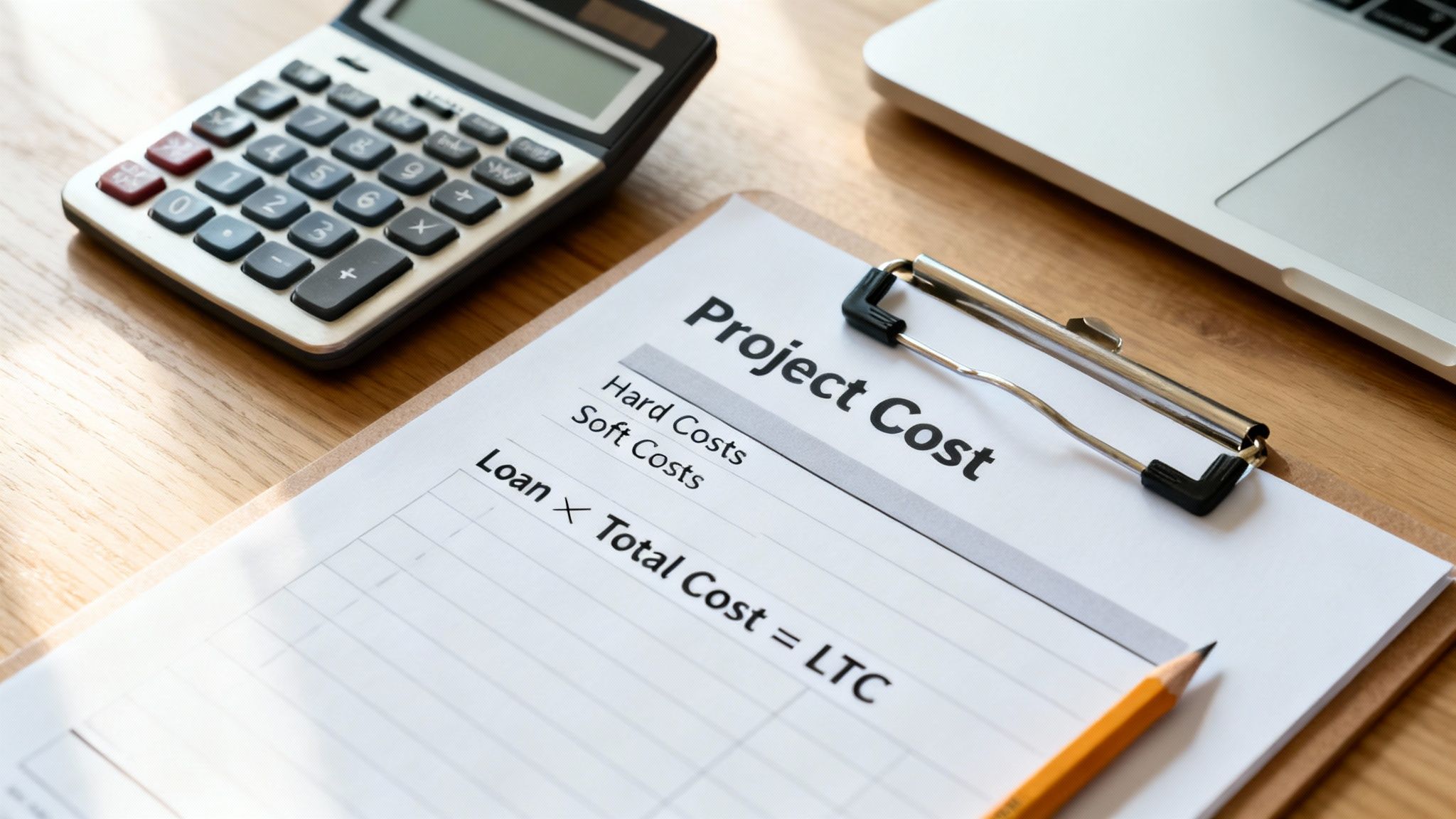
Calculating the Loan-to-Cost (LTC) ratio is refreshingly simple. The math itself isn't what trips people up—it’s accurately defining the numbers that go into the formula. This ratio is a lender’s first gut check to see how much of their own money they’re being asked to put into your deal.
The formula is as straightforward as it gets:
LTC Ratio = Loan Amount / Total Project Cost
So, if you’re asking for a $340,000 loan on a project that costs $400,000 in total, your LTC is 85%. The lender covers 85% of the cost, and you’re responsible for the other 15%.
While the formula is easy, the real key is understanding exactly what your lender considers "Total Project Cost."
Defining Your Total Project Cost
Your total project cost isn't just the purchase price—it's the full, detailed picture of every dollar needed to take a property from an idea to a completed, market-ready asset. Lenders focus on this number because it directly defines their risk.
They typically split the budget into two main categories: hard costs and soft costs.
- Hard Costs: These are the tangible, physical expenses of construction. Think lumber, concrete, drywall, and the labor needed to put it all together. It's everything you can physically touch.
- Soft Costs: These are the intangible but necessary expenses. This includes architectural plans, city permits, insurance, legal fees, and even the loan fees themselves.
Coming to a lender with a detailed budget that clearly outlines both cost types is a massive credibility builder. It immediately shows you've done your homework.
Pro Tip: A well-documented cost breakdown is your best tool for building lender confidence. It demonstrates professionalism and proves you have a realistic plan, which can help you secure better financing terms and avoid funding shortfalls mid-project.
Lenders will put your budget under a microscope, comparing your numbers to industry averages to see if they’re realistic. A sloppy or incomplete budget is one of the fastest ways to get your loan application denied.
Checklist: Hard and Soft Costs
Here's a quick checklist to help you identify what goes into each category. A solid grip on these items is non-negotiable for creating a budget a lender will approve.
Hard Costs Checklist:
- Materials (lumber, roofing, flooring, fixtures, etc.)
- Labor (wages for contractors, electricians, plumbers)
- Site Work (grading, excavation, utilities hookup)
- Landscaping (sod, plants, outdoor structures)
Soft Costs Checklist:
- Professional Fees (architects, engineers, surveyors, attorneys)
- Permits and Inspection Fees
- Loan Fees (origination, appraisal, etc.)
- Insurance (builder's risk and liability coverage)
Getting these projections right is a skill that separates seasoned investors from amateurs. For a deep dive into building a bulletproof budget, check out our guide on how to estimate renovation costs.
Seeing Loan-to-Cost in Real-World Scenarios
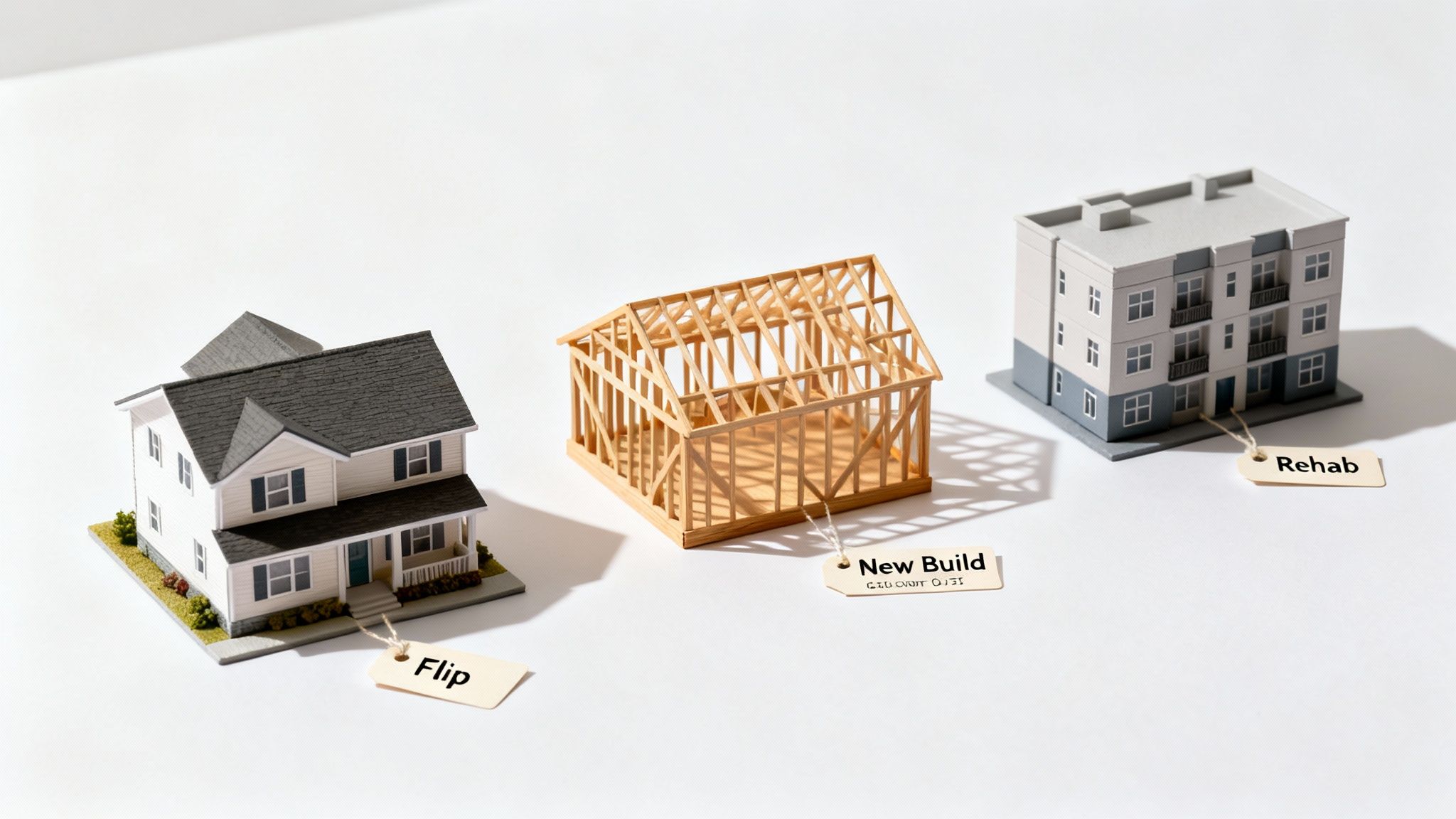
Knowing the LTC formula is one thing, but seeing how it works on actual deals is where it all clicks. This isn't just an abstract number; it's the key metric that determines exactly how much of your own cash you need to bring to the table.
Let's walk through three common real estate scenarios to see how the LTC calculation plays out.
Example 1: The Suburban Fix-and-Flip
You’ve found a dated but solid single-family home in a great neighborhood—a perfect candidate for a classic fix-and-flip. Your plan is to modernize the kitchen and bathrooms, install new flooring, and give it a fresh coat of paint.
Here’s how the numbers stack up:
- Purchase Price: $250,000
- Renovation Budget: $60,000
- Total Project Cost: $250,000 + $60,000 = $310,000
You take the deal to a lender who offers a loan at 85% loan to cost.
Loan Amount = Total Project Cost × LTC Ratio Loan Amount = $310,000 × 0.85 = $263,500
The lender is willing to finance $263,500 for the purchase and renovation. This means your "skin in the game"—the cash you have to contribute—is the remaining amount.
Your Cash Contribution: $310,000 (Total Cost) - $263,500 (Loan Amount) = $46,500
This initial cash covers your down payment and closing costs. For flippers, getting these numbers right is essential. A good fix and flip calculator can be a game-changer for running quick, accurate scenarios like this one.
Example 2: The Ground-Up New Construction
Now for something more complex: building a brand-new home on a vacant lot. New construction projects have higher costs and longer timelines, which makes lenders more cautious.
Here are the project financials:
- Land Purchase Price: $100,000
- Hard Construction Costs (Materials & Labor): $350,000
- Soft Costs (Permits, Plans, Fees): $50,000
- Total Project Cost: $100,000 + $350,000 + $50,000 = $500,000
To account for the higher risk, your construction lender caps their LTC at 80%.
Loan Amount = Total Project Cost × LTC Ratio Loan Amount = $500,000 × 0.80 = $400,000
The lender will provide $400,000. Your job is to cover the rest.
Your Cash Contribution: $500,000 (Total Cost) - $400,000 (Loan Amount) = $100,000
Notice how the lower LTC percentage requires a much larger cash outlay from you? That's the lender's way of ensuring you're fully committed to this riskier project.
Example 3: The Multifamily Rehab-to-Rent
Finally, let's look at a value-add project on a small multifamily property. You've found a four-plex that needs a serious facelift to command higher rents. Your plan is to renovate all the units, find new tenants, and then refinance into a long-term commercial loan.
It's worth noting that every line item matters in a renovation. Even seemingly small expenses add up, and understanding things like the real cost to stage a house can be crucial for attracting top-tier tenants.
Here's the financial picture for our rehab-to-rent:
- Purchase Price: $400,000
- Rehabilitation Budget: $120,000 ($30,000 per unit)
- Total Project Cost: $400,000 + $120,000 = $520,000
Your lender, a bank specializing in multifamily properties, views this as a commercial project and offers a loan at a 75% LTC.
Loan Amount = Total Project Cost × LTC Ratio Loan Amount = $520,000 × 0.75 = $390,000
The bank will fund $390,000 to acquire and renovate the building.
Your Cash Contribution: $520,000 (Total Cost) - $390,000 (Loan Amount) = $130,000
These examples make it clear: the acceptable LTC changes depending on the project's risk. Lenders see a standard flip as safer than a ground-up build, while commercial projects often have their own set of rules. When you analyze your deals through the lens of LTC, you can confidently predict your cash needs and walk into any lender meeting fully prepared.
How Lenders See Your Deal Through Loan-to-Cost
Ever wondered what a lender is really thinking when you submit a loan application? It all boils down to one word: risk. Their primary job is to protect their money, and the Loan-to-Cost (LTC) ratio is the first tool they use to measure it.
Think of it this way: a high LTC tells a lender they're putting up most of the cash, while you're contributing very little. This makes them nervous because it means they're shouldering nearly all the financial risk. A low LTC, on the other hand, instantly shows you have significant "skin in the game." That commitment makes lenders breathe a whole lot easier.
Before they dive into your experience or the property's potential profit, they use LTC as a quick test to see if the deal's structure even makes sense.
Setting the Guardrails: LTC Thresholds
Lenders don't just pull these numbers out of thin air. They set maximum LTC thresholds based on the project type and its inherent risk. These limits are their safety net, creating a financial cushion that protects their money if the project goes wrong.
Here are the typical LTC limits you’ll encounter:
- Fix-and-Flip Projects: Often capped at 80-85% LTC. Flips are a common investment model, so lenders are comfortable financing a bigger piece of the project.
- New Construction: Expect a lower threshold, usually around 75-80% LTC. Building from the ground up involves more moving parts and a longer timeline, which adds risk.
- Commercial or Multifamily Rehab: These can be the most conservative, ranging from 65-75% LTC. Larger, more complex projects naturally come with tighter financing terms.
These thresholds aren't arbitrary; they ensure you're a committed partner. Your cash contribution is the first line of defense, absorbing the hit from budget overruns or a market dip before the lender's capital is ever touched.
A lender's primary goal is capital preservation. The Loan-to-Cost ratio is a simple, powerful tool that helps them measure their exposure and ensure the borrower is financially committed to the project's success.
This is standard practice across the board. In the commercial real estate world, maximum LTCs typically fall between 80% to 90%, meaning lenders expect you to bring 10% to 20% of the total cost as equity. You can learn more about how lenders apply these ratios from experts in commercial real estate loans.
What Lenders Look for Beyond the Numbers
While LTC sets the baseline, the final loan amount isn't just a math problem. A strong application tells a compelling story of a low-risk, high-reward investment, and several factors can nudge a lender toward offering you a higher LTC or better terms.
Three key things that can tip the scales in your favor:
- Your Track Record: A seasoned investor with a portfolio of successful flips is a much safer bet than a first-timer. A history of finishing projects on time and on budget builds confidence.
- The Property and Market: The deal itself must be solid. A property in a desirable, appreciating neighborhood is far more appealing than a project in a stagnant area. Lenders do their own homework on the location.
- The Strength of Your Plan: A professional, detailed budget and scope of work prove you're not just guessing. A clear plan that accounts for unexpected issues signals competence and lowers the lender's perceived risk.
Ultimately, understanding how lenders use the Loan-to-Cost ratio helps you frame your project in the best possible light. You're not just asking for money—you're presenting a well-vetted business plan and inviting them to partner with you in a profitable venture.
LTC Versus LTV: Understanding Key Lending Metrics
In the world of real estate, you’ll hear the acronyms LTC and LTV used constantly. They might sound similar, but they measure two completely different things. Confusing them can lead to major miscalculations when you're trying to fund your next project.
Here’s a simple way to remember the difference:
- LTC (Loan-to-Cost) is about the cost to create something new (like a renovation or new build).
- LTV (Loan-to-Value) is about the value of what already exists (like a finished home).
LTC is the go-to metric for fix-and-flip and new construction loans. LTV, on the other hand, is what lenders use for standard mortgages and refinances, where their main concern is the property’s current appraised market value.
Cost Versus Value: The Fundamental Difference
At their core, the two metrics measure completely different aspects of a deal. LTC is a forward-looking metric that helps a lender gauge the risk and feasibility of a project. LTV is a present-day metric that evaluates the strength of the collateral backing a loan on a finished property.
A private or hard money lender uses the Loan-to-Cost ratio to see if your budget is realistic and, more importantly, if you have enough of your own money invested to see the project through to completion.
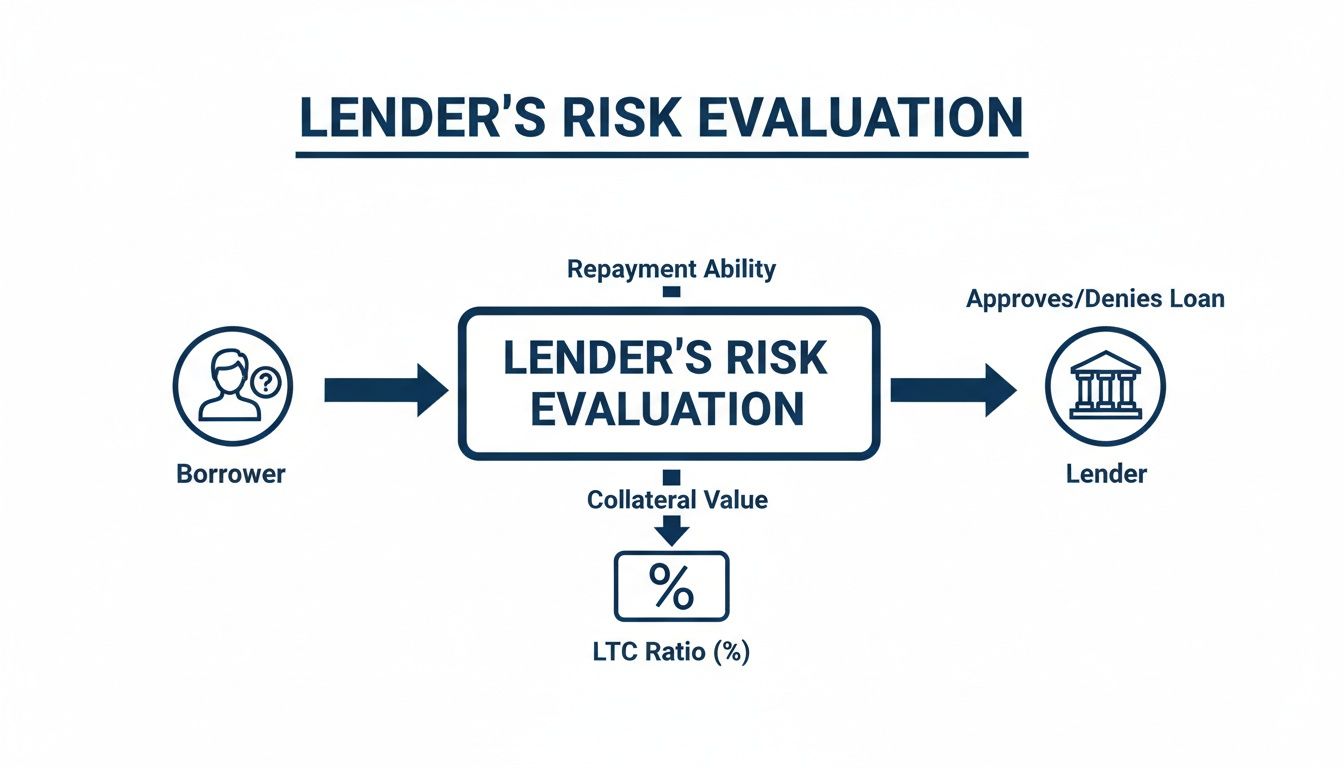
This process shows why a lower LTC ratio makes you a much more attractive borrower. It signals to the lender that you're just as committed to the project's success as they are. This has become especially critical as lending standards tighten, making both LTC and LTV crucial hurdles to clear.
To get a deeper understanding of how traditional financing works, you can learn more about the Loan-to-Value (LTV) ratio and see how it differs from project-based metrics.
Comparing Key Real Estate Financing Metrics
To make it even clearer, let's break down the key differences between Loan-to-Cost (LTC) and Loan-to-Value (LTV). Understanding these distinctions is fundamental to speaking a lender's language.
| Metric | Basis of Calculation | When It's Used | What It Measures |
|---|---|---|---|
| LTC (Loan-to-Cost) | Purchase Price + Renovation/Construction Costs | Fix & Flips, New Construction, Major Rehabs | The lender's risk relative to the total project investment. |
| LTV (Loan-to-Value) | Appraised Market Value of a Property | Standard Mortgages, Refinances, Home Equity Loans | The lender's risk relative to the current collateral value. |
In short, LTC answers the question, "How much of the total project cost is the lender funding?" while LTV answers, "How much is the loan compared to what the property is worth right now?"
When to Use Each Metric
Knowing which metric applies to your situation is key to having a productive conversation with a lender.
- You use LTC when: You're pitching a project that doesn't exist yet or is undergoing a major transformation. Think ground-up construction, a full gut renovation, or a heavy fix-and-flip.
- You use LTV when: You're buying a move-in-ready property, refinancing an existing mortgage, or taking out a home equity loan on a stabilized, completed asset.
Key Takeaway: LTC is for the builders and flippers who are actively creating value. LTV is for the homeowners and long-term investors who are financing existing value. Getting this right is the first step to securing the right type of loan for your needs.
Your Loan-to-Cost Questions Answered (FAQ)
Getting a handle on real estate financing can feel like learning a new language. Here are quick, straightforward answers to the questions we hear most often from buyers and investors.
1. What is a good Loan-to-Cost (LTC) ratio?
A "good" LTC for most fix-and-flip or new construction projects is generally 85% or less. This shows the lender you are contributing at least 15% of your own money to the deal, which they call "skin in the game." A lower ratio, such as 75-80%, is even better because it reduces the lender's risk and can often lead to more favorable loan terms for you.
2. Is it possible to get 100% financing for a project?
While some lenders may advertise 100% financing, it is incredibly rare in practice. This type of loan is typically reserved for highly experienced investors with a long and successful track record with that specific lender. For nearly everyone else, lenders require a cash contribution to ensure you are financially committed to the project's success.
3. How can I improve my project's LTC ratio to get a better loan?
You can improve your LTC ratio by either reducing the loan amount you need or lowering the total project cost. Here are three practical ways to do it:
- Increase your down payment: Bringing more cash to the table is the most direct way to lower your loan amount.
- Negotiate a lower purchase price: Every dollar you save on the property acquisition reduces your total project cost.
- Optimize your renovation budget: Find cost-effective materials or get competitive bids from contractors without sacrificing quality.
4. Do lenders only look at the LTC ratio when approving a loan?
No, LTC is just one piece of the puzzle. Lenders conduct a full review, or underwriting, of your application. They will also scrutinize your personal credit score, your real estate investing experience, and other key deal metrics like the property’s After-Repair Value (ARV). A successful loan application tells a complete story of a low-risk, high-potential investment.
Ready to stop guessing and start analyzing deals with precision? Flip Smart gives you the tools to calculate renovation costs, determine after-repair value, and assess profit potential in seconds. Make your next investment your best investment by visiting https://flipsmrt.com.