

Before you scroll through a single property listing, let’s talk about your game plan. Jumping into the real estate market without a clear strategy is the fastest way to feel overwhelmed, chase bad deals, and burn out. The secret isn't just finding a property; it's knowing exactly what you're looking for before you even start.
Think of this guide as your personal roadmap. We'll walk you through defining your goals, picking the right strategy, and creating a checklist so you can move from a casual browser to a focused investor, ready to find a property that truly works for you.
Define Your Investment Strategy
Imagine planning a road trip. You wouldn't just get in the car and start driving, would you? You’d pick a destination (your financial goal), choose the right vehicle (your investment strategy), and map out the route (your property criteria). Real estate investing works the same way. Without this clarity, every "For Sale" sign looks like an opportunity, which can lead to "analysis paralysis" or, worse, a costly mistake.
Align Your Goals With a Proven Strategy
Your personal finances and long-term goals will point you toward the right strategy. Are you hoping for a quick profit to reinvest, or are you building a source of steady, long-term rental income? Do you have cash ready for a big renovation, or do you need a home that’s move-in ready?
Answering these questions honestly will help narrow your search.
Here are the most common strategies for new investors:
- Fix-and-Flip: This is the classic model of buying a property that needs work, renovating it, and selling it for a profit, usually within a few months. It's a great fit if you have capital for repairs and understand your local market's property values.
- Long-Term Rentals: The "buy-and-hold" approach is all about creating consistent monthly cash flow and building wealth as the property appreciates over time. It’s a marathon, not a sprint, and you'll need a plan for managing the property and tenants.
- BRRRR Method: This acronym stands for Buy, Rehab, Rent, Refinance, Repeat. It's a powerful way to grow your portfolio by buying a fixer-upper, renovating it, placing a tenant, and then pulling your initial capital back out with a cash-out refinance to fund your next deal.
- Vacation Rentals: If you're in a tourist-heavy area, short-term rentals on platforms like Airbnb can be very profitable. Just be aware that they often require more active, hands-on management than a typical long-term rental.
If you're still weighing your options, take some time to explore these real estate investment strategies to see which one aligns best with your financial situation.
This simple process shows how everything connects. Your goals dictate your strategy, and your strategy dictates your property criteria.
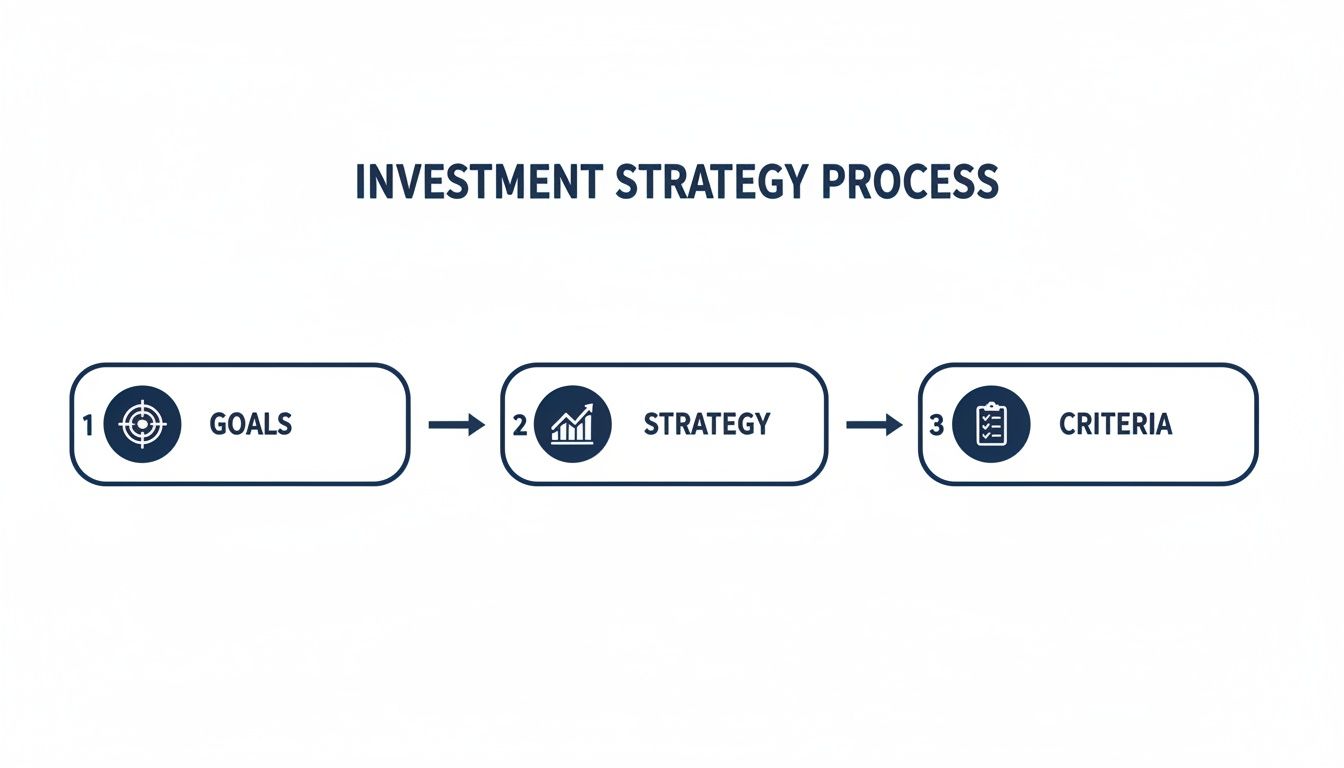
Starting with a clear end goal ensures you don't waste a single second analyzing deals that won't get you there.
Create Your Personal Investment Checklist
Once you've picked a strategy, it’s time to get specific by creating your "buy box"—a non-negotiable checklist of what your ideal property looks like. This is your most important tool for systematically finding investment properties and avoiding emotional decisions.
Quick Takeaway: A well-defined "buy box" is your best defense against emotional decisions. It forces you to focus on the numbers and ensures every property you consider is a legitimate contender for your portfolio.
Get specific with your checklist. Don't leave anything to chance. Here are a few must-haves for your list:
- Location: Pinpoint the exact neighborhoods, zip codes, or even school districts you're targeting.
- Property Type: Are you exclusively looking for single-family homes? Or are duplexes and condos on the table?
- Budget: What’s your absolute maximum "all-in" number? This should include both the purchase price and your estimated renovation budget.
- Financial Metrics: Define your minimums. What cash flow (profit after expenses), cap rate (return on investment), or cash-on-cash return (return on your down payment) are you aiming for?
- Property Condition: Are you hunting for a major renovation project, a home needing simple cosmetic updates, or a completely rent-ready property?
With this checklist in hand, your property search transforms from a frustrating hunt into a targeted mission. You'll be able to instantly filter out 99% of the noise and focus only on the deals with a real shot at meeting your goals.
Sourcing On-Market and Off-Market Deals
Okay, you've got your investment strategy dialed in. Now for the fun part: finding potential properties. Great investment properties rarely fall into your lap; you have to actively hunt them down. This hunt happens in two main places: the publicly listed on-market world and the quieter, often more lucrative off-market world.
A balanced approach is the best way to build a consistent pipeline of opportunities. If you only look at one, you’re missing half the market. The goal is to create a system that brings you a steady stream of potential deals to evaluate.
Mastering the On-Market Search
On-market properties are the ones everyone sees. They're listed for sale on the Multiple Listing Service (MLS), which is a database real estate agents use. This is where most investors get their start. Yes, it's competitive, but you can find an edge with the right tactics.
Websites like Zillow, Redfin, and Realtor.com are your primary tools here, since they all pull data directly from the MLS. The trick isn't just browsing—it's about turning these tools into an automated hunting machine.
- Set Up Hyper-Specific Alerts: Use the criteria from your investment checklist to create saved searches with surgical precision. Don't just look for "3-bedroom houses." Filter by your target zip codes, price range, square footage, and even keywords like "fixer-upper," "TLC," or "as-is."
- Act Immediately: When a property that fits your buy box hits your inbox, the clock is ticking. Good deals on the MLS can get snapped up in hours, not days. Be ready to analyze the numbers and schedule a showing the moment you see it.
- Find an Investor-Friendly Agent: This is a key step. A regular agent helps people find a home they love. An investor-friendly agent helps you find a deal that makes money. They understand the numbers, can spot potential red flags, and often hear about deals before they hit the market.
Uncovering Lucrative Off-Market Properties
This is where the real magic can happen. Off-market properties aren't publicly listed for sale. Finding them takes more effort, but the payoff can be huge because you're often the only person negotiating with the seller.
These deals usually come from motivated sellers—people who need to sell quickly due to situations like foreclosure, divorce, an inherited property, or a sudden job relocation. For them, a quick, hassle-free sale is often more important than getting the absolute highest price.
Quick Takeaway: Think of off-market deals as a conversation, not just a transaction. You're often solving a problem for the seller, which creates a win-win scenario that’s impossible in a bidding war.
So, how do you find these hidden gems? It all boils down to proactive outreach and good old-fashioned networking.
Direct and Digital Strategies
- Driving for Dollars: This classic method is still one of the most effective. You literally drive through your target neighborhoods looking for signs of a neglected property—overgrown lawns, boarded-up windows, or mail stuffed in the mailbox. Note the address, find the owner through public records, and reach out.
- Direct Mail Campaigns: Sending targeted postcards or letters to specific homeowners in your desired area can yield great results. You can buy lists filtered by criteria like how long they've owned the home or if they are absentee owners (landlords who live elsewhere).
- Leverage Networking: Your network is your most powerful asset. Tell everyone you're looking to buy property—friends, family, colleagues, your barber, everyone.
I saw this happen firsthand. An investor in my local meetup group was just chatting with a property manager, explaining his exact criteria. A week later, that manager called him. One of his clients needed to sell a beat-up rental property fast and quietly to cover a family emergency. The investor got the property 15% below market value without it ever hitting the market.
Building Your Deal-Finding Team
You can't do this alone. Finding a steady stream of properties means building a team of people who are your eyes and ears in the market.
Start building relationships with these key players:
- Wholesalers: They are experts at finding off-market deals. They get properties under contract and then sell that contract to an investor like you for a fee.
- Attorneys: Divorce and probate attorneys constantly work with clients who need to liquidate real estate assets quickly.
- Contractors and Handymen: These folks are on the front lines. They're often the first to know when a homeowner is struggling with repairs they can't afford.
Many of these off-market opportunities are what we call "distressed" properties—meaning either the house itself or the owner is in a tough spot. To really dig into this niche, check out our guide on how to find distressed properties for more advanced strategies. By combining a sharp on-market search with a robust off-market strategy, you'll create a powerful system that consistently brings you deals.
Using Market Trends to Spot Hidden Opportunities
Knowing how to find a property is one thing. Knowing when and where to buy is what separates good investors from great ones.
The savviest investors understand that real estate is connected to larger economic forces. Learning to read these trends can help you spot opportunities before they become obvious to everyone else. This isn't about perfectly timing the market—that’s nearly impossible. It’s about making smarter, more informed decisions.

Reading Macroeconomic Signals
Think of macroeconomic factors as the big economic currents that affect the entire country, like interest rates and job growth. These have a direct impact on your local real estate market.
For instance, when the Federal Reserve raises interest rates, mortgage rates usually go up. This can cool down buyer demand, leading to slower price growth. While this might scare off some buyers, a prepared investor sees a potential buying opportunity with less competition and more room to negotiate.
Conversely, when rates are low, borrowing is cheaper, which tends to fuel demand and drive property prices up. Understanding this cycle helps you anticipate market shifts instead of just reacting to them.
Identifying Emerging Markets
An emerging market is a location that's poised for significant growth. Getting in early, before the area becomes a well-known hotspot, is how real fortunes are made.
So, how do you find these places? Look for the signs.
Here are the key indicators of an emerging market:
- Job Growth: When companies move into an area, they create jobs. Those jobs attract people who need housing. Keep an eye out for announcements of new corporate headquarters, factories, or tech hubs.
- Population Growth: Are more people moving into the city than leaving? Consistent population growth is a strong signal of a healthy, expanding market.
- Infrastructure Investment: Pay close attention to major public projects like new light rail lines, highway expansions, or downtown revitalization efforts. These investments make an area more attractive and almost always boost property values.
Quick Takeaway: By tracking these trends, you're essentially following the path of future demand. You’re not just guessing; you’re making a data-backed prediction about where the market is headed.
For example, a market rebound after a correction can be a prime time to invest. After a period of uncertainty between 2022-2024, global private real estate values climbed for five consecutive quarters by Q2 2025. Transaction volumes hit $739 billion over the trailing 12 months, up 19% year-over-year, as savvy investors rebalanced their portfolios. This growth wasn't isolated; commercial real estate deals in Europe jumped 13.7% from 2023, while Asia and the US saw 13.4% and 11.3% growth, respectively.
Using Data to Your Advantage
Reading headlines is a good start, but diving into the actual data gives you a real analytical edge. To spot hidden opportunities, stay informed about broader real estate market trends.
Focus on local metrics that paint a clear picture of supply and demand. Look at things like days on market (DOM), rental vacancy rates, and the number of new building permits being issued.
A decreasing DOM and low vacancy rates signal strong demand. On the other hand, a sudden surge in new construction permits could indicate a future oversupply. Making sense of these numbers is much simpler when you explore the power of data analytics in real estate. By combining a big-picture view with local data, you can build a powerful framework for making smarter investment decisions.
Analyzing Deals to Ensure Profitability
Finding a property is easy. Knowing if it’s a good deal—one that will actually make you money—is a different ballgame. This is where you stop thinking like a homebuyer and start thinking like a business owner.
Successful investors don't get swept up in the emotion of a charming porch or a great backyard. They fall in love with the numbers. This analysis phase is your most important defense against overpaying, underestimating costs, and buying a liability instead of an asset. Let’s break down how to screen deals quickly so you can focus only on the winners.
The Core Numbers That Matter
Before you build a complicated spreadsheet, you need to understand three fundamental metrics. These numbers will tell you in about 60 seconds whether a deal is worth a deeper look.
- After-Repair Value (ARV): This is your most important number. ARV is what the property will be worth after you’ve finished all planned renovations. It's an estimate based on "comps"—recently sold, comparable, and updated properties in the immediate area.
- Renovation Costs: This is the number one place new investors get into trouble. You need a realistic, line-by-line budget for every repair. Always add a 10-15% contingency fund on top of your estimate for unexpected surprises.
- Potential Cash Flow: For a rental, this is everything. It's the money left over each month after you pay the mortgage, taxes, insurance, and set aside funds for vacancies and future repairs. Positive cash flow is what makes a rental a true asset.
Think of these three numbers as the legs of a stool. If one is shaky, the whole deal falls apart.
From Napkin Math to Deep-Dive Analysis
You'll look at dozens, maybe even hundreds, of properties to find one good deal. You can't spend hours analyzing every single one. You need shortcuts to filter out the bad ones fast.
For fix-and-flippers, the classic shortcut is the 70% Rule. It’s a simple formula that tells you the maximum you should pay for a property.
The 70% Rule in Action: A Simple Example
Let's say a property has an ARV of $300,000, and you estimate it needs $40,000 in repairs.
- First, find 70% of the ARV: $300,000 x 0.70 = $210,000
- Then, subtract your repair costs: $210,000 - $40,000 = $170,000
Your Maximum Allowable Offer (MAO) is $170,000. The remaining 30% is your cushion for profit, closing costs, agent commissions, and holding costs.
This quick gut check lets you discard overpriced listings in seconds.
For a rental property, a great initial screen is the 1% Rule. It suggests that the gross monthly rent should be at least 1% of your total investment (purchase price + rehab). If you're all-in for $200,000, you need to see at least $2,000 per month in rent to justify a closer look.
Using Modern Tools for Faster, Smarter Analysis
Napkin math is great for initial screening, but you need to go deeper before writing an offer. This is where technology gives you a massive advantage. Manually pulling comps and building budgets can take hours for each property.
Tools like Flip Smart can completely change the game. Instead of spending your weekend in spreadsheets, you can get a comprehensive deal analysis in minutes. Just plug in a property address, and the platform does the heavy lifting.
Here’s a look at how Flip Smart lays out the complete financial picture, from purchase to profit.
This data-driven approach removes the emotion from the equation. It provides a reliable ARV based on real-time market data, a detailed renovation scope, and clear profit projections for both flipping and renting.
Of course, once you own the property, keeping it profitable is the next challenge. Efficiently managing your rental with one of the best property management apps can make a huge difference. But none of that matters if the numbers don't work from day one. By leaning on solid data, you can make confident offers with a clear path to profitability.
How to Identify and Avoid High-Risk Markets

It’s easy to get caught up in the excitement of a "hot" market. But chasing rapidly rising prices is one of the quickest ways for new investors to get burned. A key to long-term success isn't just finding deals—it's actively managing risk by learning to spot a real estate bubble before it pops.
This skill is what separates seasoned pros from the crowd. You have to learn the difference between sustainable growth (built on real economic fundamentals like job creation) and speculative hype (fueled by emotion and fear of missing out).
Telltale Signs of an Overvalued Market
An overvalued market, or "bubble," happens when property prices get disconnected from their real, underlying value. These markets are incredibly dangerous because when sentiment shifts, prices can fall just as fast as they rose.
Learning to recognize the warning signs is your best defense.
Here are a few major red flags to watch for:
- Prices Outpacing Incomes: This is the classic sign of a bubble. If home prices are skyrocketing while local incomes are staying flat, it creates an unstable foundation where residents can no longer afford to buy.
- Rapid, Unsustainable Price Spikes: Healthy markets appreciate gradually. When you see a market jumping 20% or 30% in value year after year, it's rarely due to organic demand. It's usually a sign of speculative buying.
- Excessive "Flipping" Activity: If a huge percentage of sales are going to short-term flippers instead of owner-occupants or long-term rental investors, it signals a market driven by speculation, not fundamentals.
Quick Takeaway: A healthy market is built on people needing a place to live, supported by a strong local economy. A bubble is built on the belief that prices will go up forever. Your job is to invest in the former and avoid the latter.
Using Data to Steer Clear of Bubbles
Data-driven analysis is the perfect antidote to making emotional, hype-driven decisions. High-level reports like the UBS Global Real Estate Bubble Index are a great starting point to see which major cities might be overheating.
For example, the latest index flags Miami as a major risk hotspot, with cities like Tokyo and Los Angeles also flashing warning signs. At the same time, it shows cities like Madrid have seen strong growth but remain in a more moderate-risk zone. This kind of data provides crucial context.
While these global reports are useful, you have to pair them with local data. This is where tools like Flip Smart become essential. You can analyze the fundamental health of a specific neighborhood, not just the city. By focusing on metrics like rental demand, days on market, and local job growth, you can make an informed decision based on what’s actually happening on the ground—not just what the headlines say. This is the due diligence that protects your capital and sets you up for consistent returns.
Frequently Asked Questions (FAQ)

Navigating your first investment can bring up a lot of questions. Here are clear, simple answers to some of the most common ones.
How much money do I really need to start investing?
There's no single magic number, as it depends on your market and strategy. For a traditional mortgage on an investment property, lenders typically require a 20-25% down payment. You'll also need to budget for 2-5% in closing costs and have cash reserves for unexpected repairs. If you're short on cash, creative strategies like "house hacking" (living in one unit of a multi-family and renting out the others) or partnering with another investor can significantly lower your entry cost.
What’s the best way to find properties that aren’t listed online?
Finding off-market properties is all about networking and direct outreach. Start by building relationships with real estate wholesalers, probate attorneys, and local contractors, as they often know about properties before they go public. You can also try "driving for dollars"—looking for distressed-looking homes in your target neighborhood, finding the owner's contact info, and reaching out directly.
How can I quickly tell if a property is a good deal?
To avoid wasting time, use simple rules of thumb for an initial screening. For rentals, the 1% Rule is a great first check: does the potential monthly rent equal at least 1% of the total purchase price plus repair costs? For fix-and-flips, the 70% Rule helps you determine your maximum offer price. If a property passes these initial tests, you can then perform a more detailed analysis of its cash flow and potential return on investment.
Should I get a real estate license to find better deals?
A license can be a great asset, giving you direct access to the MLS (Multiple Listing Service) and allowing you to earn a commission on your own purchases. However, it's not a necessity. Many successful investors choose to build a strong relationship with an investor-friendly real estate agent who understands their goals and can bring them deals that fit their specific criteria.
Ready to stop guessing and start analyzing deals with precision? Flip Smart delivers data-driven insights—from ARV and rehab costs to profit projections—in a few clicks. Analyze your first deal for free at https://flipsmrt.com.