

Finding the right property is the single most important step in a successful house flip. The best deals aren't found by luck; they’re uncovered by investors who know where and how to look before anyone else gets there.
Think of it like creating a personalized treasure map. A successful strategy combines traditional real estate channels with proactive, off-market tactics to find those hidden gems. Let's walk through how you can build a system to find your first (or next) profitable project.
Your Game Plan for Finding Flip-Worthy Homes

Before diving into specific tactics, it's important to understand the big picture. Your goal is to create a consistent "deal flow"—a steady pipeline of potential properties to analyze. Relying on just one source is risky; a multi-channel strategy is the best way to protect yourself from market shifts and keep opportunities coming.
The current market presents both challenges and opportunities. Recent data shows that home flipping profit margins have hit a 17-year low. The typical gross profit is around $65,000, which is a 27.5% return before you subtract expenses like repairs, loan payments, and selling costs.
However, during that same period, investors bought a staggering 33% of all homes sold—the highest share in at least five years. You can review more on the state of the flipping market to understand these trends.
What does this mean for you? Competition is fierce, but plenty of properties are still being purchased by smart investors. They aren’t just getting lucky; they’re following a proven playbook.
A Quick Look at Where to Find Deals
Every successful investor uses a few core methods to find properties. Each has its pros and cons, and understanding them will help you build a robust deal pipeline.
| Method | Primary Advantage | Main Challenge | Best For |
|---|---|---|---|
| On-Market (MLS) | High volume of listings and easy access to data. | Intense competition and lower profit margins. | Beginners learning a market or investors with a speed advantage. |
| Off-Market | Significantly less competition and better negotiation power. | Requires proactive outreach and consistent effort to find. | Experienced investors looking for higher-margin deals. |
| Auctions | Potential to acquire properties at a deep discount. | High risk, requires cash, and demands fast, thorough due diligence. | Cash-heavy investors comfortable with risk and quick decisions. |
| Wholesalers | Access to pre-vetted, off-market deals. | Margins are split, and you're relying on someone else's numbers. | Investors who value time and convenience over maximum profit. |
This table is just a starting point. The real magic happens when you blend these strategies, creating a system that constantly brings new opportunities to your doorstep.
Key Takeaway: A winning strategy doesn't rely on just one channel. Combine the accessibility of public listings with the high-profit potential of off-market deals to build a resilient and balanced deal flow.
In the next sections, we'll break down exactly how to master each of these channels, giving you the practical steps needed to turn leads into profitable projects. It's time to stop searching and start finding.
Mastering On-Market Deals: The MLS and Auctions

It’s a common myth that all the best deals are hidden away in complex, off-market channels. While those sources are valuable, don't overlook the opportunities hiding in plain sight on the Multiple Listing Service (MLS)—the database that powers sites like Zillow and Realtor.com.
The secret isn’t just endless scrolling; it's searching with an investor's mindset. Your first step should be to partner with an investor-friendly real estate agent. They can set up automated searches that filter out the noise and deliver potential flips right to your inbox.
Using Smart MLS Keyword Filters
A good agent can create custom alerts using keywords that signal a property might be a great flip. This helps you weed out move-in-ready homes and focus on houses that need work.
Here are the money-making keywords to look for:
- "As-is": A classic sign that the seller won't be making any repairs, often because they want a quick, simple sale.
- "TLC" or "Tender Loving Care": This is code for "needs work." These homes can be great for cosmetic flips that don't require a total renovation.
- "Fixer-upper": The most direct term, marketed specifically to investors and handy buyers.
- "Bring your contractor": This suggests the property’s issues are likely beyond a simple DIY project and will require professional help.
- "Estate sale": These homes are often dated and sold by heirs who may prioritize a fast, clean closing over getting the absolute highest price.
Beyond keywords, a great tactic is filtering by Days on Market (DOM). Ask your agent to set up a search for properties that have been listed for 60 days or more. These are often called "stale" listings. A house that hasn't sold in two months usually has a motivated seller who may be more open to negotiating a lower price.
A Beginner's Guide to Real Estate Auctions
Once you have an MLS strategy, you can explore auctions. Auctions can be a fantastic way to buy properties below market value, but they operate differently than a traditional home purchase. They move fast, demand thorough preparation, and leave little room for hesitation.
You'll generally find a few different types:
- Foreclosure Auctions: Often held on the courthouse steps for homes where the owner defaulted on their mortgage. Payment is typically required in full, in cash, on the day of the sale.
- Sheriff's Sales: Similar to foreclosure auctions, these are sales of property seized to satisfy a court judgment.
- Private Auctions: Run by professional auction companies, these sometimes offer more flexibility, like online bidding or longer closing periods.
Expert Insight: The biggest mistake at an auction is getting caught in a bidding war. It's easy to let adrenaline take over and bid more than you planned. You must set a firm walk-away price before the auction begins and stick to it. Your profit is made when you buy, not when you sell.
You must do your due diligence before you bid. You won't get a formal inspection, so you'll need to do a drive-by, check public records for any hidden liens, and create a rough repair budget based only on what you can see. Most importantly, you need a solid understanding of the property's potential value after it's fixed up. For a complete walkthrough on this, check out our guide on building a detailed comparative market analysis.
Uncovering Off-Market Deals to Beat Your Competition
While the MLS and auctions are good starting points, the best deals are often the ones nobody else knows about. These are called off-market deals, and they are highly sought after because you avoid the bidding wars and competition of public listings. Finding them takes more effort, but the payoff can be significant.
This is where you shift from being a passive buyer scrolling online listings to an active deal hunter. Your goal is to find motivated sellers and connect with them directly, often before they’ve even thought about calling a real estate agent.
The Power of Driving for Dollars
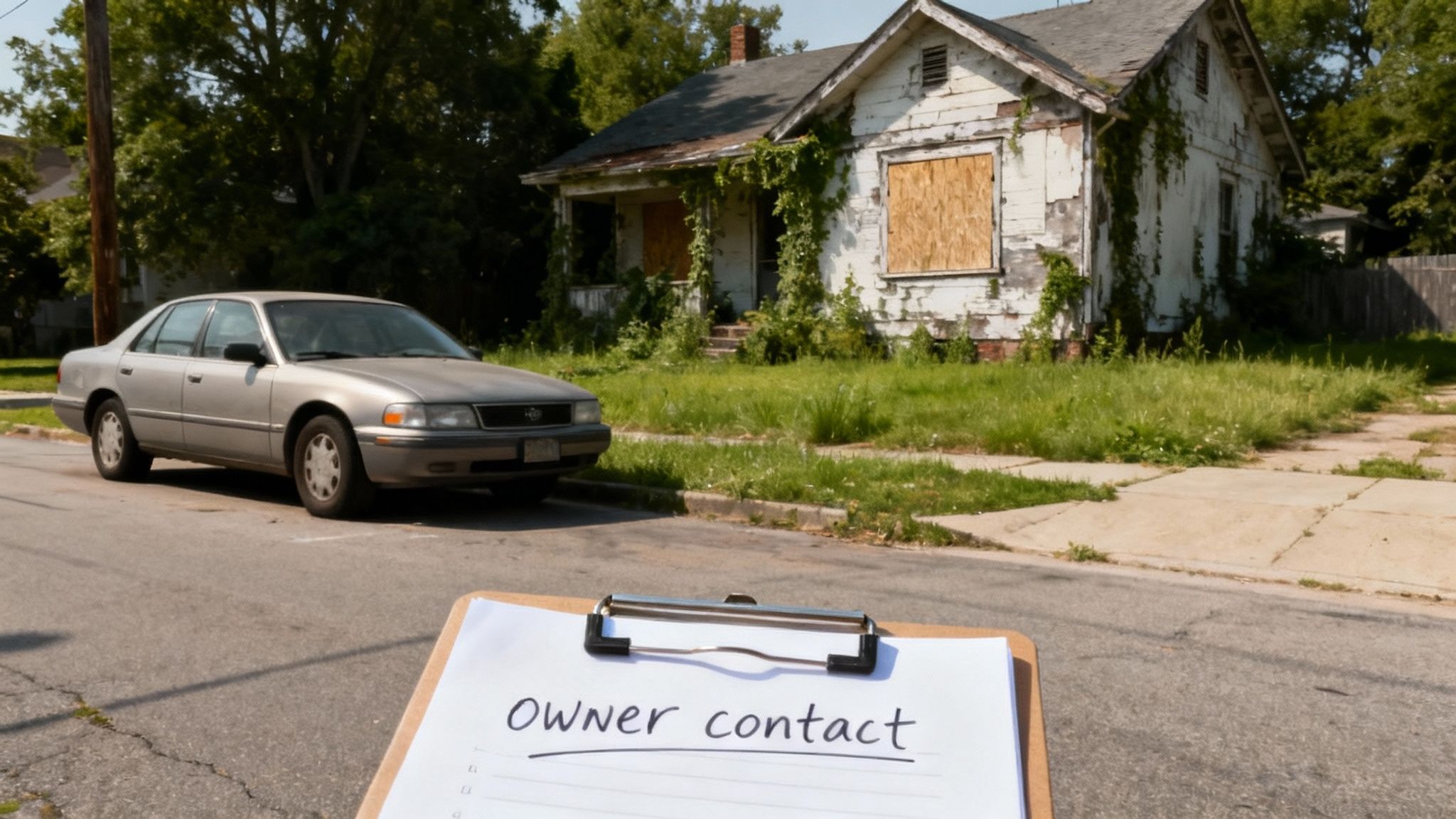
One of the oldest and most effective strategies is "Driving for Dollars." It’s exactly what it sounds like: you drive through neighborhoods you’re interested in and look for properties that show signs of neglect.
Look for visual clues that a property might be distressed or vacant:
- Overgrown lawns and landscaping: A clear sign of neglect.
- Piled-up mail or newspapers: Suggests no one is home to collect them.
- Boarded-up windows or doors: A dead giveaway that the property is empty.
- Visible exterior damage: Such as peeling paint, a sagging roof, or broken gutters.
When you spot a potential property, write down the address. The next step is to find the owner's contact information using public records or a skip-tracing service. This direct approach allows you to reach out and see if they’d consider selling. To learn more, check out this guide on how to find distressed properties.
Build a Network of Wholesalers
If you're short on time, connecting with real estate wholesalers is a great shortcut. A wholesaler's job is to find discounted, off-market properties. They get a property under contract with a seller and then assign that contract to a buyer (you) for a fee.
Essentially, they do the legwork of finding motivated sellers, providing you with a pipeline of potential flips. The key is to find reputable wholesalers who understand your investment criteria. Attending local real estate investor meetups is a great way to find them.
A Quick Word on Wholesaling: While wholesalers bring you deals, always run your own numbers. Never blindly trust their estimated After Repair Value (ARV) or repair costs. Do your own due diligence to ensure the deal works for your profit goals.
Actionable Outreach Scripts and Templates
Contacting homeowners directly can feel intimidating, but a simple, respectful script can make all the difference. Whether you're calling a For Sale By Owner (FSBO) or mailing a letter, your goal is to present yourself as a problem-solver.
Sample Phone Script for an FSBO Seller:
"Hi, my name is [Your Name]. I saw your home for sale at [Property Address] and decided to reach out directly. I’m a local investor looking for a property in the area, and I’m in a position to make a cash offer and close quickly, without the usual financing hassles. Would you be open to a quick chat about your property?"
This script is direct, professional, and highlights the benefits you offer: a fast, no-nonsense sale. You can also explore modern tech solutions, like learning how web scraping to build a lead list automatically, to give you an edge.
Building Your Deal-Finding Network and Online Presence
Systems are great, but the best deals often come from people. In real estate investing, your network is your net worth. When you build genuine relationships with the right professionals, you create a pipeline that brings you opportunities before they ever hit the open market.
The goal is to become a go-to buyer in your area. You want to be the first person an agent, attorney, or contractor thinks of when a distressed property comes up. This is about proving you’re a serious, reliable investor who can close a deal without drama.
Cultivating Your Inner Circle of Deal Finders
Your "deal team" is more than just you. It's an ecosystem of professionals, each with a unique view of the market. Once they trust you, they become your eyes and ears.
Start building connections with these key players:
- Real Estate Agents: Look for agents who specialize in investment properties or do a high volume of sales.
- Contractors and Tradespeople: Plumbers, roofers, and electricians are often the first to know when a homeowner is overwhelmed by repairs and might want to sell.
- Property Managers: They have a direct line to tired landlords who may be ready to sell their rental properties.
- Probate and Divorce Attorneys: Life changes often lead to property sales. A professional introduction can put you top-of-mind when an attorney needs a quick, as-is sale for a client.
When you reach out, offer value first. Ask about their business and how you can make their life easier. A great conversation starter is, "I'm a local investor who can close quickly with cash. What are the biggest frustrations you face when selling distressed properties? I want to be the solution to those problems."
Pro Tip: Your reputation is everything. If you say you'll do something, do it. Word gets around fast in local real estate circles, and being known as a reliable closer will bring you more deals than any marketing campaign.
Establishing Your Digital Footprint
Your in-person networking needs a digital counterpart. You don't need a fancy website, but you do need to be visible online where sellers and other investors are looking.
A great place to start is by joining local real estate investor groups on Facebook. Participate in discussions, offer helpful advice, and let people know what kind of deals you're looking for. This quickly establishes you as an active member of the community.
At the same time, let technology work for you. Set up customized alerts on platforms like Zillow and Redfin for keywords like "FSBO," "foreclosure," and "auction" in your target zip codes. This automates part of your deal search.
Once leads start rolling in, you need to analyze them fast. That's where having the right tools makes all the difference. For more on that, check out our guide on using the best real estate analysis software to make quicker, smarter decisions.
How To Know If You've Found a Good Deal
Finding a property that needs work is the easy part. The real skill is knowing how to quickly and accurately determine if a deal will actually make you money. This is where you have to set emotions aside and let the numbers guide your decision.
You need to run the numbers on every single potential property, with no exceptions. This is the most critical step to avoid losing money on a flip.
No matter how you find a lead, the process always comes down to this: analyzing the deal's financial viability before you make an offer.
Calculate The After Repair Value (ARV)
The After Repair Value (ARV) is the estimated market value of a property after you’ve completed all renovations. Getting this number right is crucial.
To determine the ARV, you need to look at "comps"—recently sold, comparable properties in the immediate area (ideally within a half-mile). Look for homes that are a close match in:
- Size: Square footage, bedroom count, and bathroom count.
- Style: Ranch, colonial, split-level, etc.
- Age and Condition: You're looking for homes that reflect what your property will look like after you've fixed it up.
Your real estate agent can pull a list of comps from the MLS. You’ll want at least three to five good examples from the last 90 days. The average of their final sale prices will give you a reliable ARV estimate.
Create a Realistic Repair Budget
Underestimating renovation costs is the number one reason flips fail.
Even if you’re not a contractor, create a detailed list of every single thing that needs to be fixed or replaced—from big-ticket items like the roof and HVAC system down to small details like light fixtures and doorknobs.
Get a quote from a trusted contractor for the whole job. Once you have that number, add a 15-20% contingency fund on top. You will almost always find unexpected issues once you start opening up walls. This buffer is what protects your profit.
My Personal Rule: Never, ever skip the contingency fund. I learned the hard way that a "simple" bathroom remodel can quickly turn into a full plumbing and subfloor replacement. A contingency fund isn't just a nice-to-have; it's essential insurance for your project.
Master The 70% Rule And Your Profit Margin
The 70% Rule is a quick formula that veteran flippers use to screen deals. It states that you should pay no more than 70% of the property's ARV, minus the cost of repairs.
Here’s the formula: (ARV x 0.70) - Estimated Repairs = Maximum Allowable Offer (MAO)
Let's look at an example:
- ARV: $400,000
- Estimated Repairs: $50,000
The math is: ($400,000 x 0.70) - $50,000 = $230,000. This is your maximum offer.
This rule builds in a 30% cushion to cover your profit, carrying costs (like taxes, insurance, and loan payments), and selling costs (agent commissions). While it’s a great starting point, you still need to calculate your true profit margin.
The market is always changing. A recent poll found that while 89% of U.S. home flippers are planning at least one project, about 20% are expecting lower profits. This highlights how crucial precise calculations are. You can read more about current flipper sentiment to see how other investors are adapting.
Sample Deal Analysis Checklist
Use this checklist to run the numbers on every potential deal. This ensures you're making a data-driven decision, not an emotional one.
| Evaluation Metric | Calculation/Formula | Target Goal | Notes |
|---|---|---|---|
| After Repair Value (ARV) | Avg. of 3-5 Recent Comps | As high as possible | Use comps sold in the last 90 days. The foundation of your analysis. |
| Purchase Price | Your Offer Price | Below MAO | This is the biggest variable you can control. |
| Estimated Repair Costs | Contractor Bids + 15-20% | Stay within budget | Always include a contingency fund for unexpected issues. |
| Maximum Offer (70% Rule) | (ARV x 0.70) - Repairs | Your hard limit | A quick check to see if the deal is in the ballpark. |
| Total Project Cost | Purchase + Repairs + Closing/Carrying | Minimize | Your total cash investment in the project. |
| Estimated Gross Profit | ARV - Total Project Cost | 20-30% of ARV | Profit before selling costs and financing are paid. |
| Estimated Net Profit | Gross Profit - Selling/Financing Costs | 15-20% of ARV | The real number. This is what you actually walk away with. |
| Projected Timeline | From Purchase to Sale | 3-6 Months | Longer timelines increase carrying costs and market risk. |
If your estimated net profit doesn't hit your minimum target after filling this out, it’s time to walk away and find the next opportunity.
Frequently Asked Questions About Finding Houses to Flip
Here are answers to some of the most common questions new investors have when they're just getting started.
How do I finance my first house flip?
Financing a flip is different from getting a mortgage for your own home. Lenders typically require a higher down payment, usually 20-25%. Many new investors use hard money loans, which are short-term loans based on the property's value after repairs (the ARV). These loans fund quickly but come with higher interest rates. Another option is a private money loan from an individual investor. Whichever route you choose, make sure you also have cash reserves for the down payment, closing costs, and the entire renovation budget.
What are the first steps to finding a house to flip?
The first step is to define your investment criteria. Decide on your target market (specific neighborhoods or zip codes), your budget, and the type of property you're looking for (e.g., single-family homes, 3-bedroom/2-bath). Next, start building your deal-finding channels. Get pre-approved for a loan, connect with an investor-friendly real estate agent to set up MLS alerts, and start networking with local wholesalers and contractors.
How can I find houses to flip with no money?
Finding a flip with absolutely no money is extremely difficult and risky for a beginner. However, there are strategies that require very little of your own cash. One common method is wholesaling, where you find a discounted property, put it under contract, and then assign that contract to another investor for a fee. You never actually buy the house. Another option is partnering with a money partner who funds the entire deal in exchange for a share of the profits. Both strategies require a deep understanding of the market and strong negotiation skills.
What is the biggest mistake to avoid when looking for a flip?
The single biggest mistake is "analysis paralysis"—over-analyzing potential deals to the point where you never actually make an offer. While careful due diligence is critical, many beginners get stuck looking for the "perfect" deal that doesn't exist. They pass on good deals in search of a grand slam and end up with nothing. The key is to establish your criteria, trust your numbers, and be prepared to take calculated risks. Your first deal is a learning experience, so focus on finding a solid single or double, not a home run.
Ready to stop guessing and start analyzing deals like a seasoned pro? Flip Smart eliminates the guesswork from your calculations. In seconds, you can determine a property's ARV, get a solid estimate on renovation costs, and see your true profit potential. Start making smarter, faster, and more confident investment decisions by visiting https://flipsmrt.com.