

When you’re buying a home, it’s easy to get caught up in paint colors and curb appeal. But one of the most important questions you should ask is, "Is this a good investment?" That's where Return on Investment, or ROI, comes in. Think of it as a scorecard for your property. It cuts through the jargon to tell you exactly how much profit you're making compared to the money you've put in. Understanding this simple metric is a critical tool for any savvy home buyer.
Understanding the Basics of Real Estate ROI
So, what is ROI in real estate, really? It’s a simple calculation that helps you look past a home’s asking price and see its true potential as a wealth-building asset. Getting a handle on ROI is what separates an emotional purchase from a smart financial move. It allows you to compare different properties using clear, objective numbers.
This calculation isn’t just about the final sale price. It includes everything from the rental income you might collect to every dollar you spend on closing costs and renovations. Mastering ROI helps you confidently decide whether a house is just a place to live or a powerful financial asset for your future.
The Core Components of ROI
To understand how ROI works, you just need to know its two key parts: what you gain and what it costs you. Before we jump into the formula, let's break down these essential terms.
| Component | What It Means | Example |
|---|---|---|
| Investment Gain | The total profit you make. This includes cash flow from rent and the increase in the home's value (appreciation). | If your property’s value increased by $50,000 and you earned $5,000 in net rental income, your total gain is $55,000. |
| Investment Cost | All the cash you've personally put into the deal. This is your down payment, closing costs, and any major renovation expenses. | A $40,000 down payment plus $8,000 in closing costs and $15,000 for a new kitchen equals a total cash cost of $63,000. |
Getting a clear picture of both your gains and your costs is the only way to accurately measure your investment's performance.
At its heart, ROI answers a fundamental question for every home buyer and investor: "For every dollar I put in, how many am I getting back?"
How to Calculate Real Estate ROI
Figuring out the return on investment for a property might sound intimidating, but it’s more straightforward than you’d think. With a couple of simple formulas, you can get a clear picture of how an investment is likely to perform.
Let's walk through a practical example to make the numbers easy to understand.
Imagine you're buying a property for $400,000. You plan to put down $80,000 (a 20% down payment) and have budgeted $12,000 for closing costs. Your total cash investment—the actual money coming out of your pocket—is $92,000.
The Two Main Formulas for ROI
To really understand what is ROI in real estate for your deal, there are two main ways to calculate it. Each gives you a different perspective on your returns.
- The Cost Method: This formula gives you the big-picture view. It measures your return based on the property's total purchase price, including the money you borrowed. It’s perfect for seeing how the asset itself is performing.
- The Out-of-Pocket Method: This is the one most investors focus on. It measures the return you're making on your actual cash investment. It tells you how hard your money is working for you.
For more specialized investments like vacation homes, getting precise numbers is crucial. A dedicated vacation rental investment calculator can be a huge help in forecasting income and expenses accurately.
A Practical Example Step-by-Step
Let's stick with our $400,000 property. After renting it out, you calculate that your annual net income is $10,000. This is the cash left over after paying all expenses—mortgage interest, property taxes, insurance, maintenance, etc.
Now, let's plug that number into our two formulas.
| Calculation Method | Formula | When to Use It |
|---|---|---|
| The Cost Method | Annual Net Income / Total Property Cost | To assess the overall profitability of the asset itself, including the portion financed by the bank. Great for comparing the fundamental performance of different properties. |
| The Out-of-Pocket Method | Annual Net Income / Total Cash Invested | To measure the return on your personal cash investment. This is the best metric for understanding how effectively you're using your own capital. |
1. Calculating with the Cost Method
This method looks at your annual profit relative to the total purchase price.
- Formula: Annual Net Income / Total Property Cost = ROI
- Calculation: $10,000 / $400,000 = 0.025
- Result: Your ROI using this method is 2.5%.
This number shows how efficiently the entire property—your money and the bank's—is generating a return. It's a solid, conservative benchmark for comparing one property's performance to another.
2. Calculating with the Out-of-Pocket Method
This is where it gets interesting for you, the investor. This formula measures your return based only on the cash you personally put into the deal.
- Formula: Annual Net Income / Total Cash Invested = ROI
- Calculation: $10,000 / $92,000 = 0.1087
- Result: Your ROI is roughly 10.9%.
Notice the big difference? This much higher percentage illustrates the power of leverage. You're using the bank's money to help generate a much larger return on your own cash.
Of course, running these numbers for every potential property can be time-consuming. This is why many buyers and investors use digital tools. An investment property ROI calculator can automate these exact steps to give you instant clarity.
What Is a Good Real Estate ROI?
As you begin your home-buying journey, a common question is: what ROI should I be aiming for? The honest answer is that there’s no single magic number that defines a "good" return on investment.
It really depends on your personal financial goals, the type of property you're buying, the local market, and your overall investment strategy.
While many experienced investors often target an annual return between 8% and 12%, this isn't a universal rule. In some fast-growing areas, you might expect more. In stable, slower markets, a consistent 5% to 7% could be a great success. Context is everything.
This simple graphic shows the journey from buying a property to making a profit—the very core of the ROI concept.
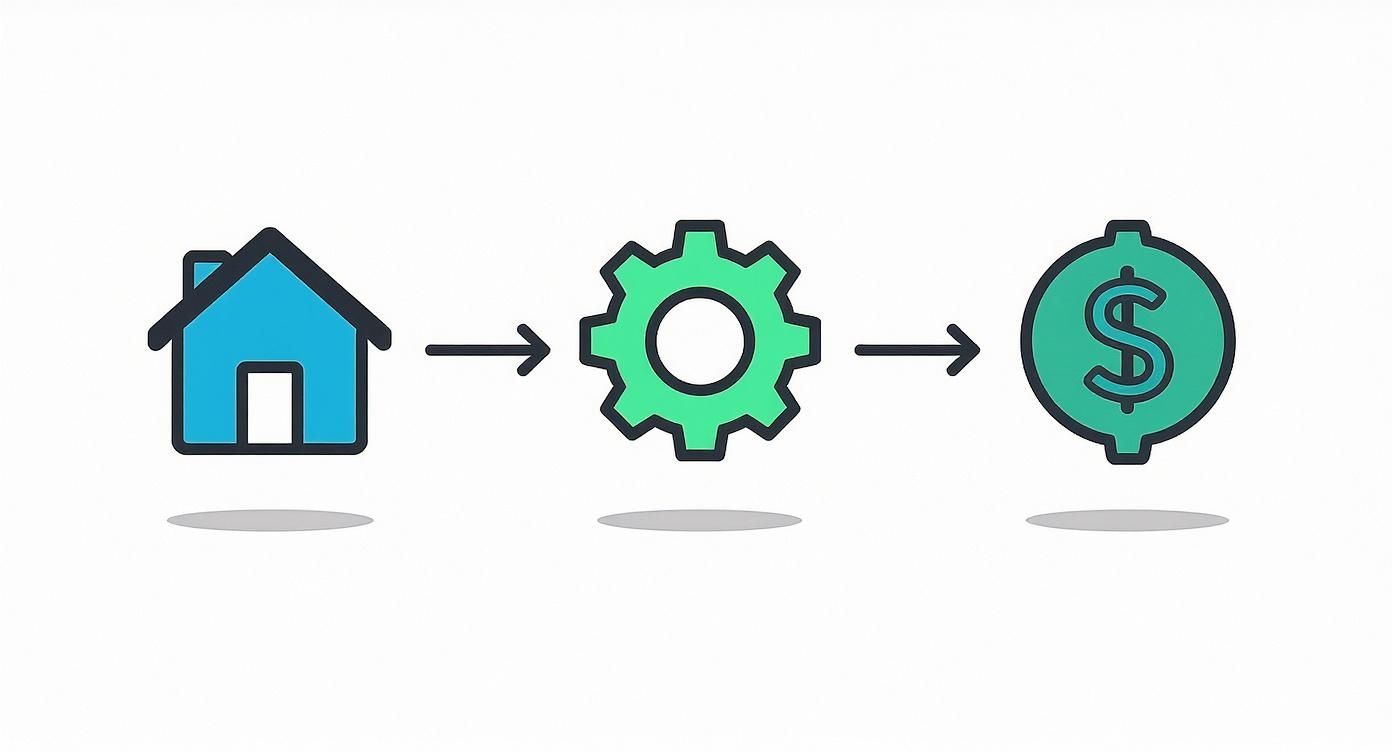
This flow highlights that ROI isn't just a one-time calculation. It’s something you manage from the day you invest to the day you sell or refinance.
Setting Realistic Expectations
Your definition of a "good" ROI must align with your personal goals and comfort with risk. Are you looking for steady, long-term cash flow from a rental property, or are you hoping for a quick profit from fixing and flipping a home in a popular neighborhood? Your answer will shape what a good number looks like for you.
A "good" ROI is one that meets your financial objectives while aligning with the realities of the local market and the specific property you're considering.
Recent global trends show that the average real estate investor has seen returns in the 4%–8% range. Your goal is to move beyond generic advice and define what a successful return means for you. To learn more about setting your own targets, check out this detailed guide on what makes a good ROI for rental property.
Key Factors That Influence Your Property's ROI

Understanding what is ROI in real estate is the first step. But knowing what actually drives that number is the key to a truly successful investment.
Your property’s return isn’t just about the purchase price. It’s a mix of several powerful elements that can either boost your profits or slowly eat into them over time. Think of these factors as the hidden variables behind any property listing. Once you learn to spot them, you can look past the fresh paint and see a property’s real financial potential.
Location and Market Dynamics
You’ve heard it before, and it's true: location is everything. A property’s surroundings have a huge impact on its ROI.
- Neighborhood Quality: Being close to good schools, parks, and shops can seriously increase a home’s value and rental demand.
- Economic Health: A strong local job market and a growing population are signs of a healthy real estate environment, often leading to steady appreciation.
- Market Trends: Broader economic forces like interest rates and housing supply directly affect your financing costs and the property's potential to gain value.
A great location acts as a safety net for your investment. Even in a down market, a property in a desirable area is more likely to hold its value and attract tenants.
Property Condition and Financing Terms
Beyond the neighborhood, the specifics of the property itself—and the loan you get—are critical. A home with a solid structure that just needs cosmetic updates can be a fantastic investment if you’re smart about the improvements. Knowing which home renovation projects for maximum ROI actually add value is a skill in itself.
Your financing also plays a huge role. A good mortgage with a lower interest rate directly reduces your monthly expenses. This improves your cash flow and your overall return from day one. To assess a property's income potential without factoring in your loan, you can use the capitalization rate formula for real estate.
How Different Property Types Affect Your ROI
When you're trying to nail down what ROI means in real estate, remember this: not all properties are created equal. The type of property you buy is one of the biggest factors influencing your potential returns.
Think of it like building an investment portfolio. A traditional single-family home in a quiet suburb is like a blue-chip stock—it offers stability and slow, steady growth. On the other hand, a downtown condo might be a high-growth tech stock, promising higher rental income but also coming with HOA fees that can affect your profits.
Each property type carries its own unique risk-and-reward profile. The key is to match the property to your specific investment strategy, whether that’s generating consistent monthly cash flow or banking on long-term appreciation.
Traditional vs. Alternative Investments
Single-family homes and duplexes are the bread and butter of real estate investing. But savvy buyers know to look beyond the obvious. There's a whole world of alternative property types, some of which are posting impressive returns by catering to specific market needs.
The most profitable opportunities often lie just outside the mainstream, in niche markets that serve the foundational needs of our modern economy.
Recent market analysis shows that some of the highest ROI opportunities are in these alternative sectors. For example, data centers, which power our digital lives, delivered a total return of 11.2%, while manufactured housing communities generated an even higher return of 11.7%. You can get a deeper look into these global private market trends and their impact on investors.
This shows that if you broaden your search beyond conventional homes, you can unlock significant financial upside. The best investment isn’t just any house—it’s the property that perfectly aligns with your financial goals and the unique demands of today's market.
Seeing ROI in Action: A Real-World Example

Formulas are great, but nothing makes a concept click like seeing it play out in the real world. Let's look at a practical example from the UK property market. It’s a perfect case study to show how different economic forces can shape an investor's total return.
This example shows how a market can bounce back, driven by the powerful combination of strong rental income and a recovery in property values. When you look closer, you see that different sectors within the same market can perform in wildly different ways. This highlights a critical lesson for any buyer: you have to understand the specific dynamics of the local market you’re getting into.
A Market in Motion
The UK real estate market is a compelling snapshot of how ROI can shift. Over a recent 12-month period, UK real estate delivered a healthy 8.1% total return. That's an impressive figure, fueled by two key factors: solid rental growth and a turnaround in capital values. To see how this stacks up globally, you can check out this global real estate market outlook.
This practical illustration brings the theory to life. It shows the delicate balance between the two main parts of ROI—the income you collect and the appreciation you gain.
The key takeaway is that your total return is a story written by many factors. A strong rental market can cushion your investment during times of slow appreciation, while a rising market can turbocharge your overall gains.
Common Questions About Real Estate ROI
Even after you get the hang of the formulas, a few common questions always come up, especially for new homebuyers. Let's walk through the most frequent ones so you can move forward with total confidence.
How do mortgage payments affect my ROI calculation?
This is a great question. Think of your mortgage payment as having two parts. The interest you pay is a direct expense that reduces your net profit and lowers your ROI. But the principal part of your payment builds your ownership stake in the home, known as equity. The Out-of-Pocket ROI calculation is especially useful here because it shows how effectively you are using the bank's money (leverage) to grow your own investment.
What are some simple ways to improve a property's ROI?
Boosting your return almost always comes down to two things: increasing income or reducing expenses. Here are a few practical ways to do that:
- Smart Renovations: Focus on high-impact updates that buyers and renters love, like modernizing a dated kitchen or refreshing a bathroom.
- Increase Rental Income: If you're renting out the property, make sure your rent is competitive for the area. Small improvements can often justify a higher rent.
- Refinance Your Mortgage: If interest rates have dropped since you bought the home, refinancing can lower your monthly payments, instantly improving your cash flow and ROI.
Is a higher ROI always the better choice?
Not necessarily. A very high ROI can sometimes be a red flag for a riskier investment. It’s crucial to look at the whole picture. For example, a property in a less stable neighborhood might offer a flashy 15% projected ROI, but it could come with higher vacancy rates or unexpected costs. In contrast, a property in a prime location might offer a more modest but reliable 7% ROI. Always weigh the potential reward against the level of risk you're comfortable with.
Ready to stop guessing and start analyzing properties like a pro? Flip Smart gives you the tools to calculate valuations, renovation costs, and profit potential in seconds. Analyze your first deal for free at Flip Smart.