
If you're starting to explore real estate investing, you'll hear the term "cap rate" a lot. The capitalization rate formula in real estate might sound complicated, but it's a simple and powerful tool that helps you quickly check an investment property's potential. Think of it as a way to measure the profitability of a property, giving you a clear percentage that shows its potential return if you were to buy it with cash.
This guide will walk you through what the cap rate is, how to calculate it, and how to use it to make smarter decisions on your home-buying journey.
What is a Capitalization Rate in Real Estate?
A capitalization rate, or "cap rate," is a quick health check for an investment property. Before you dive into detailed spreadsheets, this single percentage gives you a snapshot of a deal's profitability. Seasoned investors often use it as the first filter to sort through potential investments.
The beauty of the cap rate is its simplicity. It shows you the potential annual return on a property as if you bought it entirely with cash. This is a key detail because it removes the complexities of mortgages and financing, allowing you to make a clean, apples-to-apples comparison between different properties.
It all boils down to two key components:
- Net Operating Income (NOI): This is the total income a property brings in (from rent, parking fees, etc.) after you subtract all the day-to-day operating expenses. It's the property's pure, annual profit before you account for loan payments.
- Market Value or Purchase Price: This is what the property is worth or what you're paying for it.
The relationship between these two numbers is what gives the cap rate its power. It tells you exactly how hard your capital would be working for you relative to the property's price tag.
Breaking Down The Cap Rate Formula
This table gives you a quick-reference guide to each piece of the cap rate formula, so you can see how they all fit together.
| Component | What It Measures | Why It's Important for Buyers |
|---|---|---|
| Net Operating Income (NOI) | The property's annual income after all operating expenses are paid (but before mortgage payments). | It shows the property's ability to generate profit from its day-to-day operations. |
| Market Value | The current price the property would sell for on the open market, or the actual purchase price. | It represents the total capital investment required to acquire the asset. |
| Capitalization Rate (Cap Rate) | The unleveraged rate of return on the investment, expressed as a percentage. | It provides a standard way to quickly compare the profitability of different properties. |
Understanding these pieces is the first step to using this metric effectively in your own analysis.
Why This Metric Is A Starting Point
The cap rate has been a go-to tool for real estate investors for decades, helping them size up everything from massive apartment buildings to small duplexes. A big reason for its popularity is its simplicity. The formula, Cap Rate = NOI / Market Value × 100, gives you a clear, easy-to-understand percentage.
For example, if a property generates a Net Operating Income (NOI) of $80,000 a year and is on the market for $1,000,000, its cap rate is 8%. This tells you the property has a theoretical 8% annual return on the investment before considering any financing.
Quick Takeaway for Buyers: The cap rate is a measure of an asset's unleveraged yield. It helps you quickly understand how a property's income potential stacks up against its price tag, making it an essential first step in any serious property analysis.
Of course, this is just one piece of the puzzle. While the cap rate is focused on operating income, other metrics are also essential. For instance, knowing how to calculate rental yield can provide a different perspective on a property's performance. By looking at a property from multiple angles, you get a much clearer, more reliable view of its financial health.
How To Calculate Net Operating Income Correctly
Net Operating Income, or NOI, is the engine that powers the cap rate formula. Getting this number right is absolutely critical—a small mistake here can completely throw off your analysis and make a bad deal look good.
Think of NOI as the property's pure, unfiltered profitability. It tells you how much cash a property generates from its day-to-day operations, completely separate from the owner's mortgage or tax situation.
The process is straightforward: add up all your income, then subtract all your operating expenses. Let's break it down.
Step 1: Start With Gross Operating Income
First, you need to account for every dollar the property can produce. This begins with Gross Potential Rent (GPR)—the total amount of rent you'd collect if every unit was occupied 100% of the time, with every tenant paying on time.
Of course, perfect occupancy is rare. That's why you should immediately subtract an allowance for vacancy, typically between 5-10% of the GPR, depending on your local market. For a deeper dive, check out our guide on how to calculate rental income accurately.
But rent often isn't the only income. You also need to add any other money the property generates.
- Parking Fees: Money from assigned or covered parking spots.
- Laundry Facilities: Revenue from coin-operated washers and dryers.
- Storage Units: Fees from tenants using on-site storage.
- Pet Fees: Monthly charges for furry tenants.
Once you add this "other income" to your rental income (after accounting for vacancy), you get your Gross Operating Income (GOI). This is the real starting point for your calculation.
This is the first key input for the cap rate formula, as the diagram shows.
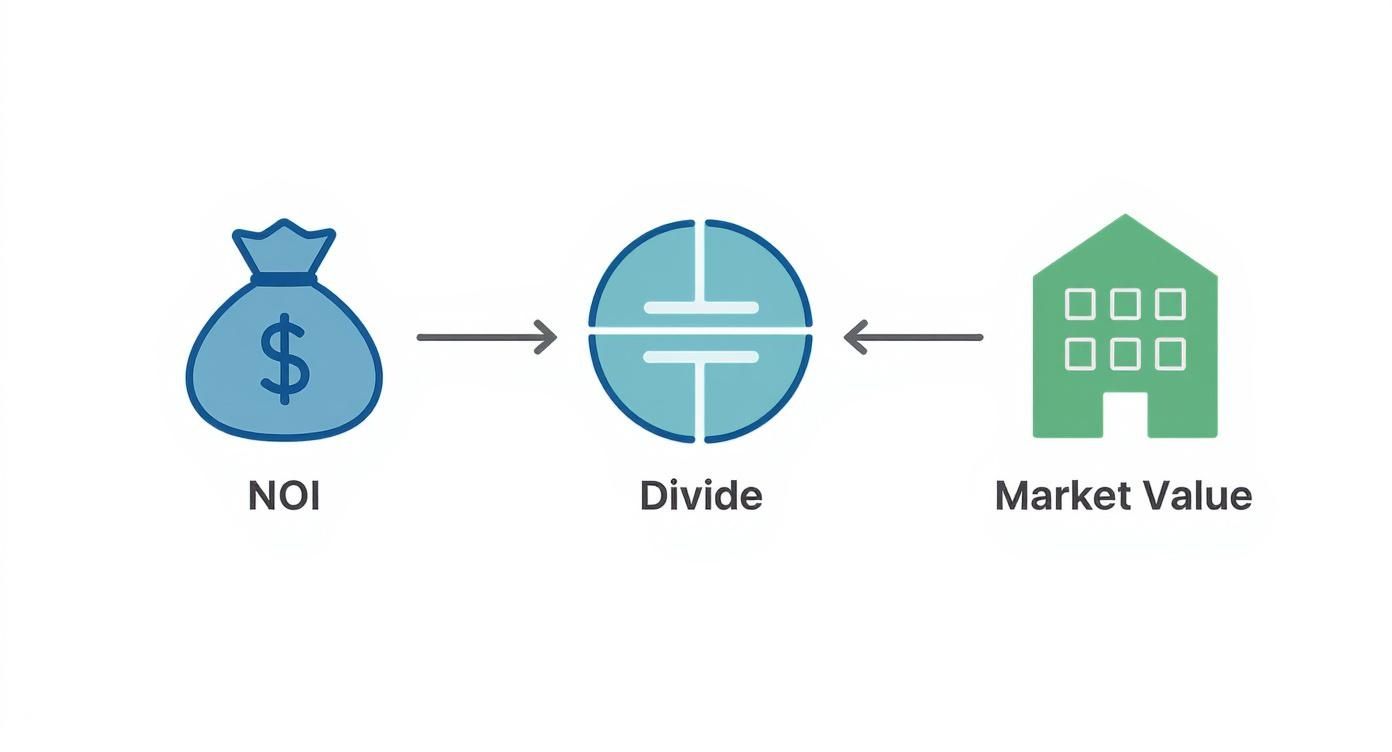
Without an accurate NOI, the rest of the formula is useless.
Step 2: Subtract Your Operating Expenses
Next, it’s time to subtract every cost required to keep the property running smoothly. These are your operating expenses.
Common operating expenses include things like:
- Property Taxes: Your annual bill from the local government.
- Property Insurance: Coverage for liability, fire, and other potential disasters.
- Utilities: Any water, sewer, or trash bills you cover as the landlord, plus electricity for common areas.
- Repairs & Maintenance: Your budget for routine upkeep—think leaky faucets, landscaping, and pest control.
- Property Management Fees: If you hire a professional, this is usually 8-10% of the rent they collect.
To get an accurate NOI, you need to be thorough. For instance, knowing all the available tax deductions for UK landlords can make a real difference in your final calculation.
What Expenses to Exclude from NOI
Just as important as knowing what to include is knowing what to leave out. The NOI calculation intentionally ignores costs related to financing and the owner's personal situation, focusing only on the property itself.
Key Takeaway: The whole point of NOI is to measure a property's standalone performance. By leaving out financing and owner-specific costs, you can compare different properties on an apples-to-apples basis, no matter how they were purchased.
Here’s what you should never include in your NOI calculation:
- Mortgage Payments: Both principal and interest are out. Your loan is about your financing, not the property's operational health.
- Capital Expenditures (CapEx): Big-ticket, one-off improvements like a new roof or HVAC system aren't daily operating costs. You should budget for them separately.
- Depreciation: This is a "paper" expense for tax purposes; it doesn't actually impact your cash flow.
- Income Taxes: This is a personal expense tied to your specific tax situation, not a property expense.
Subtract the correct operating expenses from your Gross Operating Income, and you've got your Net Operating Income—the clean, precise number you need to calculate a meaningful cap rate.
Putting The Cap Rate Formula Into Practice
Okay, you have a handle on Net Operating Income (NOI). Now for the fun part: putting the capitalization rate formula real estate investors use to the test. This is where the numbers on a spreadsheet start telling a real story about a property's potential.
Let's stick with an example of an apartment building. After adding up all the income and subtracting every operating cost, we landed on a solid NOI of $75,000 a year.
Now, let’s see what happens when we use that NOI to analyze two different properties. They both make the same money, but they have very different price tags.
Calculating The Cap Rate For Two Scenarios
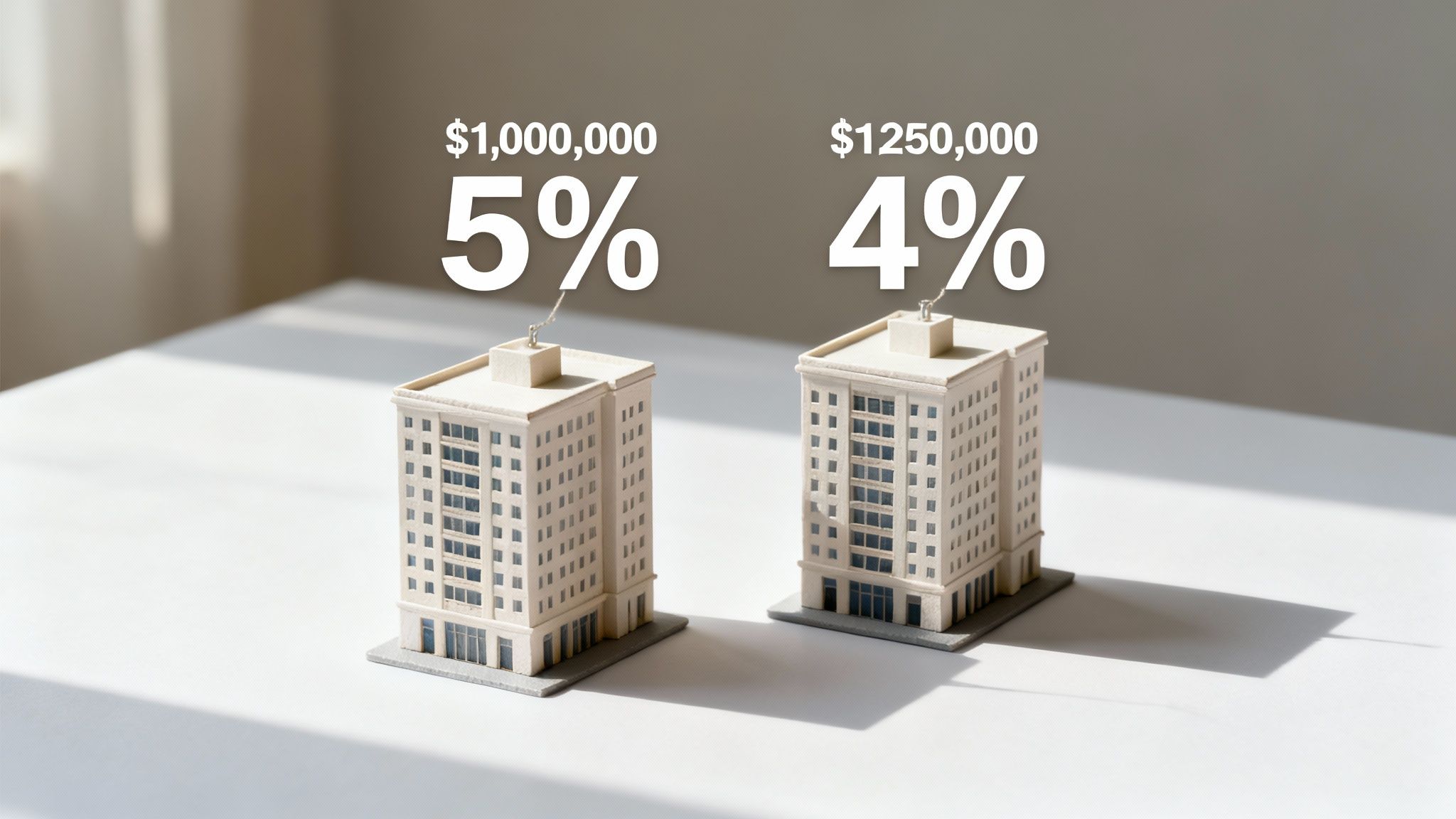
Imagine two apartment buildings that are almost identical. They're both generating the same $75,000 NOI. The only real difference is their location, which has a huge impact on their market value and the risk you're taking on as a buyer.
Scenario A: The Prime Location Property
This building sits in a top-tier, high-demand neighborhood. Because of its location, the asking price is $1,250,000.
Let's plug that into our formula:
Cap Rate = Net Operating Income / Market Value
For this prime property, the math looks like this:
- Cap Rate = $75,000 / $1,250,000
- Cap Rate = 0.06 or 6.0%
A 6.0% cap rate in a great area typically signals a stable, lower-risk investment. Investors are willing to pay more for the same income stream because they have confidence in the location's long-term stability, which pushes the cap rate down.
Scenario B: The Up-And-Coming Neighborhood Property
This identical building is in a neighborhood that's still transitioning. It produces the same income, but its market value is a lower $1,000,000 because there's more perceived risk.
Let’s run the numbers again:
- Cap Rate = $75,000 / $1,000,000
- Cap Rate = 0.075 or 7.5%
See the difference? A 7.5% cap rate is higher, which means you're getting a better immediate return for your money. That higher return is your compensation for taking on the added risk of a less-proven market.
Understanding The Inverse Relationship
These two examples perfectly illustrate a core principle every investor must understand: the seesaw relationship between price and cap rate. Assuming the NOI is constant, a higher price pushes the cap rate down, while a lower price sends it up.
Key Insight for Buyers: Price and cap rate move in opposite directions. A low cap rate means you're paying more for every dollar of income, which usually implies lower risk. A high cap rate means you're paying less for that same dollar of income, which often comes with higher risk.
This one simple calculation gives you an instant snapshot of what you're "paying" for a property's income. It's an incredibly powerful first-pass filter to see if an asking price makes sense for its performance and the market it's in.
Of course, running these numbers for every single deal can get old fast. That's why having a good real estate investment calculator is a non-negotiable tool for serious investors looking to analyze deals quickly and accurately.
By walking through these scenarios, you can see how the cap rate formula cuts through the noise and helps you make decisions based on cold, hard numbers—the key to any smart investment strategy.
What Is Considered A Good Cap Rate?
Asking for a "good" cap rate is a lot like asking how much you should pay for a car. The only real answer is: it depends. A fantastic cap rate for a brand new apartment complex in a bustling downtown would look completely different from a good cap rate for an older office building in a quiet suburb.
The key is to stop hunting for a single magic number. Instead, think of the cap rate as a barometer for the risk-versus-reward trade-off in real estate.
The Great Balancing Act: Risk and Return
At its heart, a cap rate shows you the unleveraged annual return you’d get if you bought a property with cash. A higher cap rate signals a higher potential return, but it almost always comes with a higher level of risk. On the flip side, a lower cap rate means a lower immediate return, but it suggests a safer, more stable asset.
Here’s a simple way to look at it:
- Low Cap Rates (e.g., 3-5%): You'll find these in prime markets like New York City or Los Angeles. Investors are willing to pay a premium (pushing the cap rate down) because they see the property as a safe bet. It’s in a great location, has strong tenant demand, and is likely to appreciate. You're essentially buying stability.
- High Cap Rates (e.g., 8-10%+): These are more common in smaller, less certain markets or on properties that need some work. The higher return is the market’s way of rewarding you for taking on more risk—things like potential vacancies, a weaker local economy, or the need for significant repairs.
Neither one is inherently "better." The right cap rate for you depends entirely on your investment strategy and your personal tolerance for risk. To see how this plays out in practice, check out our deep dive on calculating the cap rate on a rental property.
Market Tiers and Property Types Matter
The definition of a "good" cap rate shifts dramatically based on both the location and the type of property. A 7% cap rate might be an absolute home run for a multifamily property in a top-tier city, but it could be a serious red flag for a retail center in a small town.
Historically, cap rates move with broader economic cycles. When interest rates are low and demand is high, competition drives property prices up, causing cap rates to go down. From the early 2000s to 2020, we saw cap rates in major hubs like San Francisco and New York fall from the 8-10% range down to 3-5%. In contrast, during the 2008 financial crisis, uncertainty sent property values tumbling, and cap rates spiked as investors demanded higher returns for the increased risk. For a detailed look at these cycles, Origin Investments offers great insights on real estate capitalization rate trends.
Quick Takeaway: Context is everything. A cap rate is meaningless in a vacuum. You must always compare it to the going rates for similar properties in the same market to know if you've found a great opportunity or a potential money pit.
Let's break down what typical rates look like.
Typical Cap Rate Ranges By Property Market
This table gives you a general feel for the cap rate ranges you can expect for different property types across various market tiers. Use it as a starting point to benchmark the opportunities you're analyzing.
| Property Type | Tier 1 Market (e.g., NYC, LA) | Tier 2 Market (e.g., Austin, Nashville) | Tier 3 Market (e.g., Smaller Cities) |
|---|---|---|---|
| Multifamily Apartments | 3.5% - 5.0% | 4.5% - 6.0% | 5.5% - 7.5% |
| Office Buildings (Class A) | 4.0% - 5.5% | 5.0% - 6.5% | 6.0% - 8.0% |
| Retail Centers | 4.5% - 6.0% | 5.5% - 7.0% | 6.5% - 8.5% |
| Industrial / Warehouse | 3.0% - 4.5% | 4.0% - 5.5% | 5.0% - 7.0% |
As the table shows, investors expect higher returns (and thus higher cap rates) for the perceived risk of investing in smaller, less-established markets.
By understanding these benchmarks, you can quickly tell if a deal makes sense. If you find a property with a cap rate that’s way outside the typical range for its market and type, it’s time to dig deeper.
Common Mistakes To Avoid When Using Cap Rates
The cap rate is an incredibly useful tool, but relying on it as your only metric can lead to costly surprises. It’s a fantastic first look, but it’s not the final word.
Understanding its limitations is just as important as knowing how to use the capitalization rate formula real estate investors depend on. Let's dig into the common pitfalls that can trip up even savvy buyers and turn a "great deal" sour.
Mistake 1 Trusting The Seller's Numbers Blindly
This is the biggest trap for new investors. A seller’s pro forma is a marketing document designed to make the property look as attractive as possible, often with inflated rent projections and conveniently forgotten expenses.
Always do your own math. Get your hands on actual lease agreements and bank statements to verify the income. Then, build your own expense sheet using real-world local costs for taxes, insurance, and maintenance—not the seller's wishful thinking.
Checklist for Buyers: Verify the Numbers
- Ask for at least 12 months of utility bills and tax statements.
- Review current lease agreements to confirm rental income.
- Research local property management fees, even if you plan to self-manage.
- Get an independent insurance quote.
A deal that looks like an 8% cap rate on paper can quickly shrink to a 6% cap rate once you plug in realistic figures.
Mistake 2 Ignoring Future Capital Expenditures
Your Net Operating Income (NOI) calculation doesn't include major, one-time costs called Capital Expenditures (CapEx). These are big-ticket items that don't hit every month but can absolutely wreck your cash flow.
We’re talking about things like:
- Replacing a roof: A bill that can easily run into the tens of thousands.
- Upgrading an HVAC system: Another massive expense that isn't part of "routine" maintenance.
- Repaving a parking lot: A huge cost for any multifamily or commercial property.
A property with a tempting high cap rate might be hiding a five-year-old HVAC unit on its last legs. Always get a thorough inspection and start building a CapEx reserve fund from day one. Pretending these costs don't exist is a recipe for disaster.
Mistake 3 Forgetting That Cap Rate Is Just A Snapshot
The cap rate gives you a picture of a property's performance today. What it doesn't tell you is anything about tomorrow.
It completely ignores the most powerful wealth-building engines in real estate:
- Property Appreciation: The cap rate has zero to say about the property’s value going up over time.
- Rent Growth: In a hot market, your NOI will climb, boosting your returns year after year. The cap rate doesn't see that coming.
- Loan Amortization: Every mortgage payment you make builds equity, but this forced savings plan is invisible to the cap rate formula.
- Tax Benefits: The financial perks from depreciation and other deductions don't show up in this one metric.
A low cap rate property in a rapidly appreciating neighborhood could easily outperform a high cap rate property in a stagnant market over the long haul. The cap rate is a static photo, not a video of your investment's future. Always pair it with other metrics and a deep understanding of where the local market is headed.
Frequently Asked Questions (FAQ)
Here are answers to a few common questions that new home buyers and investors have about capitalization rates.
1. Does a higher cap rate mean a better investment?
Not necessarily. A high cap rate suggests a higher immediate return on your investment, but it often comes with higher risk. This could be due to a less desirable location, the property needing significant repairs, or unstable rental income. A lower cap rate usually indicates a safer, more stable property in a prime area. The "better" investment depends on your personal financial goals and how much risk you're comfortable taking on.
2. How does my mortgage affect the cap rate?
It doesn't. The cap rate formula is designed to be completely independent of financing. It uses Net Operating Income (NOI), which intentionally excludes mortgage payments. This allows you to compare the raw performance of different properties equally, regardless of how you plan to finance them. If you want to see how a loan impacts your personal returns, you should calculate your Cash-on-Cash Return, which compares your annual profit to the actual cash you invested.
3. Can I use the cap rate for a single-family home?
You can, but it's less reliable. The cap rate is most effective for commercial properties like apartment buildings, where value is directly tied to the income produced. A single-family home's value is heavily influenced by "comps" (what similar homes have sold for nearby). For a single-family rental, metrics like Gross Rent Multiplier (GRM) or Cash-on-Cash Return often provide a clearer picture of its investment potential.
4. What's the difference between cap rate and ROI?
Think of it as a snapshot versus the whole movie. The Cap Rate is a snapshot of a property's potential return in a single year, based on its current income and price. Return on Investment (ROI) is the whole movie—it measures your total profit over the entire time you own the property, including rental income, appreciation when you sell, and all of your initial costs. ROI gives you the complete performance story from beginning to end.
Ready to stop guessing and start analyzing properties with precision? Flip Smart is the tool that lets you evaluate any real estate deal in seconds. Get accurate valuations, rehab cost estimates, and profit projections instantly, so you can make smarter, faster investment decisions. Analyze your next deal for free at Flip Smart.