

When you're buying a home, you'll hear a lot of new terms. One you'll encounter, especially if you're looking at a fixer-upper or a new build, is holding costs. In simple terms, these are all the expenses that pile up from the day you officially own a property until the day you can actually move in.
Think of them as the "cost of time"—every single day you own that home, even if it's empty, these expenses are part of your overall cost of buying the house.
The Hidden Price of Owning an Empty Home

It’s a lot like owning a car. Even when it’s just sitting in your driveway, you’re still responsible for insurance, registration, and maybe even loan payments. The car isn't actively being used, but it's still costing you money. Real estate holding costs work exactly the same way.
These are all the expenses that accumulate while the property is in your name but isn't ready to be lived in—like during a major renovation or while waiting for construction to finish. For any home buyer, understanding holding costs is crucial because they directly impact your total budget.
Why Holding Costs Matter So Much
Holding costs, sometimes called carrying costs, are a universal concept. In retail, for example, these expenses can eat up 20% to 30% of an inventory's value annually just for sitting on a shelf. The principle is identical for a home buyer waiting to move into a new property. You can dig into the specifics of these industry benchmarks in this global economic outlook from Deloitte.
What this means for you is simple: the longer your renovation or construction project drags on, the more these costs add up, increasing the total amount you spend on your home.
Mastering your holding costs is the key to protecting your budget. A three-month renovation that stretches to six months doesn't just delay your move-in date—it actively makes your new home more expensive.
To give you a clear picture, here’s a quick overview of the typical expenses that fall under the holding costs umbrella. We'll break each of these down in more detail.
Key Components of Real Estate Holding Costs
This table provides a quick snapshot of the most common expenses that make up a property's total holding costs.
| Expense Category | Brief Description | Example |
|---|---|---|
| Financing | The interest and fees on the loan used to purchase the property. | Your monthly mortgage payment. |
| Taxes | Property taxes assessed by local government authorities. | Annual or semi-annual tax bills. |
| Insurance | Homeowner's or builder's risk insurance to protect the asset. | Your monthly insurance premium. |
| Utilities | Basic services like electricity, water, gas, and sewer. | The electric bill for an empty house. |
| Maintenance | Routine upkeep, such as lawn care or minor repairs. | Landscaping services or snow removal. |
Getting a firm handle on these numbers before you buy is one of the biggest differentiators between a smooth home-buying journey and one full of financial surprises.
The Most Common Holding Costs You Will Face
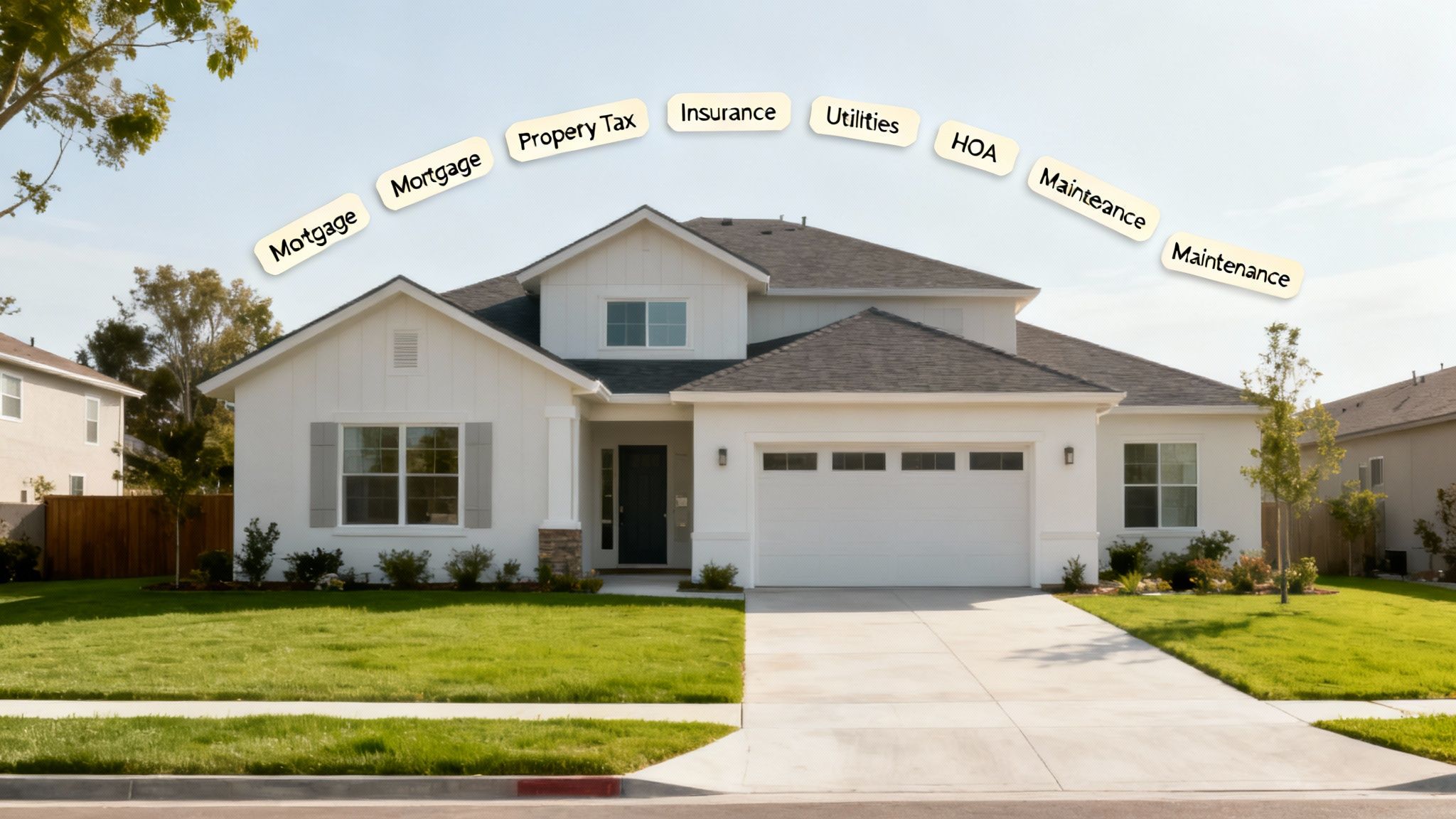
So, you get the big picture of what holding costs are. Now, let’s unpack the specific expenses that add up to this critical number. Think of these as individual ingredients in a recipe. Each one matters, and if you forget one, you can throw off your entire home-buying budget.
We'll break down every component you’re likely to encounter, using a typical single-family home as our example. Some of these are obvious, but others are the sneaky ones that are easy to forget until a bill shows up.
Core Financial Obligations
These are the big-ticket items, the ones most people think of first. They're predictable, they recur every month, and they usually make up the biggest slice of your holding cost pie.
- Mortgage or Loan Payments: If you financed the property, this is your largest and most consistent holding cost. It includes both principal (what you pay down on the loan) and interest (the lender's fee for borrowing their money).
- Property Taxes: Local governments charge these to fund schools, roads, and public services. You might pay them annually or semi-annually, but you must break them down into a monthly figure for your calculations.
- Homeowner's Insurance: Lenders won’t give you a loan without it, and you shouldn’t own property without it either. This is a non-negotiable expense that covers you for disasters like fires or storms.
Essential Property Upkeep
Beyond the main financial commitments, you've got the day-to-day costs of just keeping the property functional and preventing it from falling apart. These can fluctuate, but you absolutely have to budget for them.
Utilities are a perfect example. Even if the house is empty, you need to keep the lights on and the water running for contractors, showings, and to prevent issues like frozen pipes in the winter.
Remember, even a vacant property requires basic utilities. Shutting everything off can lead to bigger problems like mold or burst pipes, which are far more expensive to fix than a minimal utility bill.
- Utilities: This bucket includes electricity, water, gas, sewer, and trash removal. It’s smart to budget a baseline amount every month, even if no one is living there.
- HOA Fees: If your property is in a community with a Homeowners Association, you'll have monthly or quarterly fees. These cover shared amenities and common area maintenance. Don't forget them.
- Routine Maintenance: This is everything from lawn care and snow removal to pest control. These small but consistent costs keep the property looking good and prevent it from falling into disrepair, protecting your investment.
The Hidden and Opportunity Costs
This last category is where new buyers can get tripped up. It includes expenses that are less obvious but can impact your finances if ignored. The biggest one here is opportunity cost.
Opportunity cost is the potential income you're giving up by tying your money up in this property instead of putting it somewhere else. For example, if you used $50,000 in cash for a down payment, what could that money have earned in a savings account or another investment during your holding period? It's a real cost, even if you never write a check for it.
For businesses that sell physical goods, effective inventory management strategies are critical for minimizing similar hidden costs. They have to account for storage, insurance, and the risk of products becoming obsolete—all concepts that are a lot like a home buyer's holding costs on a property. Acknowledging these invisible factors is what separates a savvy buyer from a hopeful one. It shows you understand the true price of time and money.
Alright, let's get down to business. We've covered what holding costs are, but knowing the theory is one thing—putting it into practice is what helps you budget effectively. This is where you move from concepts to cash flow, and while the math is straightforward, the devil is in the details.
The basic formula is simple: add up all your monthly expenses and multiply that number by how many months you plan to hold the property before moving in. This gives you a baseline forecast for your carrying costs. If you need a refresher on the essential calculations, our guide on the most important real estate math formulas is a great place to start.
Calculating Costs for a House Flip
For any fix-and-flip project, your holding period starts the day you close on the purchase and ends the day you close on the sale. A rookie mistake is being too optimistic about this timeline. Always—and I mean always—build in a buffer for the inevitable delays with contractors, city permits, or even just finding the right buyer.
Let's walk through a real-world example for a property you expect to flip in four months.
This table breaks down how quickly those seemingly small monthly expenses can stack up over the course of a typical renovation project.
Sample Holding Cost Calculation for a 4-Month House Flip
| Expense Item | Estimated Monthly Cost | Total Cost Over 4 Months |
|---|---|---|
| Mortgage (Interest-Only Loan) | $1,200 | $4,800 |
| Property Taxes ($3,600/year) | $300 | $1,200 |
| Insurance ($1,200/year) | $100 | $400 |
| Utilities (Basic Service) | $150 | $600 |
| Lawn Maintenance | $100 | $400 |
| Total | $1,850 | $7,400 |
In this scenario, you need to budget $7,400just to carry the property through the renovation and sale. That’s cash coming directly out of your bottom line before you’ve even accounted for repairs or closing costs. Every dollar and every day counts.
Calculating Costs for a Rental Property
When it comes to rentals, holding costs are all about vacancy. You'll calculate these expenses for the time the property sits empty—whether that's before you land your first tenant or during turnover between tenants. This is crucial for understanding your breakeven point and ensuring you have enough cash reserves to weather a few quiet months.
Since the vacancy period can be unpredictable, the focus here is on the monthly cost. Knowing that number helps you prepare for the worst-case scenario.
The pain of holding costs isn't unique to real estate, either. A 2023 global survey revealed that companies with high inventory holding costs—over 30% of their inventory's value—saw their gross margins shrink by a painful 5% to 10%. You can dive deeper into these economic impacts by reading the full report from the IMF. It’s a powerful reminder of just how critical it is to minimize your holding period, no matter the industry.
Your Holding Cost Worksheet
Don't guess—calculate. Use this simple table to plug in your own numbers and get a clear picture of your project's expenses. Being precise is what protects your profits and turns a good deal into a great one.
| Expense Item | Estimated Monthly Cost | Total Cost Over [X] Months |
|---|---|---|
| Mortgage Payment | $______ | $______ |
| Property Taxes | $______ | $______ |
| Insurance | $______ | $______ |
| Utilities | $______ | $______ |
| HOA Fees | $______ | $______ |
| Maintenance | $______ | $______ |
| Total | $______ | $______ |
In real estate, the old saying "time is money" isn't just a cliché—it's a fundamental truth. Every single day a property sits empty, whether it's during a renovation or waiting for a buyer, it's actively draining your bank account. Delays aren't just inconvenient; they're direct hits to your budget.
Think about it. An unexpected snag—a contractor going MIA or a city permit getting stuck in bureaucratic limbo—can quickly turn a smooth process into a financial headache. A seemingly small one-week setback means another week of mortgage payments, insurance premiums, taxes, and utility bills. These holding costs are the silent killers of a budget, ticking away relentlessly in the background.
The Snowball Effect of Delays
Picture your holding costs as a snowball rolling downhill. It starts small, but with each passing day, it picks up more financial weight and momentum. A one-month delay doesn't just add one month's worth of expenses; it can also push your project into a shifting market or expose you to rising interest rates, compounding the financial damage.
The most successful real estate investors obsess over their timelines just as much as their budgets. They understand that a project finished on time and slightly over budget is often more profitable than one finished under budget but two months late.
This isn't a new phenomenon. History shows a clear link between holding costs and broader economic trends. During the high-inflation nightmare of the 1970s, for instance, carrying costs could explode to over 40% of an asset's value annually thanks to sky-high interest rates. That kind of pressure made a slow-moving property a catastrophic financial burden.
Visualizing Your Budget Impact
The first step to controlling holding costs is understanding how to calculate them. It's not complicated, but it is critical. This simple flowchart breaks down the basic steps.
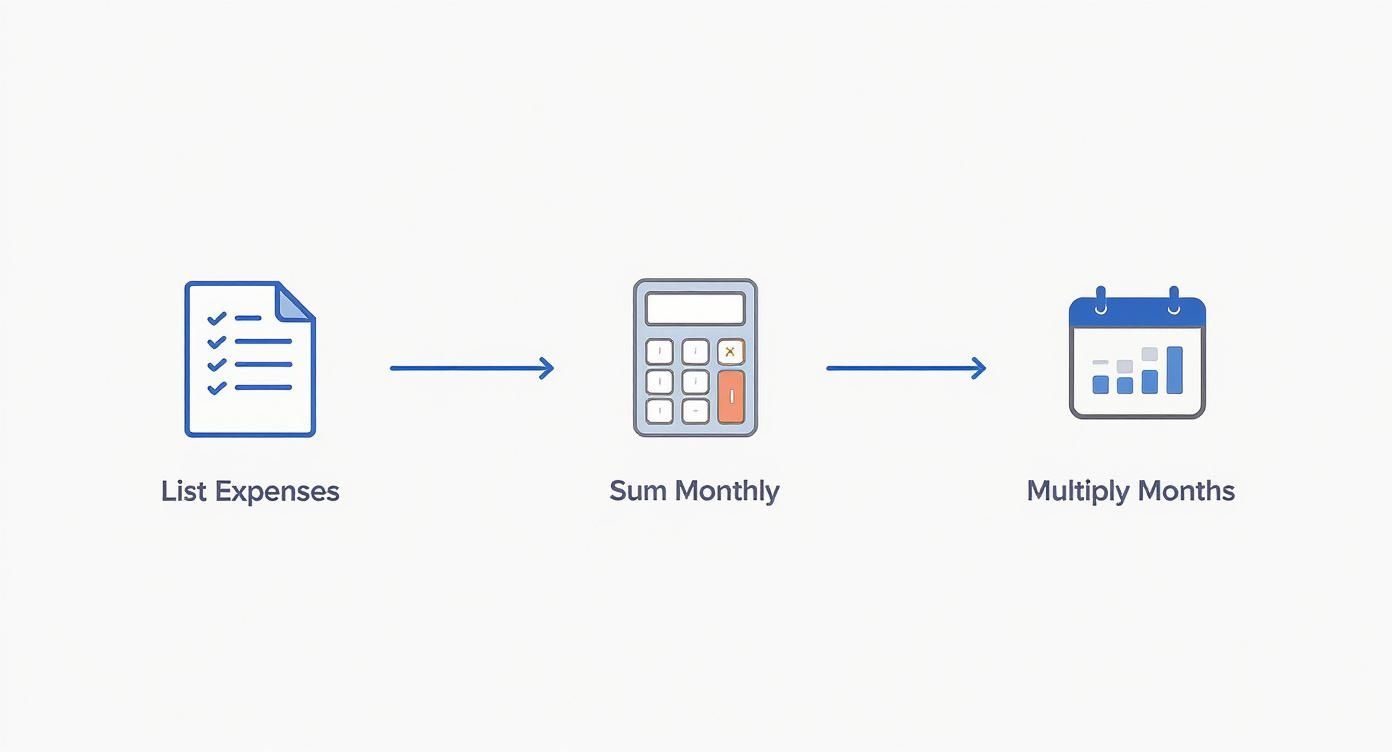
This visual drives home a crucial point: your total holding costs are a direct multiple of your project's timeline. The longer you hold the property before you can use it, the more it costs you. Period.
Let's put some real numbers to this. Imagine your projected monthly holding cost is $2,000. If your renovation gets delayed by just two months, that’s an extra $4,000 in expenses that comes directly out of your pocket. For a project with a renovation budget of $20,000, that delay just increased your total cost by 20%.
This unbreakable link between time and money is why proactive project management and brutally honest planning are your best defenses. An efficient timeline is just as vital as a detailed budget. To get a firm grip on your numbers from the start, using a specialized tool can make all the difference. Our fix-and-flip calculator is designed to help you accurately forecast these costs and see exactly how delays will impact your potential profit.
Smart Strategies to Lower Your Holding Costs
Knowing what holding costs are is one thing. Actively minimizing them is how you protect your budget and your sanity.
These costs are a silent drain on your finances, dripping away every single day you own an empty property. A proactive strategy isn't just a nice-to-have; it's absolutely essential. The good news? You have far more control over this than you might think.
By focusing on speed, efficiency, and smart planning, you can seriously reduce the financial bleed of carrying a property. Your goal is simple: shrink the timeline between buying the home and moving into it.
Let's dive into some practical, real-world tactics to get your holding costs under control.
Speed Up Your Renovation Timeline
Time is the single biggest ingredient in your holding cost recipe. The faster you finish the renovation, the faster you stop paying for a home you can't live in. A well-managed project is a budget-friendly one.
- Order Materials in Advance: Never wait for a contractor to show up before ordering windows, cabinets, or flooring. Supply chain delays are common, and having materials ready on-site prevents expensive dead time where you're paying for nothing.
- Create a Detailed Scope of Work: A crystal-clear, written plan for every part of the renovation eliminates confusion and keeps your crew moving forward. A solid plan is the foundation for a speedy project.
- Vet Your Contractors Thoroughly: Hire professionals with a proven track record of being on time and on budget. A cheap contractor who causes delays will cost you thousands more in holding costs than a reputable one with a higher upfront price. Don't be penny-wise and pound-foolish here.
Optimize Your Expenses and Marketing
Beyond the renovation itself, there are several other levers you can pull to lower your monthly burn rate and shorten the time it takes to get the property sold or rented.
Pro Tip: Don't wait until the renovation is 100% complete before you start marketing a property for sale or rent. You can list it as "coming soon" or begin showing it to potential buyers or tenants while the final touches are being completed. This can shave weeks off your timeline.
One of the most powerful ways to cut ongoing costs is to minimize how long a rental sits empty. This is where aggressive marketing comes into play. Focusing on strategies like marketing rental properties effectively to fill vacancies fast can drastically cut down on lost income.
Finally, make a habit of reviewing your recurring bills.
- Shop for Insurance Annually: Rates change, and loyalty doesn't always pay. Get quotes from multiple providers every year to ensure you’re not overpaying for your builder’s risk or homeowner's policy.
- Negotiate with Lenders: If you have a good relationship with your lender, ask if there's any flexibility on terms, especially for short-term financing. It never hurts to ask.
- Pay Property Taxes Early: Some municipalities offer a small discount for paying your property taxes before the deadline. It's a small win, but every single dollar you save goes straight to your bottom line.
Frequently Asked Questions for Home Buyers
What's the difference between holding costs and closing costs?
This is a great question that often confuses new buyers. Closing costs are the one-time fees you pay on the day you buy the house (e.g., attorney fees, title insurance, loan origination fees). You pay them once, and you're done. Holding costs are the recurring expenses that begin the day you become the owner and continue until you move in or sell, such as your mortgage, taxes, and insurance.
How can I budget for unexpected renovation delays?
It's wise to plan for the unexpected. A good rule of thumb is to add a "contingency" of 10-20% to both your renovation timeline and budget. For example, if you expect a renovation to take three months, budget your holding costs for at least four months. This buffer protects you from the financial stress of unforeseen issues with contractors, permits, or materials.
Do I pay holding costs on a brand new construction home?
Yes, but how you pay them can differ. If you get a construction loan and own the land while the house is being built, you will pay holding costs (interest on the loan, property taxes on the land, insurance) throughout the building process. If you buy from a large builder in a development, they typically cover these costs and bundle them into the final purchase price of the home, which you pay at closing. Always clarify this with your builder and lender.
Are holding costs the same as my monthly mortgage payment (PITI)?
They are very similar, but not always identical. Your PITI (Principal, Interest, Taxes, and Insurance) payment covers the core holding costs. However, holding costs also include other expenses like utilities (electricity, water), HOA fees, and basic maintenance (like lawn care) that are not part of your mortgage payment. To get a true picture of your monthly holding costs, you need to add these extra expenses to your PITI.
Stop letting hidden costs eat into your profits. With Flip Smart, you can analyze any deal in seconds and get a crystal-clear breakdown of holding costs, renovation estimates, and potential profit. Make your next investment your best one. Analyze your first deal for free at flipsmrt.com.