

So, you’re looking at a real estate deal and asking the big question: "What's a good return?"
Let's cut right to it. While the "perfect" number depends on your goals, most savvy investors in stable residential markets are looking for a total annual return between 8% and 12%. This isn't just one number; it’s a combination of the cash you collect from rent (cash flow) and how much the property's value grows over the year (appreciation).
Think of it as the property's total annual scorecard. This guide will walk you through what that number means, how to calculate it, and what to expect from different types of properties.
Setting the Benchmark for Real Estate Returns

Before you put your hard-earned money into a property, you need a yardstick to measure its potential. A good ROI isn't just a number—it’s a measure of how effectively that property is working for you compared to other options. The widely accepted benchmark of an 8% to 12% annual return is the starting line for most serious deal analysis.
Why that specific range? It’s attractive because it generally beats safer, more passive investments. For instance, a high-yield savings account might give you 4-5%, which often just keeps your head above water with inflation. The stock market, using the S&P 500 as a proxy, has historically averaged around 10% a year, but it comes with a stomach-churning amount of volatility.
Real estate aims for that sweet spot in between—offering solid growth potential without the day-to-day whiplash of the stock market. This is what makes it such a powerful tool for building long-term, tangible wealth.
Why This Range Is the Standard
That 8% to 12% figure isn't just pulled out of thin air. It’s rooted in the two powerful ways a real estate asset makes you money. Unlike a stock that you just hope goes up in value, a property can generate returns from two distinct sources:
- Income Returns: This is your cash flow—the rent you collect after paying all the bills (including the mortgage). It's the steady, predictable heartbeat of your investment.
- Capital Appreciation: This is the long game. It's the increase in the property's market value over time, which quietly builds your net worth in the background.
Quick Takeaway: A "good" ROI is one that properly rewards you for the risk and effort of owning property while hitting your personal financial targets. For most investors, that 8-12% range strikes the perfect balance.
To give you a quick reference, here’s how ROI expectations typically break down by strategy.
Quick Guide to Real Estate ROI Benchmarks
This table provides a quick overview of typical ROI expectations for different real estate investment strategies, helping you quickly find the information relevant to your goals.
| Investment Strategy | Typical Annual ROI Range | Primary Return Source |
|---|---|---|
| Fix & Flip | 15-25%+ (per project) | Short-term appreciation |
| Buy-and-Hold (Rental) | 8-12% (annual) | Cash flow & appreciation |
| Commercial Property | 6-10% (annual) | Stable cash flow from leases |
| BRRRR Method | 12-20%+ (annual) | Refinance equity & cash flow |
These benchmarks help set realistic expectations as you explore different ways to invest.
Putting It Into a Global Context
This benchmark isn't just a local rule of thumb; it holds up in many stable markets worldwide. For example, in places like the United States and much of Europe, a total annual return between 8% and 12% is considered a solid performance.
To see this in action, the MSCI Monthly Index reported an 8.1% total return for UK real estate over the 12 months ending February 2025. That return was primarily driven by income from strong rental growth. For a deeper dive, you can explore the full real estate market outlook.
Ultimately, understanding what makes a good ROI starts with this foundational benchmark. It gives you a clear target to aim for when you analyze deals and helps you quickly filter out the duds that won't get you closer to your goals.
Three Key Ways to Measure Real estate Returns
A single ROI number doesn't tell you the whole story. To really get a feel for a property's health, savvy investors look at a few key metrics, each offering a different angle on performance. Think of it like buying a car: you wouldn't just look at the top speed. You'd also check its gas mileage and safety rating.
To get the full financial picture, you need to look beyond one percentage. We'll break down the three most important numbers in plain English, using a simple duplex example to show how they all work together.
The Cap Rate: Gauging Raw Income Potential
First up is the Capitalization Rate, or Cap Rate. This is your quickest gut check on a property's raw, unleveraged income potential.
Imagine you're buying the property with all cash—no mortgage involved. The cap rate tells you what your annual return would be in that perfect, debt-free world. You calculate it by dividing the property's Net Operating Income (NOI) by its purchase price. A higher cap rate often signals a higher potential return, but it can also mean higher risk. It's the best tool for an apples-to-apples comparison between different deals before financing even enters the conversation.
What is Net Operating Income (NOI)?
NOI is your property's total income (like rent) minus all its operating expenses (like taxes, insurance, and maintenance). Critically, it does not include your mortgage payment.
The Cash-on-Cash Return: Your Actual Pocketed Profit
Next, we have the Cash-on-Cash Return. This metric is a personal favorite for many investors because it shows the actual return on the real money you pulled out of your own pocket.
Unlike cap rate, this calculation absolutely considers your financing. It measures your annual pre-tax cash flow against the total cash you invested to get the deal done—your down payment, closing costs, and any initial repair money. Because it factors in leverage (your mortgage), it gives you a crystal-clear picture of how hard your invested cash is actually working for you.
Here’s why it’s so crucial: two properties could have the exact same cap rate, but different financing terms could make one a vastly better cash-on-cash investment.
Let's put these two metrics into action with a simple deal.
- Example: A Duplex Deal
- Purchase Price:$400,000
- Down Payment (25%):$100,000
- Closing Costs & Repairs:$10,000
- Total Cash Invested:$110,000
- Annual Gross Rent:$36,000
- Annual Operating Expenses:$12,000
- Annual Mortgage Payments:$18,000
With these numbers, we can run our first two calculations:
- Net Operating Income (NOI): $36,000 (Rent) - $12,000 (Expenses) = $24,000
- Cap Rate: $24,000 (NOI) / $400,000 (Price) = 6.0%
- Pre-Tax Cash Flow: $24,000 (NOI) - $18,000 (Mortgage) = $6,000
- Cash-on-Cash Return: $6,000 (Cash Flow) / $110,000 (Cash Invested) = 5.45%
The Total ROI: The Big Picture View
Finally, there’s Total ROI. This is the all-in-one metric that captures the complete financial performance of your investment over a year. It combines your cash flow with two other powerful wealth-building engines: property appreciation and the equity you build by paying down your loan.
Total ROI shows you how your net worth grew from owning the property, not just the cash that landed in your bank account. To dig deeper into the calculations, check out our guide on the essential real estate math formulas every investor needs to know.
Let's finish our duplex example by adding in appreciation and equity:
- Annual Appreciation (est. 4%): $400,000 x 0.04 = $16,000
- Annual Principal Paydown (Loan Equity): Let's assume it's $4,000 in the first year.
Now, we can find the total annual gain:
- Total Gain: $6,000 (Cash Flow) + $16,000 (Appreciation) + $4,000 (Equity) = $26,000
- Total ROI: $26,000 (Total Gain) / $110,000 (Cash Invested) = 23.6%
See how the Total ROI paints a much more impressive picture? Beyond these core metrics, other financial measures can add even more color. For instance, you can learn how to calculate rental yield for your investment property to get another angle on its performance. By using all three of these core metrics—Cap Rate, Cash-on-Cash, and Total ROI—you can analyze any deal with confidence and make smarter investment decisions.
ROI Benchmarks: What to Expect from Different Investment Strategies
A "good" ROI isn't a one-size-fits-all number. What looks amazing for a slow-and-steady rental property would be a disaster for a high-risk fix-and-flip. Your strategy, timeline, and how much risk you're willing to take completely change the game.
To set yourself up for success, you need to know the typical ROI benchmarks for your chosen path. Let's break down what a realistic return looks like for the most common real estate plays.
The High-Stakes World of Fix-and-Flips
Think of fix-and-flip investing as the sprint of the real estate world. The entire model is built on speed: get in, renovate, and get out, usually in under a year. This strategy is hands-on and requires serious cash for the purchase and renovation, so the potential rewards have to be much higher to justify the risk.
Experienced flippers aim for a per-project ROI of 15-20% or more. Anything less, and the deal might not be worth the headache. That high percentage is crucial to cover holding costs (like taxes and insurance), the renovation budget itself, and the closing costs you pay when you buy and when you sell.
This visual breaks down the essential metrics you'll use to compare these different strategies.
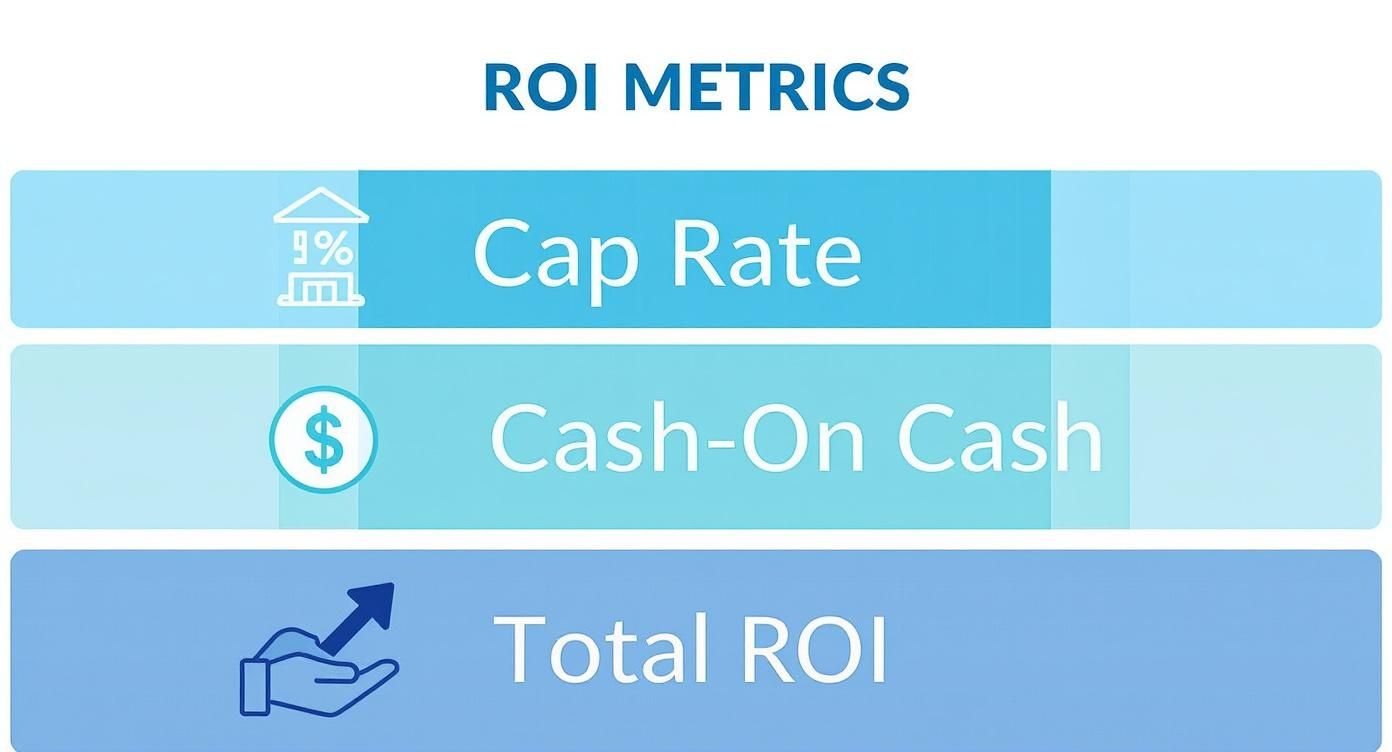
Whether it's a quick flip or a long-term rental, these metrics give you different angles to see if a deal truly makes sense.
The Steady Wealth-Builder: Buy-and-Hold Rentals
If flipping is a sprint, buy-and-hold investing is the marathon. This strategy is all about building long-term wealth through steady cash flow and the magic of property appreciation over time. It’s generally less stressful and hands-on than flipping, with risks spread out over many years.
For a traditional long-term rental, a healthy annual Total ROI is typically in the 8-12% range. This return isn't just one number; it's a powerful combination of:
- Cash Flow: The money left in your pocket each month after the mortgage and all expenses are paid.
- Appreciation: The property’s value climbing year after year.
- Equity Buildup: Your tenant is essentially paying down your mortgage for you, increasing your ownership stake.
This is a patient person's game. You're not looking for a single huge payday but rather building a reliable income machine that grows your net worth while you sleep. To see how this fits into a broader plan, check out our complete guide on real estate investment strategies.
Stability and Scale with Commercial Properties
Commercial real estate—think office buildings, retail strips, or warehouses—is a different beast entirely. These deals are bigger, often requiring more capital and complex management. The trade-off? Stability. With lease terms often lasting 3-10 years, you get a highly predictable income stream.
Because of this stability, commercial investors usually accept a more conservative annual ROI, often targeting the 6-10% range. This is a far cry from a flipper's target, but it comes with significantly less volatility. Certain high-demand sectors, like data centers, have seen returns climb as high as 11.2%, but the 6-10% corridor is a reliable benchmark for most commercial assets.
The Takeaway: Your strategy sets the target. High-risk, short-term flips demand high returns (15%+). Stable, long-term rentals and commercial properties focus on consistent growth in the 6-12% range.
It can also be helpful to see how these numbers stack up against other asset classes. This analysis on Airbnb Rentals vs. Stock Market: Better Returns? provides some excellent context. In the end, the "best" strategy is the one that perfectly aligns your money with your goals and your comfort level with risk.
Key Factors That Influence Your Real Estate ROI
Hitting a great ROI isn't just about finding the "right" property. It’s about understanding all the moving parts that can either supercharge or sabotage your returns. Think of your target ROI as a destination you plug into your GPS. A handful of critical factors—like traffic, road conditions, and how much gas is in the tank—will ultimately decide how quickly and safely you get there.
In real estate, those factors are the market you're in, how you structure your financing, and your personal game plan. Getting a handle on them is often what separates a smooth, profitable investment from a stressful money pit. This is your field guide to the five big ones you absolutely need to master.

Local Market Conditions
Remember the golden rule: all real estate is local. You could find the most beautifully renovated house in the world, but if it’s in a town where jobs are leaving and people are moving away, your returns are going to struggle. The property's performance is chained directly to the economic health of its neighborhood.
Here are the vital signs you need to be watching:
- Job Growth: A booming job market is like a magnet for new residents. More people means more demand for housing, which naturally pushes up both rent and property values.
- Population Trends: Simple question: is the area growing or shrinking? A rising population is one of the most powerful tailwinds for any real estate investment.
- Housing Supply: Is there a housing shortage or a construction boom? When there are more buyers and renters than available homes, prices have nowhere to go but up. On the flip side, overbuilding can flood the market and put a cap on your ROI.
Before you even think about making an offer, become an expert on the local scene. Hitting a 10% ROI in a hot market like Austin is a completely different ballgame than trying to squeeze out a 6% ROI in a Rust Belt town with a shaky economy.
The Power of Leverage
In the simplest terms, leverage means using other people's money—usually a bank's mortgage—to buy an asset. It's one of the most potent tools in an investor's toolbox, capable of magnifying your returns like nothing else.
When you finance a deal, you might only put down 20% of the purchase price, but you control 100% of the asset. You get all the benefits from the rental income and every penny of appreciation, which can send your cash-on-cash return through the roof.
But be warned: leverage is a double-edged sword. While it juices your gains on the way up, it also amplifies your risk on the way down. If the property value drops or you have a few months of vacancy, that mortgage payment doesn't care. It’s still due. Using debt wisely is the key.
Investor Insight: Smart leverage can easily turn a decent 6% property-level return into a fantastic 15% (or higher) return on your actual cash invested. But being overleveraged can turn a small hiccup into a financial disaster.
Your Investment Time Horizon
How long do you plan on owning this thing? Your answer fundamentally changes what a "good" ROI even looks like, dictating your entire strategy and what you should expect.
- Short-Term (Fix & Flip): If your goal is to be in and out within a year, you need a much higher target ROI—think 15-20% or more. This is to compensate for the higher risks, hefty transaction costs (commissions, closing costs), and short-term capital gains taxes.
- Long-Term (Buy & Hold): If you're in it for 5+ years, you can comfortably aim for a lower annual ROI, maybe in the 8-12% range. Your returns will be a slow-and-steady blend of monthly cash flow, property appreciation, and your tenant paying down your mortgage. You let compound growth do the heavy lifting.
A longer time horizon also gives you resilience. A buy-and-hold investor can simply wait out a market downturn, while a flipper might be forced to sell at a loss to get their capital back.
Tax Benefits and Implications
Real estate offers some of the best tax breaks around, and they can have a massive impact on your actual, take-home ROI. The government essentially rewards you for providing housing, and it would be a mistake not to take advantage of it.
Here are a few of the biggest perks:
- Depreciation: This is the big one. You get to deduct a portion of your property's value from your taxable income every single year, creating a "phantom" expense that lowers your tax bill—even while the property is actually going up in value.
- Deductible Expenses: Nearly every cost associated with owning and managing the property is a write-off. This includes mortgage interest, property taxes, insurance, repairs, property management fees, and more.
- 1031 Exchange: This powerful tool lets you sell an investment property and defer paying any capital gains taxes, as long as you roll the proceeds into another "like-kind" investment property.
These benefits won't show up in a simple ROI formula, but they add very real dollars back into your pocket, making your true return much higher than it appears on paper.
Personal Risk Tolerance
At the end of the day, the best investment is one that lets you sleep at night. Your personal comfort with risk should be the ultimate filter for every decision you make. A high-stakes flipping strategy might dangle a potential 25% ROI, but if the thought of a market shift keeps you up at night, it's not the right move for you.
On the other hand, an ultra-safe investment in a blue-chip neighborhood might only yield a 5% ROI. For an investor nearing retirement who values capital preservation above all else, that might be perfect. But for a younger investor trying to build wealth aggressively, it would feel painfully slow.
Your success over the long haul depends on aligning your strategy with your own unique risk tolerance.
How to Calculate Your Real Estate ROI Step by Step
Alright, let's get our hands dirty and actually run the numbers. Calculating your ROI can feel a little intimidating at first, but it really just boils down to some simple arithmetic. We're going to walk through a real-world rental property example, step-by-step.
We’ll tackle this in three simple stages: figuring out what you actually spent, calculating your annual profit, and then plugging it all into the formulas we talked about.
Step 1: Tally Your Total Initial Investment
Before you can measure a return, you have to know exactly how much cash came out of your pocket. This is your Total Cash Invested, and trust me, it’s always more than just the down payment.
To get an honest calculation, you need to add up every single dollar you spent just to get the property rent-ready.
- Down Payment: This is the big one, usually 20-25% of the purchase price for an investment property.
- Closing Costs: These are all the fees required to actually close the deal. A good rule of thumb is to budget 2-5% of the purchase price for things like lender fees, title insurance, and appraisal costs.
- Initial Repairs & Renovations: Did you have to slap on a new coat of paint, replace the ancient carpet, or fix a leaky faucet before your first tenant could move in? Every one of those costs gets added here.
Let's put some numbers to this to make it real:
- Purchase Price: $300,000
- Down Payment (20%): $60,000
- Closing Costs (3%): $9,000
- Immediate Repairs: $6,000
- Total Cash Invested: $60,000 + $9,000 + $6,000 = $75,000
Step 2: Determine Your Annual Net Operating Income
Next up, we need to figure out your annual profit from the property before your mortgage is paid. This is your Net Operating Income (NOI), and it’s a vital metric for judging a property's raw performance.
You get this number by subtracting all your operating expenses from your total rental income. Don't gloss over this part—missing a single expense can make a terrible deal look fantastic on paper.
Checklist: Common Operating Expenses
- Property Taxes
- Homeowners Insurance
- Property Management Fees (typically 8-10% of rent)
- Utilities (if you're paying them, not the tenant)
- Vacancy Fund (set aside 5-10% of annual rent for empty months)
- Maintenance & Repairs Fund (budget another 5-10% for ongoing fixes)
- HOA Dues (if there are any)
Let's continue with our example:
- Monthly Rent: $2,500 (which is $30,000 annually)
- Annual Property Taxes: $4,000
- Annual Insurance: $1,200
- Vacancy (5%): $1,500
- Maintenance (5%): $1,500
- Total Annual Expenses: $4,000 + $1,200 + $1,500 + $1,500 = $8,200
- Net Operating Income (NOI): $30,000 - $8,200 = $21,800
Step 3: Calculate Your Key ROI Metrics
Now for the fun part. With your two most important numbers nailed down—$75,000 invested and $21,800 in NOI—we can finally calculate your returns.
First, let's find the Cash-on-Cash Return. This tells you the profit you're making on your actual invested dollars. To do this, we need to bring the mortgage back into the picture. Let's say your annual mortgage payment (principal and interest) is $16,800.
- Annual Cash Flow: $21,800 (NOI) - $16,800 (Mortgage) = $5,000
- Cash-on-Cash Return: ($5,000 / $75,000) = 6.7%
That 6.7% is the direct cash return you're getting each year on the money you put in. For many investors, a steady, predictable cash flow is the whole point. You can use a dedicated investment property ROI calculator to speed this up and make sure you don't make any costly math errors.
Focusing on income isn't just a beginner's strategy. Some of the most stable real estate sectors have historically delivered about 4% of their total return just from these kinds of annual income distributions. It's a testament to the power of cash flow. If you want to dive deeper, you can learn more about income-focused real estate strategies and see why they're so crucial for long-term success.
Frequently Asked Questions
What is the difference between ROI and cash flow?
Think of it like this: cash flow is the actual money left in your bank account each month after paying all the bills, including the mortgage. It's your immediate, take-home profit. Total ROI is the big-picture annual scorecard. It includes your cash flow plus "invisible" gains like the property's appreciation in value and the mortgage principal your tenants are paying down for you. You need both, but they measure different things.
Is a higher ROI always better?
Not necessarily. A sky-high ROI often comes with higher risk, more hands-on work, or less stability. A 20% ROI on a fix-and-flip might seem better than an 8% ROI on a rental, but the flip requires significant time, expertise, and exposure to market swings. A lower, stable ROI in a great neighborhood is often a smarter long-term investment than chasing a huge number in a volatile area. The "best" ROI fits your personal financial goals and risk tolerance.
How do I account for unexpected costs in my ROI calculations?
This is crucial. The best way to handle unexpected costs is to expect them. Smart investors build reserves into their budget from day one. A good rule of thumb is to set aside 5% of your annual rent for routine maintenance (like a leaky faucet) and another 5% for capital expenditures (the big stuff like a new roof or HVAC system). By budgeting for these "surprises," you turn them into predictable expenses and protect your profit.
Can I calculate ROI for a property I haven't bought yet?
Absolutely—in fact, you must. This is called "running the numbers" or performing a pro forma analysis, and it's the most important step before making an offer. You'll need to research and estimate all the key figures: market rent, property taxes, insurance costs, and a budget for vacancy and repairs. Plugging these estimates into the ROI formulas we discussed will give you a clear forecast of the property's potential performance and help you make a decision based on math, not emotion.
Ready to stop guessing and start analyzing deals with total confidence? Flip Smart runs all these ROI calculations for you in seconds, not hours. Get dead-on valuations, rehab estimates, and profit projections for any property so you can make smarter, faster decisions. Analyze your first deal for free at flipsmrt.com.