

Ever heard the saying, "The battle is won before it is fought"? That's contractor negotiation in a nutshell. Success isn't about hardball tactics or slick persuasion. It’s won in the quiet moments of preparation, long before you even ask for a bid.
When you're prepared, you signal competence and confidence. You get better, more accurate bids from reputable professionals. Most importantly, you gain the leverage needed to secure a fair price for quality work on your new home.
Step 1: Get Your Ducks in a Row Before Calling Contractors
Here’s a hard truth for homeowners: walking into a negotiation with a vague idea like "I want to renovate the kitchen" is an open invitation to get overcharged. You’re essentially asking the contractor to fill in the blanks, and they’ll often fill them with high-end assumptions and padded numbers.
A well-prepared homeowner, on the other hand, commands respect. This prep work isn't just about saving money; it's about setting crystal-clear expectations to prevent misunderstandings, scope creep, and budget blowouts before they start.
Define Your Scope of Work Like a Pro
First things first: you need to translate your vision into a detailed scope of work (SOW). This document is the foundation of your project and the only way to get bids you can actually compare side-by-side. The more specific you are, the less wiggle room there is for expensive surprises.
Don't just say "install new flooring."
Instead, your SOW should read something like this: "Install 3/4-inch solid oak hardwood flooring, XYZ brand, model #123, in a herringbone pattern across the 400 sq. ft. living room and hallway. Finish to include one coat of sealer and two coats of semi-gloss polyurethane."
A bulletproof SOW includes:
- Specific Materials: List everything. Brands, model numbers, colors, and SKUs for faucets, light fixtures, paint, tile—you name it.
- Drawings or Sketches: A simple floor plan, even hand-drawn, can eliminate massive confusion around layouts and dimensions, especially for kitchens and baths.
- Quality Expectations: Describe the level of finish you expect. Do you want perfectly smooth drywall? Are the caulk lines supposed to be invisible? Put it in writing.
This level of detail forces every contractor to bid on the exact same project. You’re no longer comparing apples to oranges; you’re comparing apples to apples.
Know Your Numbers: Budget and Walkaway Point
You can't negotiate effectively if you don't know what a fair price even looks like. Start by researching local costs for similar projects. Talk to neighbors, get quotes from material suppliers, and check out online cost estimators for a baseline. For a really detailed breakdown, our guide on how to estimate renovation costs can walk you through building a solid budget.
A budget isn't just about what you can afford to spend. It's about defining your negotiation boundaries. You absolutely must know your "walkaway" number—the price where the deal no longer makes financial sense for you.
Armed with a data-backed budget, you can instantly tell if a bid is reasonable or completely out of line. This knowledge fundamentally changes the power dynamic. You’re not just a homeowner with a wish list; you’re an informed client who understands the market.
Organize Your Project Documentation
Last step: pull everything together into a project binder or a digital folder. When you meet contractors, you should have it all ready to go: your SOW, inspiration photos, product spec sheets, and your private budget notes.
Presenting yourself as an organized, prepared client accomplishes two critical things:
- It tells contractors you’re serious and professional, which makes them want your business and encourages a sharper, more accurate bid.
- It lowers their perceived risk. A well-defined project is far less likely to spiral into a nightmare of change orders and disputes.
This prep work is your secret weapon. You’ll walk into every conversation from a position of strength, armed with facts and clarity, ready to secure a deal that protects your home and your wallet.
Step 2: How to Analyze Bids and Vet Potential Contractors
Getting a few bids back from contractors is the easy part. The real work—and where most homeowners make or break their project budget—is learning how to read between the lines. A savvy homeowner knows the final price on a quote is often the least important number. The true story is always hidden in the details.
This is your best defense against inflated prices and unqualified crews. You're not just collecting numbers; you're gathering intelligence to find a trustworthy partner who will protect your investment, not drain it.
Look Beyond the Final Price Tag
It’s tempting to toss out the highest and lowest bids and just focus on the one in the middle. Don't do it. This is one of the most common rookie mistakes.
An unusually low bid can scream desperation, inexperience, or worse—it might mean the contractor completely missed a huge part of your scope. That sets you up for a parade of expensive change orders down the road. On the flip side, a high bid isn't an automatic "no." It could reflect better materials, a more skilled crew, or a more comprehensive warranty.
Your job is to break each proposal down, line by line.
- Materials: Are the material costs reasonable, or are they heavily marked up? A quick online search for the specific items can give you a solid baseline.
- Labor: Does the labor estimate feel right for the work described? Some contractors may pad their hours, and it's your job to catch it.
- Allowances: Be extremely wary of vague "allowances" for things like tile, fixtures, or lighting. These are almost always underestimated, leaving you to foot the real bill later.
This is precisely why your detailed scope of work is non-negotiable. It forces every contractor to bid on the exact same items, making it painfully obvious when something doesn't line up.
The flowchart below shows how these foundational steps—a clear scope and budget—are the bedrock of the entire vetting process. Nail this, and the rest gets much easier.
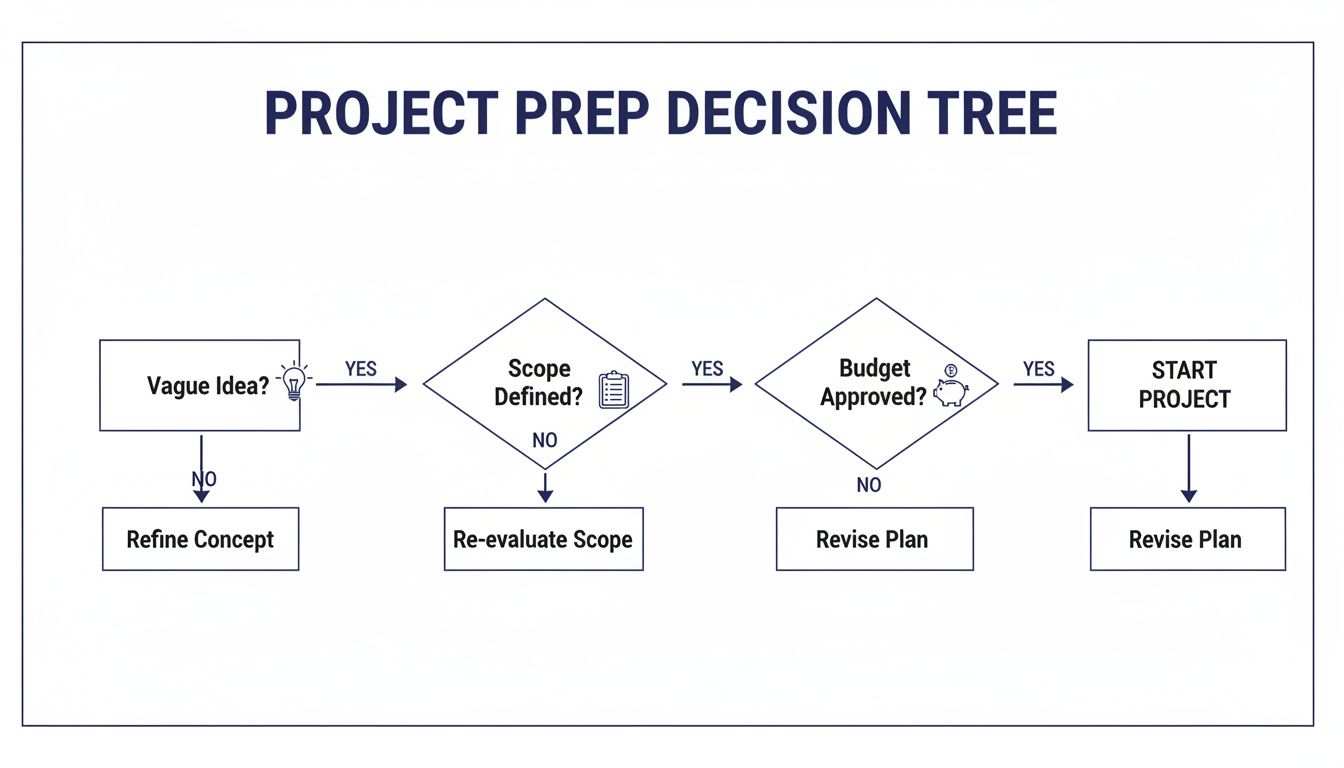
Without a clear scope and budget, you're not just negotiating—you're gambling.
To make this apples-to-apples comparison even easier, use a simple checklist to organize the information. It forces you to look at the complete picture for each contractor, not just the price.
Contractor Bid Comparison Checklist
| Evaluation Criteria | Contractor A | Contractor B | Contractor C |
|---|---|---|---|
| Total Bid Price | |||
| Material Cost Breakdown | |||
| Labor Cost Breakdown | |||
| Clarity on Allowances | |||
| Projected Timeline | |||
| Payment Schedule | |||
| Change Order Process | |||
| Warranty Details | |||
| License & Insurance Verified | |||
| Reference Check Score (1-5) |
By laying everything out side-by-side, you'll quickly spot red flags and identify the bid that offers the best value, not just the lowest price.
The Vetting Checklist Every Homeowner Needs
Once you've dissected the numbers, it's time to vet the people behind them. Remember, a cheap bid from an uninsured or unlicensed contractor isn't a bargain—it's a massive liability waiting to happen. Before you even think about negotiating, confirm these essentials:
- License and Insurance: Ask for their license number and copies of their general liability and workers' comp insurance certificates. Then, actually go online and verify them with your state's licensing board. Don't just take their word for it.
- Recent References: Don't just get a list of names—call them. Ask the tough questions: Did they communicate well? Was the quality what you expected? Did the project stay on time and, most importantly, on budget?
- Portfolio of Similar Work: You wouldn't hire a roofer to renovate your kitchen. Make sure they have a proven track record of successfully completing projects just like yours. Ask for photos and addresses.
Think of it this way: you're hiring a business partner for a high-stakes project. Due diligence isn't just a box to check; it's the single most important thing you can do to protect your home and guarantee a successful renovation.
The principles of choosing the right professional are universal, whether you're doing a full gut rehab or just a kitchen. For more on this, check out these expert tips on how to choose a kitchen remodeling contractor. It's all about doing your homework upfront.
Step 3: Proven Tactics for a Successful Negotiation
You’ve sorted through the bids, vetted the best candidates, and landed on your top choice. Now comes the part that makes or breaks your budget: the negotiation.
This isn't about being confrontational or trying to lowball a professional. The most effective negotiation is really a collaborative conversation. You're trying to find a fair price that keeps your contractor motivated while protecting your bottom line.

The trick is to approach it with mutual respect. You have a budget to stick to, and they have a business to run with real costs—overhead, insurance, and yes, a profit margin. The sweet spot is where you both feel like you've won.
Frame the Conversation as a Partnership
Kick things off by telling them how much you like their work and proposal. This sets a positive, non-adversarial tone from the jump. Instead of demanding a lower price, you're going to frame your requests as questions to find a solution together.
Try opening with something like this:
"We were really impressed with your proposal and your past work. We’re excited about the possibility of working together. Our budget is firm at [your target price], and we're just a little bit apart. Can we walk through the estimate together to see if there are any areas where we might be able to find some savings?"
This simple script changes the entire dynamic. You’re not fighting over their price; you're inviting them to problem-solve with you. It instantly shifts the vibe from a battle to a partnership.
Target Specific Line Items, Not the Total Price
A rookie mistake is asking for a random percentage off the total. It’s an amateur move that immediately signals you haven't done your homework.
A professional approach involves focusing your negotiation on specific, well-researched line items from their itemized bid. This shows you’ve actually read their proposal and have concrete points to discuss.
Here are a few examples you can adapt:
- On Material Costs:"I noticed the allowance for the quartz countertops is about 15% higher than quotes I received directly from a supplier. Is there any flexibility on that number, or would you be open to us sourcing the materials ourselves?"
- On Labor Estimates:"The labor estimate for the tile installation seems a bit high compared to the other bids we analyzed. Can you walk me through how you calculated those hours?"
- On Alternative Materials:"We're looking for ways to get closer to our budget. Would swapping the custom cabinetry for high-quality semi-custom units make a significant difference in the cost without sacrificing too much quality?"
Remember, every dollar saved on your renovation is a dollar back in your pocket. Using a robust tool to track these adjustments is essential. A good fix and flip calculator allows you to input these negotiated changes in real-time to see how they affect your budget.
Leverage Timing and Project Scope
Sometimes the biggest savings aren't in the line items but in the project's logistics. Good contractors are always thinking about their schedule and pipeline.
Think about pulling these strategic levers:
- Off-Season Scheduling: Ask if they offer a discount for scheduling the work during their slower months. For many, that's late fall or winter. A guaranteed job during a slow period is worth a lot.
- Bundling Projects: If you have other small jobs on the horizon, bring them up. Offering a contractor more guaranteed work can often lead to a better rate on the project you're negotiating now.
- Payment Terms: Propose a slightly larger upfront deposit in exchange for a small discount on the total price. Cash flow is king for small businesses, and this can be an easy win-win.
This skill set goes beyond just your general contractor. To really sharpen your abilities, check out this guide on mastering contracting with suppliers. The core principles of clear communication and finding mutual benefit are universal. By focusing on specific, logical adjustments, you can successfully lower your project cost while building a strong, positive relationship with the contractor you need to get the job done right.
Step 4: Crafting a Contract That Fully Protects You
You’ve done the research, vetted the candidates, and hammered out the numbers. You've reached a deal. But let me be clear: you're not done until that agreement is in writing. A handshake deal in the renovation world is just an invitation for disaster. A detailed, legally sound contract is the single most important tool you have to protect your investment.
Think of the contract as the official playbook for your project. It’s not about mistrust—it’s about creating crystal-clear expectations for everyone involved. This document makes sure every promise and every dollar is defined and enforceable, which is absolutely critical in an industry where one small misunderstanding can snowball into a financial nightmare.

The stakes here are incredibly high. Don't believe me? Just look at the global construction industry. The average value of contractor disputes is staggering—a recent report pegged the global average around $42.8 million. While your project might not be that big, it’s a powerful reminder of why airtight contracts matter. You can see the latest stats on global construction dispute trends to understand why getting this right from the start is non-negotiable.
Setting Up a Milestone-Based Payment Schedule
One of the most powerful moves you can make is structuring the payment schedule correctly. Never, ever agree to pay a huge chunk upfront. A contractor asking for 50% or more before the work even starts is a massive red flag. It kills their incentive to perform on schedule and puts all the risk squarely on your shoulders.
The professional way to do this is with a milestone-based payment schedule. This approach ties every payment you make to specific, verifiable stages of completion.
Here’s a real-world example for a typical bathroom remodel:
- Payment 1 (10%): Paid upon signing the contract. This covers initial material deposits and gets the project on their schedule.
- Payment 2 (25%): Released only after demolition is done and the rough-in plumbing and electrical have passed city inspection.
- Payment 3 (30%): Paid after the new drywall is up, tile is laid, and the major fixtures like the tub and vanity are installed.
- Payment 4 (25%): Released after the final painting, light fixtures, faucets, and hardware are installed and the site is clean.
- Final Payment (10%): This is your final leverage. It's paid only after you've done a final walkthrough, every single item on your punch list is fixed, and you've officially signed off on the job.
This structure keeps you in the driver's seat. You only pay for work that's been completed to your satisfaction, which is the best way to ensure quality and keep the project moving.
The Non-Negotiable Change Order Process
Scope creep is the silent killer of renovation budgets. It starts with a simple "while you're at it..." and before you know it, you're looking at a final invoice that's thousands of dollars over budget. Without a formal system, these small changes will bleed you dry.
Your contract must spell out a rigid change order process.
A change order is a written amendment to the original contract. It has to detail the new work, the exact cost (or credit), and any change to the project timeline. Most importantly, it must be signed by both you and the contractor before any of that extra work begins.
This formal process eliminates "he said, she said" arguments and surprise costs. When a contractor suggests an alteration or discovers an unexpected issue, your automatic response should be, "Sounds good. Can you write that up in a change order for me to approve?" It turns a casual chat into a documented business decision.
Essential Clauses to Protect Your Investment
Beyond payments and scope changes, a rock-solid contract needs a few more key protections. Don't even think about signing an agreement until you’ve confirmed these are included.
- Detailed Scope of Work: The SOW you built in the prep phase isn't just a planning tool. It should be attached as an exhibit and formally referenced in the contract itself.
- Workmanship Warranty: This clause holds the contractor responsible for the quality of their work for a set period, usually one year. If a tile comes loose or a pipe leaks due to bad installation, it's on them to fix it.
- Lien Waivers: This is critical. A lien waiver is a document signed by the contractor (and their subs and suppliers) stating they've been paid for a phase of work and waive their right to put a lien on your property. You should demand one with every single payment you make.
- Dispute Resolution: This clause outlines the process for handling disagreements. Specifying mediation or arbitration can save you from a long, expensive court battle if things go sideways.
Take the time to read through the contractor's standard agreement and insist on adding these clauses. This is a non-negotiable part of negotiating with contractors. It’s what transforms a piece of paper into a shield for your entire project.
You’ve navigated the negotiation, signed a solid contract, and are ready for the magic to happen. But here’s something every seasoned homeowner learns, often the hard way: the negotiation doesn't end when the contract is signed. It just changes form.
Now, it’s all about proactive project management. A successful renovation hinges on keeping the lines of communication wide open and making sure everyone sticks to the terms you fought hard to set. If you let things slide at this stage, you're practically inviting your budget and timeline to spiral out of control.
Set a Communication Rhythm
The single best way to stop small misunderstandings from blowing up into major conflicts is to lock in a communication routine from day one. Don't fall into the trap of relying on random texts or quick phone calls that nobody can find later.
Instead, schedule a non-negotiable weekly check-in. It doesn't have to be long—a 15-minute phone call, an on-site walkthrough, or even a detailed email exchange every Friday morning works perfectly. The format isn’t as important as the consistency.
During this weekly sync, you need to cover three simple things:
- Progress Check: What got done this week versus what was on the schedule?
- What’s Next: What’s the game plan for the upcoming week?
- Roadblocks: Any material delays, questions, or issues that need my attention?
This simple habit keeps you in the loop, shows your contractor you're engaged, and gives them a predictable time to bring up concerns before they turn into expensive problems.
Document Every Single Decision
Your contract is your foundation, but small decisions are always made on the fly during a project. A casual "hey, let's move that outlet a few inches to the left" is a classic example of something that gets forgotten or misremembered, sparking arguments weeks later.
The fix is easy: create one central place to track all changes and decisions. A shared Google Doc or even a simple running email thread with a subject like "Project Decisions: 123 Main St" is all you need.
After any important on-site chat or call, immediately send a quick follow-up email summarizing what you both agreed to. For instance: "Just confirming our talk from this morning—we're swapping the planned tile for Model #ABC at no extra cost. Let me know if that's not right."
This creates a paper trail that protects you and the contractor. It kills ambiguity and ensures verbal agreements are put in writing, leaving zero room for "he said, she said" debates down the road.
Sweat the Small Stuff—Immediately
It’s tempting to let minor slip-ups go, like a bit of sloppy paint in a closet or a tiny scratch on a new fixture, just to avoid rocking the boat. This is a huge mistake.
When you ignore the small problems, you're sending a signal that your quality standards are flexible. That can lead to much bigger shortcuts later on.
Address issues politely but firmly the moment you see them. A simple, non-confrontational approach is best: "Hey, I noticed a few paint drips on the trim in the master bedroom. Can we make sure that gets touched up before the final walkthrough?"
By handling these minor details early and consistently, you reinforce the quality standards you both agreed to in the contract. This proactive management style is what keeps the project you negotiated on track, on budget, and with a whole lot less stress.
This level of preparation and clear process management is becoming the industry standard. Investment in negotiation training is expected to be a $2.0 billion market by 2025, and AI-powered contract tools have been shown to shorten contract lifecycles by around 39%. You can learn more about the impact of modern negotiation tools and see just how much preparation pays off.
Frequently Asked Questions
Is it rude to negotiate with a contractor?
Not at all. In fact, professional contractors expect it as part of doing business. As long as you approach the conversation respectfully and with clear reasons for your requests (backed by research and your detailed scope of work), it is seen as a standard business discussion, not an insult. The goal is to find a fair price that works for both you and the contractor.
What’s a reasonable amount to negotiate off a contractor's bid?
While there is no set percentage, a realistic target for negotiation is often between 5% and 15% off the initial bid. This depends on factors like the project's complexity, the contractor's current schedule, and how much margin was included in the original quote. Instead of asking for a flat percentage off, you’ll have more success by negotiating specific line items, such as material costs or labor hours for a particular task.
What should I do if a contractor's bid is much lower than all the others?
An unusually low bid is a major red flag, not a lucky break. It often indicates that the contractor missed a significant part of your scope (setting you up for expensive change orders), plans to use cheap materials or unskilled labor, is uninsured, or is financially unstable. Always ask for a detailed breakdown and question them directly about why their price is so much lower to protect yourself from future problems.
Should I tell a contractor my total budget upfront?
It's generally best to keep your absolute maximum budget to yourself during the initial bidding phase. Revealing your top number too early can remove your negotiating leverage, as bids may magically come in right at your maximum. A better strategy is to provide a realistic budget range you are comfortable with. This helps contractors know if the project is a good fit for them without giving away your final walk-away number.
Ready to stop guessing and start knowing your numbers? Flip Smart gives you the detailed rehab cost estimates and after-repair values you need to walk into any negotiation with total confidence. Analyze your next deal and build your budget like a seasoned pro by visiting https://flipsmrt.com.