

Think of a house flipping business plan as your professional roadmap. It’s the document that lays out your entire strategy—how you'll find, fund, renovate, and sell properties for a profit. This is what separates a serious, scalable business from a weekend hobby, defining your goals, budgets, timelines, and how you’ll handle risks. More importantly, it's the blueprint you'll need to get anyone to invest in your vision.
Why a Business Plan Is Your Most Valuable Flipping Tool
Jumping into house flipping without a plan is like trying to build a house without blueprints. It’s a guaranteed recipe for disaster. I get it—the thrill of finding a deal and starting demolition is exciting. But the most successful investors I know will tell you the real work starts long before you ever swing a hammer.
A well-crafted house flipping business plan is easily the most valuable tool in your arsenal. It provides the clarity and direction you need to navigate what can be a very competitive, and sometimes unforgiving, market.

This isn't just some formality you write once and forget about. It's a living, strategic guide that forces you to think through every critical part of your operation.
- Securing Financing: Let's be real—lenders and private investors don't fund vague ideas. They invest in a solid, documented strategy that proves you've analyzed the market and actually understand your numbers.
- Making Smart Decisions: When unexpected problems pop up (and trust me, they always do), your plan becomes your compass. It helps you make decisions based on your financial goals, not gut reactions or panic.
- Enabling Scalability: A repeatable process, laid out in your plan, is how you move from one successful flip to the next with real efficiency. This is how you build a real business, not just complete a one-off project.
- Defining Your Focus: The plan forces you to create your "buy box"—a clear set of criteria for the properties you'll target. This alone will stop you from wasting countless hours chasing deals that don't fit your model.
From Gamble to Calculated Investment
Imagine two new flippers. The first, Alex, finds a "great deal" and dives in headfirst, estimating costs as he goes and just hoping for the best.
The second flipper, Taylor, spends a week creating a business plan first. Taylor's plan identifies a target neighborhood, establishes a maximum purchase price based on solid local comps, and includes a detailed rehab budget with a 15% contingency fund built right in. It even outlines a marketing strategy for the final sale.
While Alex is scrambling to deal with surprise plumbing issues that blow his budget and a property that sits on the market for months, Taylor's planned contingency fund easily covers an unexpected electrical problem. Because Taylor's plan was built on a thorough market analysis, the house sells quickly and right at the projected price.
A business plan transforms flipping from a high-stakes gamble into a calculated investment. It’s the professional framework that separates seasoned investors from hopeful amateurs by ensuring every action is intentional and every dollar is accounted for.
Ultimately, this document is your #1 risk management tool. It prepares you for market shifts, helps you manage budget overruns, and forces you to create backup plans, like turning a property into a rental if it doesn’t sell as quickly as you'd hoped. It’s proof—to yourself and your partners—that you're a serious investor who understands both the massive opportunities and the very real risks of this business.
Quick Takeaway: Key Elements of a House Flipping Business Plan
| Component | Purpose | Key Question It Answers |
|---|---|---|
| Executive Summary | A high-level overview of your entire business. | What is your mission and what makes your business viable? |
| Market Analysis | In-depth research of your target geographic area. | Where will you invest and why is that market profitable? |
| Acquisition Criteria | Your specific "buy box" for target properties. | What kind of properties will you buy? |
| Financial Projections | The numbers: ARV, rehab costs, profit, and ROI. | How will you make money and what are the projected returns? |
| Funding Strategy | Your plan for financing acquisitions and renovations. | Where will the money come from? |
| Operational Plan | Your day-to-day workflows for finding and managing projects. | How will you execute flips from start to finish? |
| Marketing & Sales | Your strategy for selling the renovated property quickly. | How will you attract buyers and close the sale? |
| Risk Mitigation | Your contingency plans for common flipping problems. | What could go wrong and how will you handle it? |
Finding Profitable Deals Through Smart Market Analysis
Your success in house flipping boils down to one thing: buying the right property, in the right place, at the right price. A rock-solid market analysis in your house flipping business plan is what separates the pros from the gamblers. It's your intelligence-gathering mission, showing you where the gold is buried and which properties are financial landmines.
This isn't about scrolling through Zillow for a few minutes. Real market analysis means digging into the data that tells you where a neighborhood is headed, not just where it's been. You become the local expert, spotting opportunities before they hit the mainstream radar.
Moving Beyond Basic Statistics
Anyone can look up a median home price. Your edge comes from understanding the story behind the numbers. A few key metrics will give you a much clearer picture of a market's health and trajectory.
- Average Days on Market (DOM): A low and falling DOM is a fantastic sign. It means well-priced, renovated homes are flying off the shelves. If the average DOM is under 30 days, you can feel pretty confident about a quick sale. But if you see DOM creeping up, that’s a red flag for a cooling market—time to adjust your profit projections and holding cost estimates.
- Sale-to-List Price Ratio: This tells you how much bargaining power buyers have. A ratio at or even above 100% screams strong demand, maybe even bidding wars. On the other hand, if properties are consistently selling for 95% of their list price, you know there's likely some wiggle room when you're the one buying.
- Inventory Levels: Think of this as "months of supply." It tells you how long it would take to sell every home currently listed. A balanced market sits around 4-6 months. Anything less is a seller's market—harder to find deals, but much easier to sell your finished product.
Identifying Tomorrow's Hotspots Today
The real money is made by getting into neighborhoods just before they take off. Your business plan needs to show exactly how you'll find these up-and-coming areas. You're looking for the leading indicators of growth that signal property values are about to climb.
A deep understanding of your target market's dynamics is your greatest competitive advantage. It allows you to make data-driven offers with confidence, knowing you’re buying into an area with proven demand and future growth potential.
Keep a close eye on city planning websites and local news. You're looking for announcements about things like:
- New Infrastructure Projects: Think new light rail stations, highway expansions, or even a fancy new park. These things can completely change a neighborhood's appeal.
- School District Improvements: Rising test scores or the construction of a new school is a huge magnet for families, which directly drives up demand for quality housing.
- Commercial and Job Growth: A big company moving to town or a revitalized downtown strip means more jobs and more residents—all of whom need a place to live.
Turning Data into Actionable Intelligence
All this research is useless if it doesn't guide your buying strategy. The end goal is to create a specific, data-backed "buy box"—your non-negotiable criteria for any property you even consider.
Your buy box should nail down your target zip codes, the exact type of property you're after (e.g., 3-bed, 2-bath single-family homes under 1,500 sq ft), and the formula you'll use to calculate your max offer.
This is where modern real estate platforms become indispensable. They let you filter properties and spot trends in minutes, a task that used to take days of manual work. A key part of this is running a detailed comparative market analysis to lock in your After-Repair Value (ARV). This involves looking at recent sales of similar, updated homes to get an accurate value for your flip.
When you define your target market with this kind of precision, you stop wasting time on deals that will never pencil out. Every property you pursue is already aligned with your business model, dramatically increasing your odds of success.
Building Your Financial Blueprint for Funding and Profit
This is the heart of your house flipping business plan. It's where you prove your strategy is more than just a good idea—it's a profitable one. A detailed financial blueprint doesn't just guide your own decisions; it's the key to unlocking funding from lenders and showing partners you've done your homework.
Flying blind with your numbers is the fastest way to lose your shirt in this business. A solid financial model has to account for every single dollar, from the purchase price to the final sale, giving you a clear path to profitability.
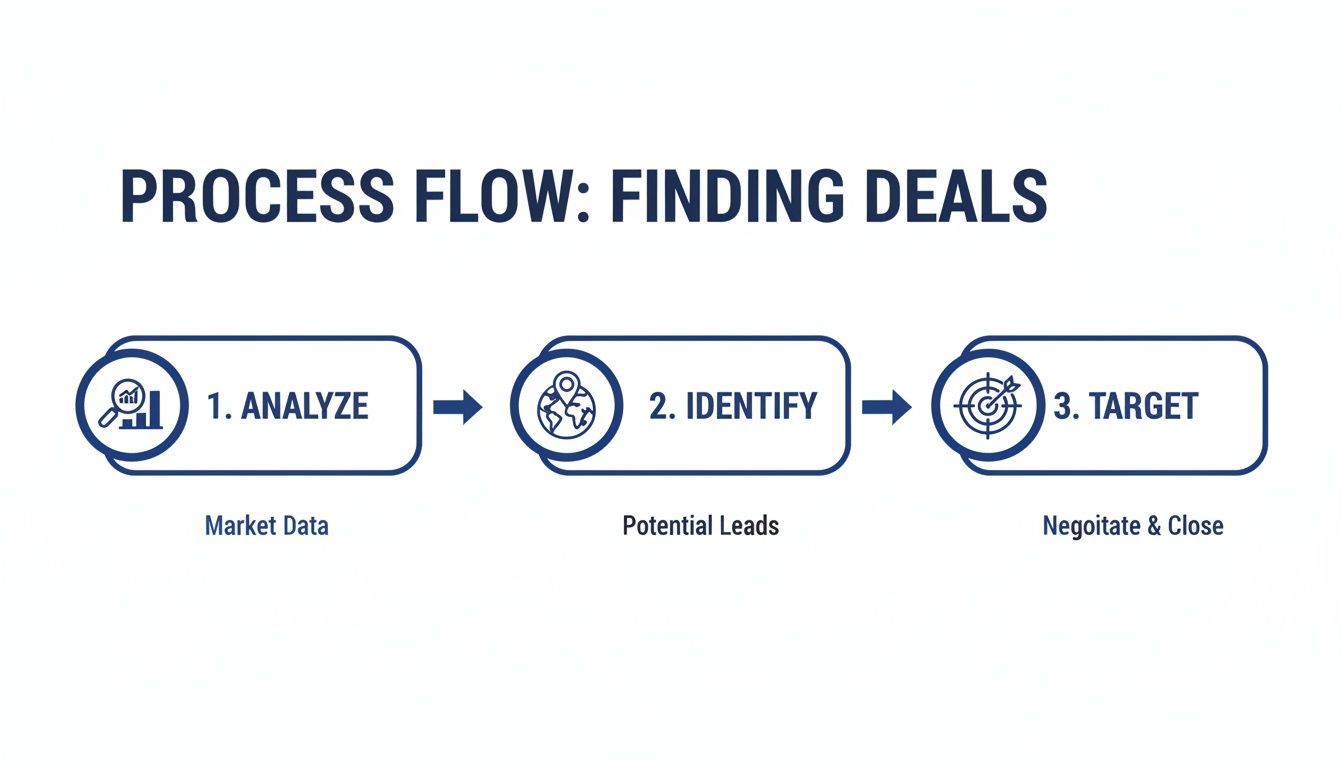
This keeps you from chasing bad deals by ensuring every potential property aligns with your financial criteria before you get emotionally invested.
Calculating Your Core Profitability Metrics
Before you even think about funding, you need to master the three core calculations that dictate a deal’s potential. These numbers are the bedrock of your entire financial projection.
- After-Repair Value (ARV): This is your best estimate of what the property will sell for once the work is done. You'll figure this out by digging into recent sales of similar, fully renovated homes (we call these "comps") right in that neighborhood. A precise ARV is non-negotiable—every other number depends on it.
- Renovation Costs: This is where new flippers get into trouble. A vague budget is a recipe for disaster. To make sure you actually make money, it's crucial to understand how to budget for your home renovation projects down to the last screw. You need an itemized list of every repair, from paint to a full kitchen gut, with real material and labor costs. Always, always add a 15-20% contingency fund for the surprises that are guaranteed to pop up.
- Net Profit Forecast: This is the simple math: ARV minus all your costs. That includes the purchase price, your full renovation budget, holding costs (loan payments, taxes, insurance), and all the fees for buying and selling. This final number tells you if the deal is even worth your time.
Projecting Your Full Financial Picture
A simple profit number isn't going to cut it for lenders. They need to see a comprehensive financial breakdown, often called a pro forma, that lays out every single expense you anticipate.
Your financial projection is the ultimate stress test for your deal. It forces you to account for every potential cost, from realtor commissions to surprise plumbing repairs, turning a hopeful guess into a data-backed forecast that can withstand scrutiny.
A sample projection might look something like this:
| Expense Category | Estimated Cost | Notes |
|---|---|---|
| Purchase Price | $250,000 | The agreed-upon sale price. |
| Renovation Budget | $50,000 | Includes a 15% contingency. |
| Holding Costs (6 mo.) | $12,000 | Loan payments, taxes, insurance. |
| Buying & Selling Costs | $30,000 | Agent commissions, closing fees. |
| Total Project Cost | $342,000 | Your total cash outlay and debt. |
| Projected ARV | $400,000 | Based on 3-5 strong comps. |
| Potential Net Profit | $58,000 | Your pre-tax profit. |
This level of detail shows that you understand the true cost of a flip, building instant credibility with anyone looking at your plan. In some markets, precise numbers are more critical than ever. For instance, in a tight market, a typical gross profit might only be $65,000, with a 25.1% return on investment before all expenses are factored in. This just goes to show why every dollar in your budget counts.
Choosing Your Funding Strategy
Once your projections are locked in, you can start talking to lenders. Your funding strategy is a critical piece of your business plan, since very few investors pay all cash for every deal.
Here are the most common routes:
- Hard Money Loans: These are the go-to for many flippers. They're short-term loans based on the property's potential (the ARV), not just your personal credit. They fund fast but come with higher interest rates and fees.
- Private Lenders: Think friends, family, or other investors in your network. The terms are completely negotiable, which offers amazing flexibility, but it requires a solid network and a huge amount of trust.
- Conventional Financing: Getting a traditional bank loan for a fixer-upper is tough, as banks get nervous about lending on distressed properties. If you can qualify, though, you’ll lock in the best interest rates.
Each option has its trade-offs, and the right one depends on the deal. For a deeper dive, check out our guide on how to finance a flip. Your business plan should clearly state which funding path you plan to take and explain why it’s the best fit for your project.
Building Your Acquisition and Renovation Machine
What separates the pros from the struggling amateurs? Efficiency. A truly profitable flipping business isn’t about landing one lucky deal; it's about building a repeatable system that finds and renovates properties like clockwork. This is the operational engine of your house flipping business plan, and getting it right will save you time, money, and a mountain of headaches.
The whole process kicks off with defining your "buy box." This is a hard-and-fast, non-negotiable list of criteria for any property you even think about buying. Emotional purchases are the fastest way to lose money in this game. By setting up your buy box ahead of time, you force yourself to analyze deals with logic, not your gut, and avoid getting suckered into a property that tanks your financial model.

This system is your best defense in a tough market where margins are getting squeezed. For example, if the median purchase price for flipped homes climbs to a record $259,700, but the median resale price is only $325,000, that leaves a slim gross profit. These stats prove you need a system for rapid, dead-on analysis to find the few deals that still have meat on the bone.
Nailing Down Your "Buy Box" Criteria
Think of your buy box as your deal filter. It should be specific enough to kick most properties to the curb immediately, letting you zero in on the ones with real potential. It’s your secret sauce for a successful flip.
Your criteria must include:
- Location: Don't just say "a good area." Pinpoint specific zip codes, neighborhoods, or even school districts where you have an unfair advantage because you know the market inside and out.
- Property Type: Are you the king of 3-bedroom, 2-bath single-family homes? Or are small condos your bread and butter? Get specific.
- Condition Level: Define the chaos you're willing to take on. Are you sticking to cosmetic jobs, or are you geared up for full gut renovations that would make others run for the hills?
- Financial Metrics: Set your limits. A maximum purchase price is a must, as is a minimum projected ROI. For instance, you might decide to only chase deals that promise at least a 20% return.
With these rules in place, you can use modern tools to sift through dozens of potential deals in the time it used to take to research one. That speed is your edge. It lets you fire off confident offers while your competition is still fumbling with spreadsheets.
Assembling Your Renovation Dream Team
Once you’ve got a property, the game shifts to the rehab phase. The quality of your contractors can single-handedly make or break your budget and timeline. Your business plan has to show exactly how you'll find, vet, and manage this critical part of your team.
Don't wait until you're under contract to start networking. Proactively build a bench of reliable pros. A great contractor is worth their weight in gold—they'll save you more than their fee just by avoiding costly mistakes and delays.
Your most powerful weapon in managing a renovation is a detailed Scope of Work (SOW). It kills ambiguity, stops budget creep in its tracks, and ensures you and your contractor are on the exact same page from day one.
Mastering the Scope of Work and Project Management
Before you even think about getting a quote, create an exhaustive Scope of Work (SOW). I'm talking about a document that lists every single task, from "replace all 6-panel interior doors with shaker style" to "install GFCI outlets in kitchen and bathrooms." This insane level of detail is non-negotiable for getting accurate, apples-to-apples bids from contractors. It also becomes your project bible.
To dodge those nasty financial surprises, you need a rock-solid grasp on repair costs. A great place to start is our detailed guide on how to estimate renovation costs. That knowledge, combined with an airtight SOW, is how you build a rehab budget that can actually withstand the pressures of a real-world project.
Finally, your plan must show how you'll keep the project on track. Are you using a simple spreadsheet or a project management app? How often are you doing site visits? A clear system for tracking progress is the only way to stay on schedule, keep holding costs down, and get your beautifully rehabbed property on the market ASAP.
Planning Your Exit Strategy for a Successful Sale
Let's be real: a stunning renovation doesn't automatically equal a profitable flip. The final, and arguably most critical, piece of your house flipping business plan is a rock-solid exit strategy. This isn't just about putting a "For Sale" sign in the yard; it's about a calculated plan to maximize your return through smart marketing, precise pricing, and having backup plans ready to go.
The moment that final coat of paint is dry, your job title changes. You switch from project manager to marketing guru, all focused on getting your beautifully rehabbed property in front of the right buyers, fast.
Crafting a Listing That Sells
In a crowded market, your online listing is your single most important sales pitch. A lazy, unprofessional listing can make even the most incredible renovation fall flat, costing you thousands in a lower sale price or, just as bad, months of extra holding costs.
Your business plan needs to budget for and detail these non-negotiables:
- Professional Photography: Don't even think about using your phone. Crisp, well-lit professional photos are proven to get more clicks, more showings, and higher offers. Budget $300-$500 for a pro shoot—it's an investment that pays for itself over and over.
- A Compelling Listing Description: Ditch the boring feature list. You need to sell the lifestyle. Instead of "new kitchen," you write, "Imagine hosting friends in this brand-new chef's kitchen, complete with quartz countertops and gleaming stainless steel appliances." You're selling a dream, not just drywall and granite.
- Strategic Staging: An empty house feels cold and sterile. Professional staging is a game-changer because it helps buyers mentally move in. They can visualize their own lives in the space, which often leads to a faster sale at a better price.
Pricing Your Property to Win
Setting the list price is a nerve-wracking tightrope walk. Price it too high, and you'll be listening to crickets while your holding costs bleed you dry. Price it too low, and you’re just giving away your hard-earned profit.
Your business plan has to outline a data-driven pricing strategy. And I'm not talking about the comps you pulled three months ago to calculate your ARV. The market moves fast. You need fresh comps—sales from the last 30-60 days for similar renovated homes right in that neighborhood. This ensures your price reflects today's market reality, positioning you to attract strong, competitive offers right away.
Why You Need Multiple Exit Strategies
So, what happens if the market suddenly shifts and your property isn’t selling? This is where the pros separate themselves from the amateurs. A serious house flipping business plan accounts for this risk with pre-defined backup options.
Your primary exit is the quick, profitable sale you planned for. Your secondary strategies are the safety nets that protect your capital when the market doesn't play nice. They're what turn a risky gamble into a resilient business.
Think about building these contingencies directly into your plan from day one:
- Pivot to a Rental: If the sales market hits a wall but the rental market is on fire, holding the property as a long-term rental can generate steady cash flow while you wait for values to appreciate. Your plan should already include a rental market analysis for this exact scenario.
- Offer Seller Financing: This can open up your property to a whole new pool of buyers who might not qualify for a traditional mortgage. You become the bank, collecting a down payment and monthly payments with interest—creating an income stream.
- Use a Lease-to-Own Option: This is a fantastic hybrid strategy. You secure a tenant who fully intends to buy the property later at a pre-agreed price. You collect rent, they get time to sort out their financing, and you get a committed future buyer.
At the end of the day, the core of this business is about maximizing the value you create. Truly understanding how to increase home value before selling with smart, market-aware renovations is the foundation. When you pair that high-quality reno with a multi-layered exit strategy, you build a business that can handle whatever the market throws at it.
Common Questions About Your House Flipping Business Plan
How much money do I really need to start flipping houses?
There isn't a single magic number, but a solid business plan shows you have enough capital to cover three critical areas: the down payment, the full renovation budget, and holding costs. For example, on a $250,000 house needing a $50,000 renovation, you might need a 20% down payment ($50,000) plus the $50,000 for repairs and at least $12,000 for 3-6 months of loan payments, taxes, and insurance. Your plan must show where this capital is coming from.
What is the 70% Rule and should I use it?
The 70% Rule is a guideline that says your maximum offer on a property should be 70% of its After-Repair Value (ARV) minus the estimated renovation costs. It’s a helpful starting point to quickly see if a deal has potential profit built in. For example, if a home's ARV is $400,000 and it needs $60,000 in repairs, the 70% rule suggests a maximum offer of $220,000 ($400,000 x 0.70 - $60,000). While useful, you may need to adjust this percentage up or down depending on how competitive your local market is.
How can I accurately estimate renovation costs for my plan?
Misjudging your renovation budget is one of the fastest ways to lose money. To get it right, start by creating a highly detailed Scope of Work (SOW) that lists every single task. Give this SOW to at least two trusted contractors for itemized bids. Most importantly, always add a contingency fund of 15-20% to your final budget to cover unexpected issues that will inevitably pop up.
What are the biggest risks in house flipping?
The three biggest risks are spending more than you budgeted on renovations, overestimating what the house will sell for (the ARV), and taking too long to sell the property. Your business plan should address these head-on. Include a mandatory 15-20% contingency fund for budget overruns, use conservative and recent sales data for your ARV, and have a backup exit strategy—like turning the property into a rental—if it doesn't sell within your planned timeframe.
Ready to stop guessing and start analyzing deals with data-driven confidence? Flip Smart is the tool that puts professional-grade property analysis at your fingertips. Get accurate ARV, rehab estimates, and profit projections in seconds, so you can make smarter offers and build your flipping business faster. Analyze your first deal for free at flipsmrt.com.