
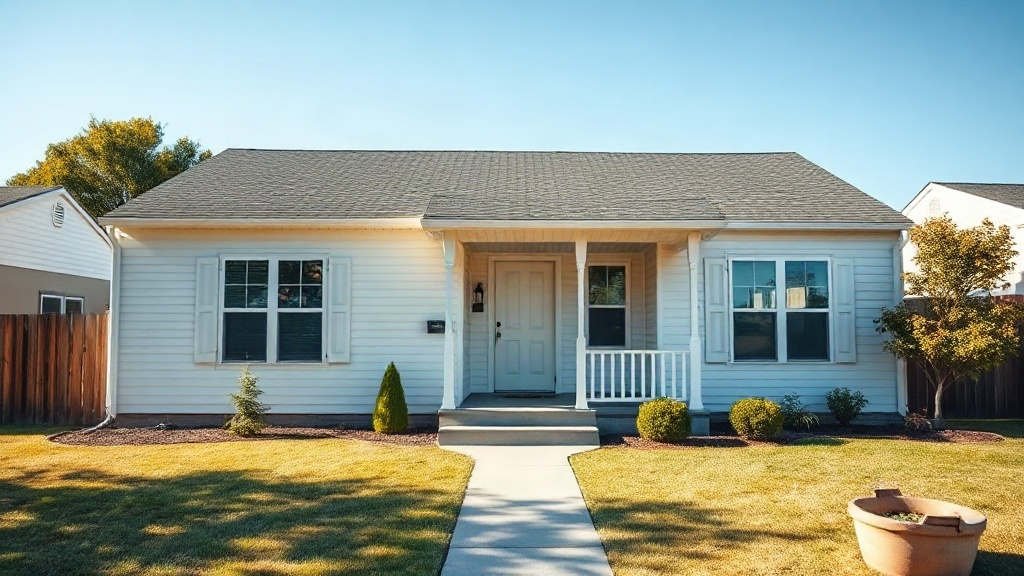
The 70% Rule: Your Blueprint for Evaluating Fix & Flip Deals
The 70% rule is the cornerstone of fix & flip deal analysis. It provides a simple, effective way to determine the maximum amount you should offer for a property, ensuring both profitability and a buffer against unexpected costs. The formula is straightforward: Maximum Allowable Offer (MAO) = (After Repair Value x 0.70) - Repair Costs. This calculation helps you set a ceiling on your offer while leaving room for profit.
Want to skip the spreadsheet? FlipSmrt pulls comps, estimates ARV and rehab, and runs the deal math from just an address. Try your first analysis free.
Here’s why the 70% rule works. The 70% factor accounts for all the costs beyond the purchase and repairs, like financing fees, closing costs, holding costs, and, most importantly, your target profit margin. It ensures that even after these expenses, you’re left with a worthwhile return. For example, if a property's ARV is $250,000 and the estimated repair costs are $50,000, the MAO would be: (250,000 x 0.70) - 50,000 = $125,000. Offering more than $125,000 would either eat into your profit or leave no margin for unexpected expenses.
By sticking to this rule, you significantly limit your risk. Fix & flip projects are notorious for hidden costs, from underestimated rehab budgets to market shifts during your holding period. The 70% rule builds in a financial cushion that can absorb these surprises without putting your entire investment at risk. It also helps you avoid overpaying—a common mistake among new investors eager to close their first deal.
Remember, the 70% rule is a guideline, not a universal law. In competitive markets, you might need to adjust your target to stay in the game, but going too far beyond 70% reduces your safety net. The key is to use this rule as a starting point and adapt based on your due diligence and local market conditions. For beginners, sticking strictly to 70% is often the safest course of action.
Ultimately, the 70% rule is about discipline. It keeps your emotions out of the equation and ensures every deal you pursue has the potential for a solid return. If the numbers don’t work, you walk away. Better to pass on a bad deal than gamble your capital on overly thin margins.
Worked Example: Calculating Maximum Allowable Offer (MAO)
The Maximum Allowable Offer (MAO) is a critical number in any fix & flip deal. It tells you the highest price you can offer on a property while still leaving room for your target profit. The formula is straightforward: MAO = (ARV x 0.70) - Repair Costs. Let’s break this down with real numbers.
Suppose you’re analyzing a property with an After Repair Value (ARV) of $300,000. This is the price the property is expected to sell for after renovations, based on comparable sales in the area. Next, you estimate the repair costs at $50,000. Using the 70% rule, you’ll multiply the ARV by 0.70 to account for 30% of the ARV being reserved for profit margin and holding costs. Here’s how the math looks:
- ARV: $300,000
- Repairs: $50,000
- MAO Calculation: ($300,000 x 0.70) - $50,000
- MAO: $210,000 - $50,000 = $160,000
This means your Maximum Allowable Offer is $160,000. Offering anything above this amount squeezes your profit potential or could even result in a loss. By sticking to this number, you ensure the deal remains viable even if unexpected costs arise or the market shifts slightly during your holding period.
When making an initial offer, aim lower than the MAO to leave room for negotiation. For instance, you might start at $140,000 or $150,000, knowing you can work your way up to $160,000 if necessary. This strategy gives you leverage while keeping the deal profitable. The MAO acts as a guardrail—stay disciplined, and you’ll protect your bottom line.
Estimating Profit: From Rehab Costs to Selling Price
Understanding how to estimate profit is critical for a successful fix and flip. A simple formula can guide you: Net Profit = Selling Price - (Purchase Price + Rehab Costs + Selling Costs). Let’s break this down with a real-world example. Say you’re considering a property with a purchase price of $150,000. The estimated After Repair Value (ARV) is $250,000, and FlipSmrt calculates the rehab costs at $50,000. Selling costs, including agent commissions, closing costs, and staging, are estimated to be 10% of the ARV, or $25,000.
Start by summing up your total investment. The purchase price is $150,000, rehab costs are $50,000, and selling costs are $25,000. That brings your total costs to $225,000. Now subtract that from the ARV of $250,000 to calculate the net profit:
- ARV: $250,000
- Total Costs (Purchase + Rehab + Selling): $225,000
- Net Profit: $250,000 - $225,000 = $25,000
In this case, the deal yields a $25,000 profit. That’s a solid return, but only if your estimates are accurate. This is why tools like FlipSmrt are invaluable—they help you estimate ARV, rehab costs, and even selling costs with precision. If you underestimated the rehab and it ends up costing $60,000 instead of $50,000, your profit would drop to $15,000. On the other hand, if the selling price comes in higher than $250,000, your profit grows.
The takeaway is clear: every dollar in rehab or selling costs eats into your profit, so accurate estimates are essential. Run the math before you commit to a deal. If the numbers don’t work, move on to the next opportunity. This disciplined approach ensures you stay profitable in the long run.
Run these numbers on a real deal in seconds
FlipSmrt turns an address into ARV, a rehab budget, and your Maximum Allowable Offer automatically.
Analyze a Property FreeAvoiding Over-Rehabbing and Timing Your Exit
Over-rehabbing is one of the easiest ways to drain your fix & flip profits. It happens when you invest in upgrades or finishes that push the property well above the expectations of your target buyer or the neighborhood’s market value. For example, spending $20,000 on high-end kitchen appliances in a neighborhood with $250,000 homes won't yield a significant return. The key is to match your rehab to the market — deliver quality, but avoid luxury upgrades unless the local comps justify it.
To avoid over-rehabbing, start by analyzing comparable sales (comps) in the area. If most sold properties feature laminate countertops and mid-grade flooring, resist the urge to install quartz and hardwood. Instead, focus on repairs and upgrades that align with the comps, such as fresh paint, updated fixtures, and functional improvements like new HVAC systems. A good rule of thumb is to aim for finishes that are slightly better than average but not excessive. This keeps your costs in check while appealing to buyers.
Timing your exit is just as critical as controlling rehab costs. Market trends, seasonality, and buyer demand all influence your selling price and days on market. For instance, spring and summer typically see higher buyer activity, which can lead to faster sales and potentially higher offers. On the other hand, listing a property in late fall or winter, when demand slows, may result in price reductions or a longer holding period.
Pay attention to local market data. If inventory is tight and homes are selling quickly, you may be able to list as soon as the rehab is complete. However, if the market is cooling or shifting to a buyer’s market, you might need to price more competitively to attract offers. Tools like FlipSmrt can help you monitor these trends and make data-driven decisions about when to list your property.
The takeaway: Over-rehabbing eats into your profit, and poor timing can leave your property sitting unsold. Stay disciplined with your rehab budget by following the comps, and plan your exit strategy around local market conditions to maximize your returns.
Common Mistakes That Kill Fix & Flip Profits
Fix and flip projects can be lucrative, but certain mistakes can quickly erode profits. One of the most common missteps is underestimating repair costs. Investors often overlook hidden issues like electrical problems, plumbing updates, or foundation repairs. For example, a budgeted $40,000 rehab can balloon to $55,000 if you fail to account for these surprises. To avoid this, always get a detailed inspection before making an offer and use a line-item rehab estimator like FlipSmrt to build a realistic budget.
Another profit killer is ignoring holding costs. These include property taxes, insurance, utilities, and loan interest, which accumulate while the property is being rehabbed and sold. If your project takes six months instead of three, these costs can double. For instance, holding costs of $1,500 per month will eat $9,000 out of your bottom line if delays occur. To mitigate this, factor holding costs into your deal analysis and build a time buffer into your rehab schedule.
Overpaying for properties is a mistake that often stems from skipping proper deal analysis. The Maximum Allowable Offer (MAO) formula exists to ensure you don’t spend too much upfront. Let’s say a property has an ARV of $250,000 and needs $50,000 in repairs. Using the 70% rule, your MAO would be $125,000 [(250,000 x 0.70) - 50,000]. If you pay $140,000 instead, you’ve already eaten into your profit margin. Stick to your MAO and walk away from deals that don’t meet your criteria.
Finally, misjudging the After Repair Value (ARV) can derail your profits. Overestimating ARV leads to inflated expectations and poor decisions. For example, if you assume an ARV of $300,000 but the market supports only $270,000, your $30,000 miscalculation can wipe out your profit margin. Use real comparable sales data, not wishful thinking, and rely on tools like FlipSmrt to get accurate ARV estimates.
To succeed in fix and flips, avoid these pitfalls by embracing thorough analysis, realistic budgeting, and disciplined decision-making. A great deal starts with getting the numbers right from day one.
FAQ: Quick Answers to Fix & Flip Deal Questions
What if repair costs exceed estimates?
Unexpected repair costs can quickly erode your profit. Build a contingency buffer into your rehab budget, typically 10-15% of the estimated costs, to account for surprises. For example, if your projected rehab budget is $40,000, set aside an additional $4,000 to $6,000 for unexpected expenses. If costs still exceed this buffer, evaluate whether trimming non-essential upgrades can keep you on track.
How do I adjust MAO in a hot market?
In competitive markets, you may feel pressure to offer above your calculated Maximum Allowable Offer (MAO). While tempting, this increases your risk. Instead, focus on finding undervalued properties or those with less visible potential. If you must adjust, consider tightening your rehab budget or aiming for a slightly lower profit margin, but never ignore the math completely. For example, if your MAO is $200,000 and demand is driving prices up, you might go slightly higher—say $210,000—but only if you can trim costs elsewhere or accept a reduced profit buffer.
Can I flip without following the 70% rule?
The 70% rule is a guideline, not a law, but it’s there to protect your margins. In some cases, such as lower-cost properties or rapidly appreciating markets, you might adjust your formula slightly. For instance, you could use 75% of ARV instead of 70%, but this narrows your cushion for mistakes. Always know your numbers and be extra cautious with deviations.
How do I estimate rehab costs accurately?
Break down the rehab into specific categories like roofing, flooring, kitchen, and bathrooms. Use local labor and material costs to create line-item estimates. Tools like FlipSmrt can help by generating a detailed budget. If you're new, walk through properties with a contractor to understand typical costs and avoid underestimating.
What’s the best way to speed up the flip process?
Time is money in a fix & flip. Line up contractors and materials before closing, and schedule work to overlap when possible (e.g., painting while flooring crews are finishing). Minimize delays by choosing reliable contractors with a track record of staying on schedule. A faster flip reduces holding costs and can boost your overall return.
Ready to analyze your next deal?
Get instant ARV, renovation estimates, and full deal math. Your first analysis is on us.
Start Free Analysis