
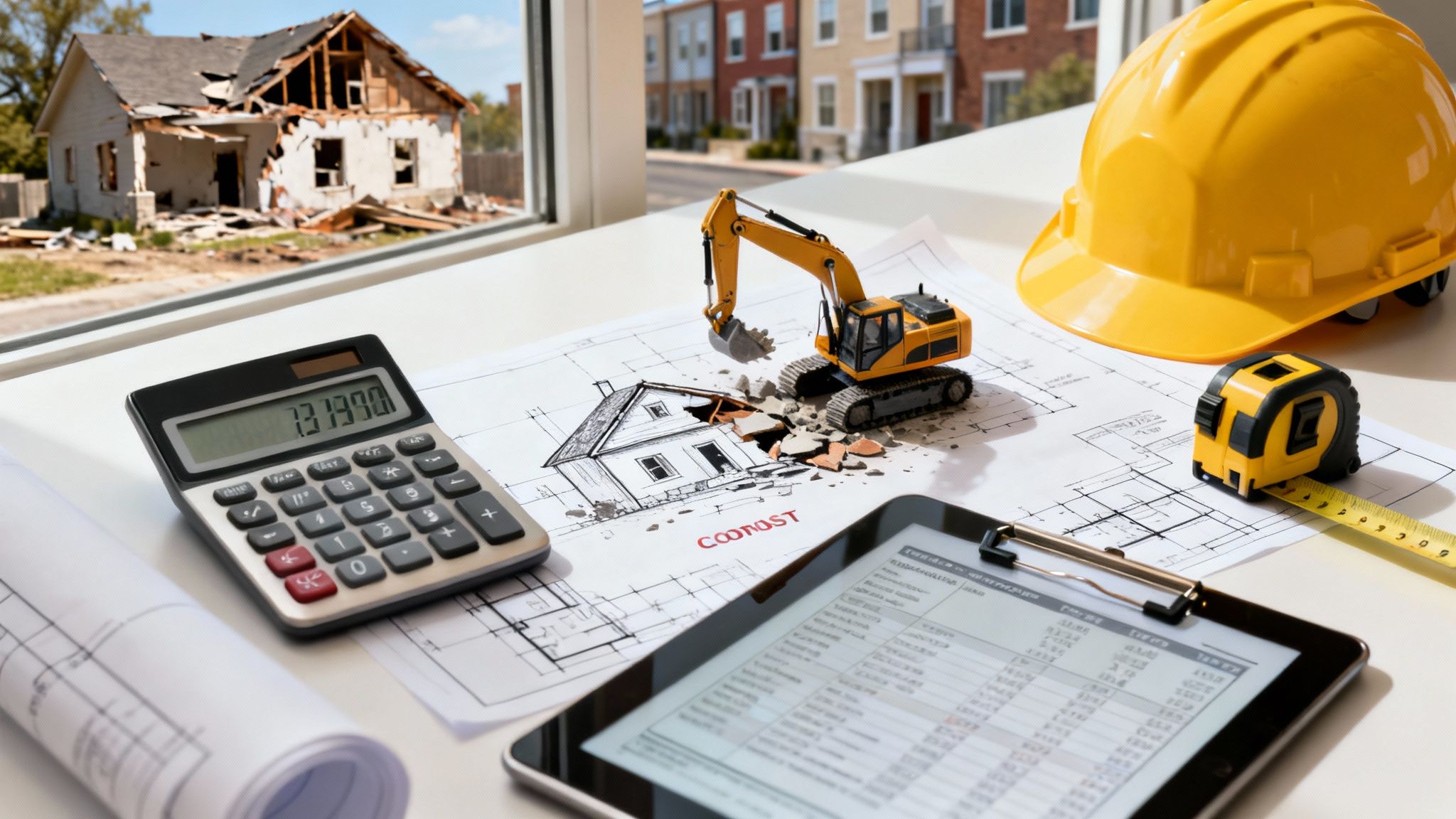
Thinking about buying a property that needs more than just a renovation? Sometimes, the best path forward is a complete teardown. But before you dream of building your perfect home from scratch, the big question is: what will it cost to clear the land? This is where a demolition costs calculator can be a great first step. It’s a tool that gives you a quick estimate of what it might take to demolish an existing structure, helping you decide if a "teardown" property is a realistic option for your budget.
Understanding Demolition Costs Before You Buy
Before you can use an online calculator and trust the numbers, it's important to understand what goes into the final cost. Think of it like a home inspection; you need to know what you’re looking for to understand the report. A good initial demolition estimate is crucial for figuring out the total cost of your new home project and determining if the property you're considering is a smart financial move.
To get a basic estimate, you'll need the property's square footage, the type of structure (like a single-family home or just a garage), and its location. Costs for labor and disposal can vary significantly from one town to the next. For a complete deep dive into all the variables, check out our full guide on the costs of demolition.
The Basic Information for Your Estimate
Your first task is to gather these key details. The real estate listing should provide the square footage, and photos can help you identify if the house is built with a wood frame, brick, or concrete. Each material has a different cost associated with its removal and disposal.
This is the basic flow of information you'll need to get a solid starting point for your estimate.
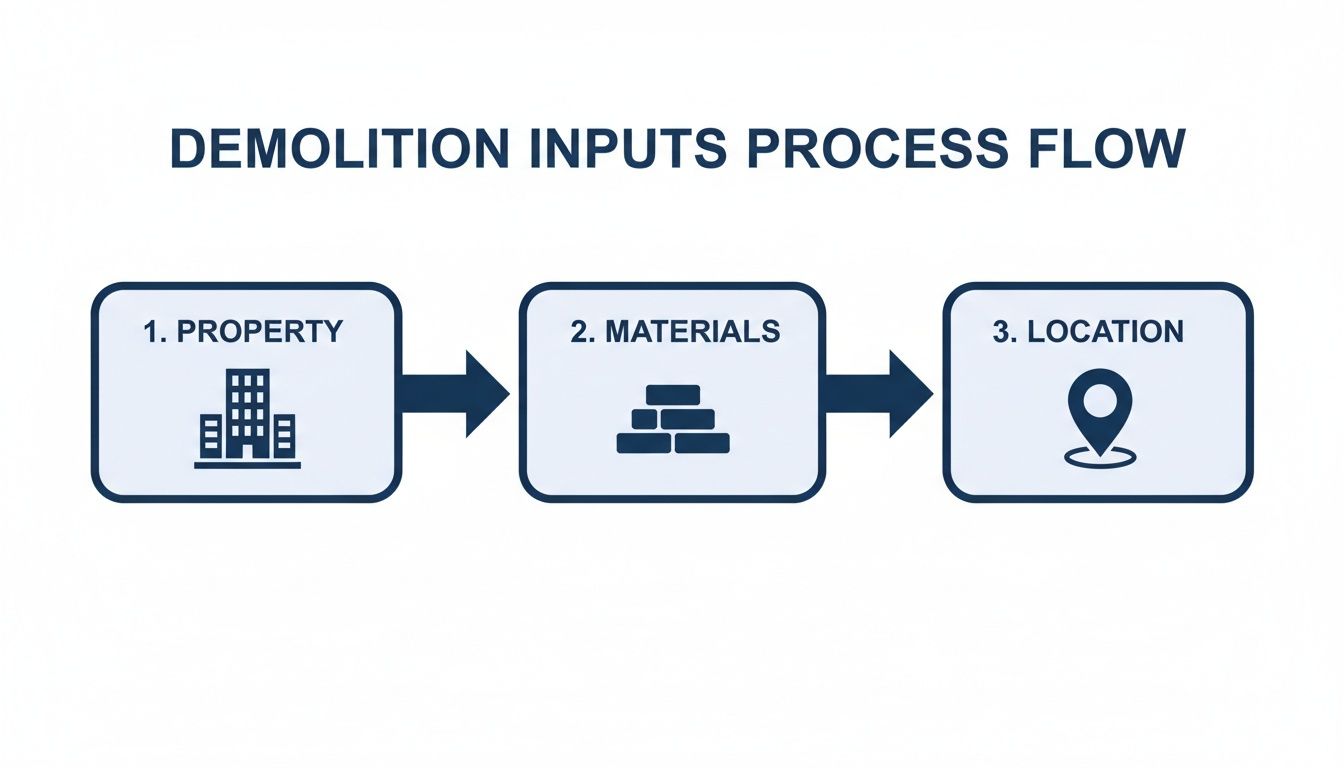
As you can see, the property's size, its construction materials, and its location are the three pillars of any reliable demolition estimate. They form the foundation of your budget.
To make this crystal clear, here’s a quick rundown of the essential information you'll need to collect.
Key Details for Your Demolition Cost Estimate
| Detail | Why It's Important | Example |
|---|---|---|
| Square Footage | This is the biggest factor. A larger house requires more work, bigger equipment, and creates more debris to haul away. | A 2,000 sq ft house vs. a 500 sq ft garage. |
| Structure Type | A simple wood-frame house is less expensive to tear down than a brick building or a concrete structure. | Single-family home, barn, mobile home, etc. |
| Location | Labor wages, permit fees, and landfill costs are different in every city, county, and state. | Urban centers like NYC vs. rural areas in the Midwest. |
| Building Materials | Wood is relatively cheap to dispose of. Heavy materials like brick, concrete, and steel cost more to remove. | Wood frame, cinder block, brick veneer, etc. |
| Hazardous Materials | The presence of things like asbestos, lead paint, or mold requires special (and expensive) removal procedures. | Popcorn ceilings from the 1970s often contain asbestos. |
| Foundation Type | A simple concrete slab is easier and cheaper to remove than a full basement with deep concrete walls. | Slab-on-grade, crawl space, or full basement. |
Gathering these details upfront will make your initial estimate much more accurate and help you avoid major surprises down the road.
Quick Takeaway: Online calculators are great for a quick look, but remember the old saying: garbage in, garbage out. The accuracy of your estimate depends on the quality of the information you provide. Start with solid details about the property’s size, materials, and location to build a realistic preliminary budget.
If you need a more detailed look at potential expenses, especially for things like hazardous material removal, a professional demolition cost calculator guide can be a huge help. Getting a firm grip on these factors is the first step to confidently figuring out the real costs that can make or break your new construction budget.
Breaking Down Core Demolition Expenses
When you receive a quote from a demolition contractor, that final number includes several different costs. Understanding these individual components is the key to using any demolition costs calculator effectively—and to knowing when an estimate seems too high or suspiciously low.
The total price is much more than just the cost of a bulldozer. It's like a restaurant bill; the total you pay covers the food, the chef's expertise, and the restaurant's operating costs. In the same way, a demolition quote is built on three main pillars: labor, equipment, and permits. Each one has a major impact on your budget.
Labor: The Human Element
In almost every demolition project, labor is the single largest expense. This includes skilled operators for heavy machinery, project managers who keep everything running smoothly, and sometimes specialized technicians if hazardous materials are found.
Labor rates can vary widely depending on your location. A union crew in a major city will cost significantly more than a non-union team in a more rural area.
For a typical 1,500 sq. ft. single-family home, you're likely looking at a crew of three to five people working for several days. If a contractor quotes $8,000 for labor, that figure isn’t just wages—it also covers insurance and worker's compensation for the entire team for the duration of the job.
Heavy Equipment Costs
Demolition requires some serious machinery. The costs tied to heavy equipment include rental fees and the fuel needed to run them. A standard residential teardown might need:
- Excavators: Used for tearing down the main structure and digging out the foundation.
- Bulldozers: Ideal for pushing debris and grading the site after the structure is gone.
- Dump Trucks: Essential for hauling away tons of debris to landfills or recycling centers.
The rental and fuel for this equipment can easily account for 25-35% of your total project cost. For our 1,500 sq. ft. house example, it’s realistic to see equipment costs falling somewhere between $3,000 and $5,000, depending on the specific machines needed and how long the job takes.
Permits and Inspections
Before any demolition work can begin, you need official permission from your local city or county. This is a crucial step that ensures the project is done safely and legally. Getting a demolition permit involves submitting detailed plans, paying fees, and scheduling required inspections.
Home Buyer Tip: Don't underestimate how long it can take to get permits. In some cities, securing a demolition permit can take weeks or even months. Factoring this administrative time into your project schedule is just as important as budgeting for the cost itself.
Permit fees are highly localized, but they typically range from a few hundred to several thousand dollars. For our example home, budgeting $500 to $1,500 for permits and the necessary inspections is a safe starting point.
For a more detailed look at how all these figures come together, you can find valuable insights on how to estimate demolition costs in our comprehensive guide.
Navigating Hidden Costs Like Hazardous Materials
What you can’t see can have a big impact on your demolition budget. Beyond the predictable costs of labor and equipment, demolition projects often uncover expensive surprises. A standard demolition costs calculator simply can't predict these issues.
These "hidden" costs, especially those related to hazardous materials, can cause your budget to skyrocket if you’re not prepared.
Older homes, particularly any built before the 1980s, often contain materials that are now heavily regulated. This includes asbestos in old ceiling tiles or insulation, lead in old layers of paint, and mold hiding behind damp walls. If any of these are found, a standard demolition project comes to a halt.
The High Price of Safe Removal
When hazardous materials are found, they can't just be torn out and thrown in a dumpster. Federal and state laws require specific abatement procedures—the professional term for the safe, documented removal and disposal of these toxic substances.
This process is expensive for good reason:
- Specialized Labor: Abatement requires certified technicians trained to handle dangerous materials safely. Their hourly rates are much higher than a regular demolition crew.
- Containment and Equipment: The work area must be sealed off with plastic sheeting and special air-filtering machines to prevent contamination. Workers wear full protective gear, including respirators.
- Legal Disposal: Hazardous waste must be transported to special facilities, and the disposal fees are high.
A huge part of calculating demolition costs involves identifying and safely handling asbestos-containing materials, which can dramatically inflate your expenses. Cutting corners here can lead to massive fines and legal issues.
Home Buyer Insight: Always budget a contingency fund of at least 15-20% of your total estimated demolition cost for unforeseen issues. It's much better to have the money set aside and not need it than to have your entire project stalled because you discovered asbestos.
Hauling and Waste Disposal Logistics
Even if your project is free of hazardous materials, getting rid of all the debris is a major expense. The cost to haul everything away is influenced by a few key factors that vary by project.
First, you have tipping fees. This is what landfills charge per ton to accept waste, and the price changes based on your location and what you're dumping. Heavy materials like concrete and brick will cost more to get rid of than lighter materials like wood and drywall. A 30-yard dumpster, a common size for a residential demolition, can cost $500 to $900 each time it's hauled away—and you’ll likely need more than one.
The good news is that recycling can help. The global market for construction and demolition waste management was valued at USD 118.69 billion in 2024, highlighting a growing trend toward recycling.
By separating materials like metal, concrete, and clean wood, you can often earn recycling credits that help offset high landfill fees. This makes deconstruction—carefully taking a building apart to salvage materials—an attractive, though more labor-intensive, alternative to a quick demolition.
How Site Conditions and Access Impact Your Budget
The estimate you get from a demolition cost calculator is a great start, but it can't see the property in person. In the real world, the physical location and accessibility of the site play a huge role in your final budget, often adding expenses that no online tool can predict.
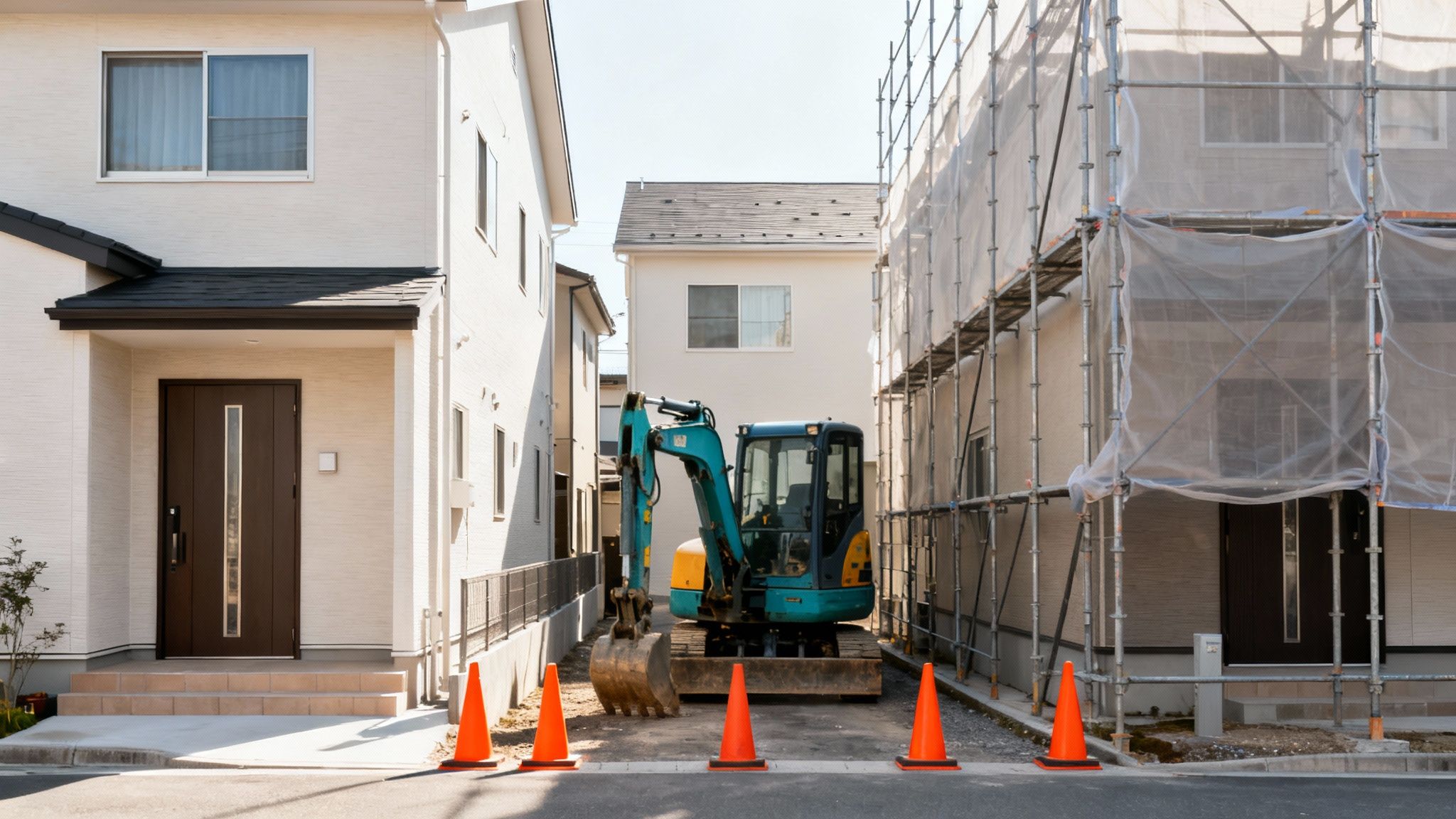
For example, tearing down a house on a flat, open lot in the suburbs is relatively straightforward. But demolishing the exact same house when it's squeezed between two other homes in a dense city is a completely different and more expensive project.

The biggest challenge is often moving heavy machinery. Excavators and dump trucks need space to operate safely and efficiently. If your property is on a narrow street, a steep hill, or has only one tight entry point, your costs will likely increase.
Contractors may need to use smaller, less powerful equipment, which means the job takes longer and your labor bill goes up. In some cases, they might even need to rent a crane to lift machinery over fences or buildings, adding a significant cost to your budget.
The Proximity Premium
When the house you're demolishing is close to neighboring properties, the project requires a more delicate approach. It's not about swinging a wrecking ball; it's about controlled, careful deconstruction. The risk of sending debris through a neighbor's window is very real, so your contractor must take extra precautions.
These safety measures often include:
- Erecting scaffolding and protective barriers to contain dust and debris.
- Using more manual labor for a precise, piece-by-piece teardown.
- Carrying higher insurance liability coverage, a cost that is passed on to you.
This "proximity premium" can easily increase your total demolition cost by 10-25%. The price goes up because the risk is higher and the work is more labor-intensive.
Real-World Example: Imagine two identical 1,500 sq. ft. houses. One sits on a spacious suburban lot and receives a demolition quote for $15,000. The other is a city row house with shared walls, and its quote is $22,000. That $7,000 difference is almost entirely due to tight site access and the need for extra safety measures.
Pre-Demolition Utility Management
Before any heavy equipment arrives, every utility line—gas, electric, water, and sewer—must be professionally disconnected. This is a critical safety step that requires you to coordinate with multiple companies, adding another layer of cost and time to your project.
You'll need to schedule and pay for:
- Gas lines to be shut off and capped by the utility company.
- Electrical service to be formally disconnected from the grid.
- Water and sewer lines to be shut off and sealed.
Each of these services has its own fees and scheduling lead time. Forgetting this step can lead to dangerous situations, hefty fines, and project delays. Always factor these costs and potential wait times into your plan from the beginning.
Choosing Between Total and Selective Demolition
When you hear "demolition," you probably picture a wrecking ball turning a building into a pile of rubble. That’s total demolition, and it’s the right choice when you need a completely clean slate to build a new home.
But for many home buyers, a full teardown isn't necessary. A more common approach for major renovations is selective demolition. This involves surgically removing specific parts of a house, like gutting a kitchen and bathrooms or taking out non-load-bearing walls, while keeping the main structure intact.
Choosing the right strategy is a major financial decision that will shape your renovation budget and timeline. The choice depends on your final goal and the condition of the property.
When Total Demolition Makes Sense
A complete teardown is the best option when a property’s structure is failing. If the foundation has major cracks, the framing is rotted, or the layout is so poor that a remodel would cost more than a rebuild, razing the structure is often the most practical path forward.
This is common when buyers find a property in a great location where the land itself is worth more than the old, dilapidated house sitting on it. The goal isn't to save the old structure; it’s to clear the way for a new, modern home that maximizes the lot's value.
The Strategic Value of Selective Demolition
For most major home renovations, selective demolition is the way to go. It allows you to keep the most expensive parts of the structure: the foundation, load-bearing walls, and roof. These elements represent a huge part of a building's cost, so by keeping them, you avoid the massive expense of building a new house from scratch.
While selective demolition requires more skilled, precise labor, it almost always leads to a lower overall project cost. The U.S. demolition industry is projected to reach USD 11.2 billion by 2025, largely driven by this targeted approach to renovation. Preserving key structural elements while gutting the interior is a smart way to control costs. You can find more demolition industry trends at IBISWorld.
Home Buyer Takeaway: Think of selective demolition as a strategic renovation tool. It reduces waste, shortens your timeline by skipping the long process of building a new structure, and frees up your budget for high-impact finishes that increase your home's value.
Deciding between a full teardown and a strategic gut job is a critical first step. Before you can compare contractor bids or map out a budget, you need to be clear on which path your project requires.
Total vs. Selective Demolition: A Comparison for Home Buyers
| Factor | Total Demolition | Selective Demolition |
|---|---|---|
| Scope | Complete removal of the entire structure, including the foundation. | Surgical removal of specific interior or exterior parts (e.g., walls, kitchens, flooring). |
| Best For | Structurally failing buildings, lots where land value is the main asset, or complete redesigns. | Major renovations, cosmetic remodels, and updating layouts in sound structures. |
| Cost | High initial cost due to heavy machinery, labor, and extensive debris hauling. | Lower overall cost, as it preserves the most expensive structural elements. |
| Labor | Primarily heavy equipment operators and general laborers. | Requires skilled labor for precision work to avoid damaging the parts of the house you're keeping. |
| Timeline | Faster for the demolition phase, but leads to a much longer overall project (building a new home). | Slower demolition due to careful work, but results in a much faster overall renovation. |
| Permitting | Extensive and complex, often requiring new building permits, zoning approvals, and utility work. | Simpler permitting process, typically falling under standard renovation or remodeling permits. |
Ultimately, using a demolition costs calculator effectively starts with knowing which type of demolition you're estimating. A total demolition calculation will be significantly higher, factoring in foundation removal and site clearing. A selective demo, on the other hand, focuses on interior gutting—a completely different set of costs.
Frequently Asked Questions About Demolition Costs
How accurate is an online demolition costs calculator?
Online calculators are great for getting a quick, ballpark estimate. They're perfect for the initial "is this even possible?" phase when you're looking at properties. However, a calculator can't see the property in person. It doesn't know about potential issues like hidden asbestos, difficult site access, or specific local permit fees. Use the online estimate as a starting point, but always get detailed, on-site quotes from at least three licensed local contractors for an accurate number.
What are the biggest hidden costs in a demolition project?
The most common hidden costs come from discovering hazardous materials like asbestos, lead paint, or mold, which require expensive, specialized removal. Other surprise costs can arise from poor site access (requiring smaller, less efficient equipment), unexpected problems with the foundation, or the need to protect neighboring properties, all of which add time and labor to the job. It's wise to set aside a contingency fund of 15-20% of the estimated cost to cover these potential issues.
How does the foundation type affect demolition costs?
The foundation is a major cost factor. A simple, flat concrete slab is the easiest and cheapest to remove. A house with a crawl space or a full basement will be much more expensive to demolish. Removing a basement involves breaking up thick concrete walls, extensive excavation, and backfilling the large hole with engineered soil, which adds significant labor, equipment, and disposal fees to the project.
How do I get a reliable quote for a demolition project?
Start by creating a clear "scope of work" that details exactly what you want to be demolished. Then, contact at least three licensed and insured demolition contractors in your area. Ask them to perform an on-site inspection of the property—a trustworthy quote should never be given sight-unseen. A professional quote will be itemized, breaking down the costs for labor, equipment, permits, and waste disposal so you can see exactly what you're paying for.
Can I save money by salvaging materials from the old house?
Yes, this is a great way to offset costs and be environmentally friendly! The process is called "deconstruction" rather than demolition. You can salvage valuable materials like old-growth wood beams, hardwood flooring, vintage doors, windows, and light fixtures. While it requires more careful, manual labor (which can increase labor costs), selling these salvaged items or reusing them in your new home can help reduce your overall project expenses.
Ready to analyze your next deal with confidence? Stop guessing and start knowing. Flip Smart provides instant valuations, accurate rehab estimates, and profit projections in seconds. Analyze any property for free today at flipsmrt.com.