
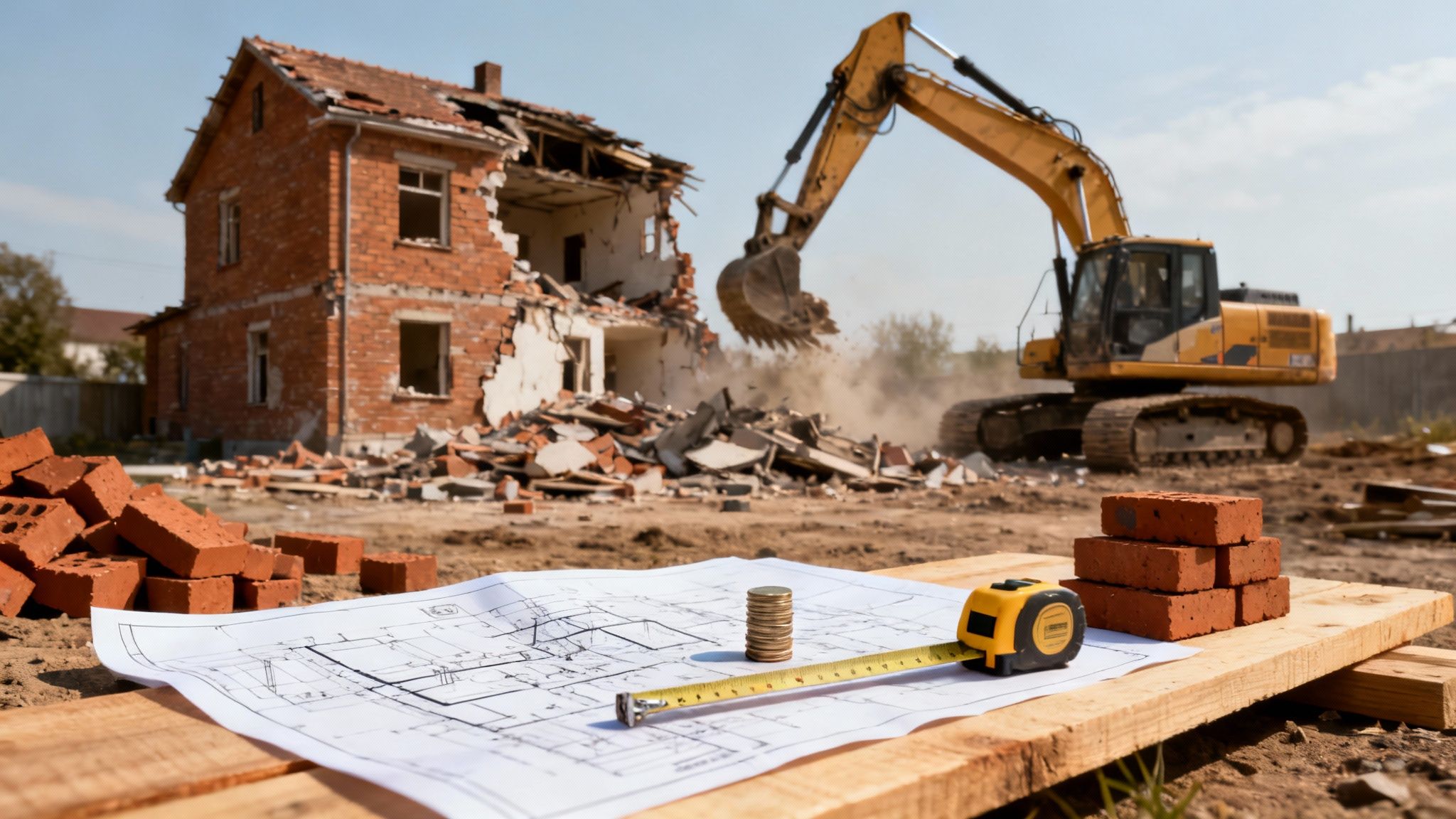
So, you're looking at a property that needs more than just a little TLC. In fact, it might need to come down completely. For any home buyer or real estate investor, that raises the big question: what's this going to cost?
The national average to demolish a house usually shakes out to be between $4 to $15 per square foot, but that's just a ballpark figure to get you started.
For a typical 1,500-square-foot house, you could be looking at a bill anywhere from $6,000 to $22,500. Most projects land somewhere in the middle, around $18,000. But the final number on that invoice is going to swing wildly based on the home's location, what it's made of, and whether any nasty surprises like asbestos are hiding in the walls.
Your Guide to Demolition Costs
When you’re eyeing a property that needs a complete do-over, getting a handle on the potential costs of demolition is the very first step. Whether the current building is unsafe or just doesn't fit your vision, a teardown gives you that coveted blank slate to build your dream home. But that clean slate has a price, and it can vary dramatically.
Think about it like taking your car to the mechanic. A simple brake job has a predictable cost. But a weird clanking sound from the engine? That could be a five-minute fix or a complete rebuild. It’s the same with demolition. Tearing down a small, single-car wooden garage is one thing. Leveling a two-story brick house with a basement and an asbestos problem is a whole different ballgame.
Key Budgeting Benchmarks
Before you get bogged down in the details, it helps to have some quick numbers in your back pocket based on the type of structure. This is perfect for that initial, back-of-the-napkin analysis you do when a potential property pops up.
Here’s a quick table to give you a starting point.
Average Demolition Costs by Structure Type
A quick look at estimated demolition costs per square foot for common structures to help with your initial budgeting.
| Structure Type | Average Cost Per Square Foot | Typical Total Cost Range |
|---|---|---|
| Single-Family Home (1,500 sq ft) | $4 - $15 | $6,000 - $22,500 |
| Detached Garage (400 sq ft) | $4 - $8 | $1,600 - $3,200 |
| Mobile Home | $3 - $6 | $1,500 - $5,000 |
| Concrete Driveway/Slab (500 sq ft) | $2 - $6 | $1,000 - $3,000 |
Treat these numbers as your baseline. As we'll get into, a ton of factors can push your actual costs well beyond these ranges. For anyone facing the decision to remodel or rebuild, weighing these financial implications is absolutely critical before you even think about calling a demolition crew.
Demolition is a surprisingly big business. In the U.S. alone, the industry is on track to hit $11.2 billion by 2025. This growth is fueled by urban redevelopment projects and a bigger push to recycle materials like concrete and steel from old structures. You can explore more detailed industry data over at IBISWorld.com.
Key Factors That Drive Demolition Prices
So, why isn't there a simple, flat-rate price for demolition? Because every property tells a different story. That initial per-square-foot estimate is just the opening chapter; the final bill depends on a handful of crucial variables that contractors have to weigh carefully.
For any home buyer, understanding these factors is like learning to see a property through a contractor's eyes. It lets you spot the potential budget-killers from a mile away and build a much sharper estimate for your purchase analysis.
The Big Three Demolition Cost Drivers
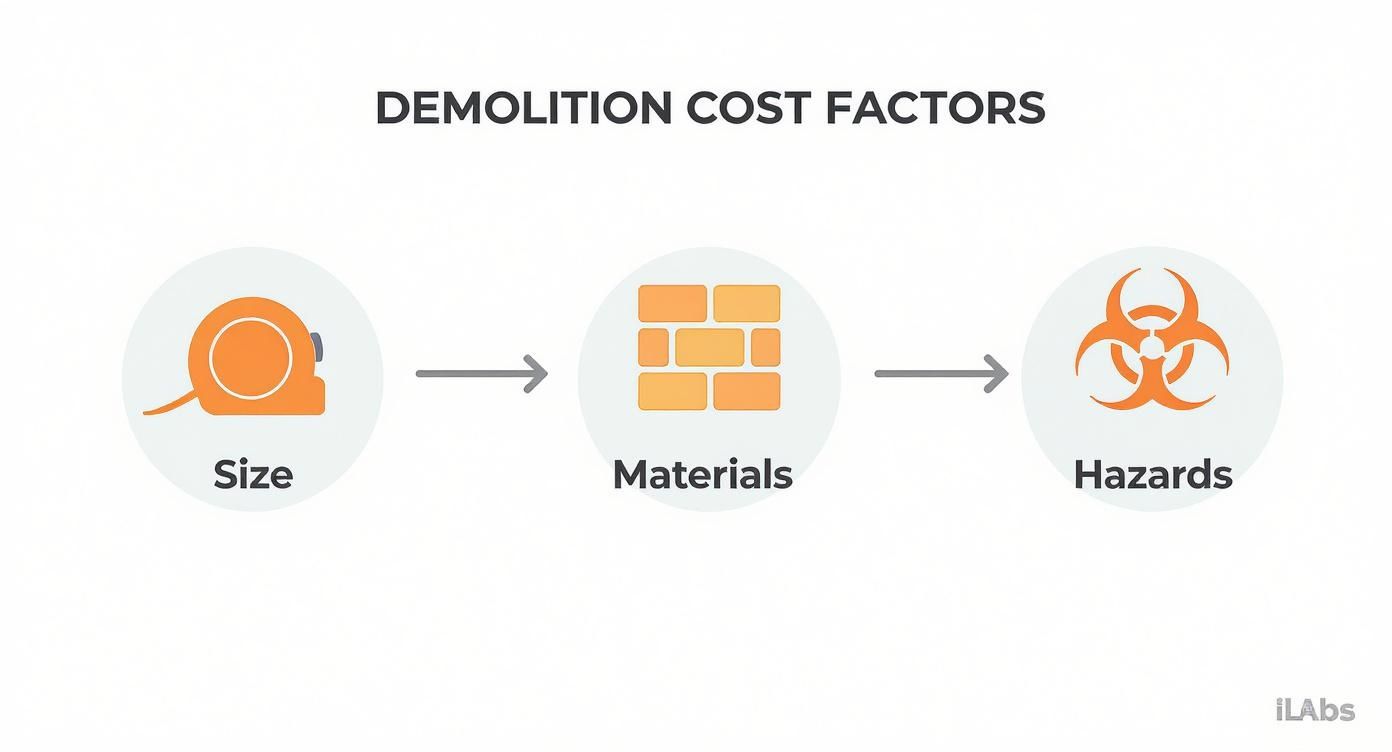
While a lot of little things can nudge the price up or down, the final cost of a teardown almost always boils down to three main things: the building's size and complexity, what it's made of, and whether there are any nasty surprises hiding in the walls.
- Size and Complexity: This one’s the most straightforward. Tearing down a massive, multi-story house simply takes more labor, bigger equipment, and more time than a small, single-story bungalow. A complicated roofline, a bunch of poorly built additions, or a deep basement will also add hours and dollars to the job.
- Construction Materials: What the house is built from matters—a lot. A standard wood-frame house is relatively simple and cheap to demolish. But a structure made of brick, stone, or reinforced concrete? That’s a different beast entirely. It’s heavier, denser, and demands more powerful machinery and intense labor, pushing the price tag up.
- Hazardous Materials: This is the ultimate wild card in any demolition budget. Finding asbestos, lead-based paint, or other toxic substances can blow up your costs. The law requires specialized containment, handling, and disposal procedures, which are both time-consuming and expensive.
Properly identifying and dealing with these materials is a huge cost factor. For a better sense of the responsibilities involved, a good guide on managing hazardous substances can help you grasp the strict legal and safety requirements.
Site Conditions and Accessibility
Beyond the house itself, the property's physical location and layout play a huge part in the final bill. Think of it this way: even the best demo crew can't work efficiently if they can't get their equipment to the building.
Here are a few site conditions that can complicate things:
- Tight Urban Lots: Is the house wedged between two neighboring properties with zero side-yard access? This often means the crew has to use smaller, less efficient equipment, which racks up the labor hours and drags out the project timeline.
- Rural or Remote Locations: If your property is way out in the sticks, you’ll likely pay a premium for crew travel time and fuel. The distance to the nearest landfill or recycling center also directly impacts your debris hauling expenses.
- Landscaping and Obstacles: Mature trees you need to save, old retaining walls, a septic system, or a swimming pool—anything that has to be carefully worked around or removed will add complexity and cost to the job.
Demolition isn't just about knocking things down; it's a logistical puzzle. The easier it is for a contractor to get heavy machinery in and haul debris out, the lower your final bill will be.
Foundations and Basements
What’s underneath the house is just as important as the structure you can see. Foundation removal is often quoted as a separate line item, and the cost can vary dramatically.
A simple concrete slab-on-grade foundation is the cheapest and easiest to remove. But a property with a full basement or a deep crawl space requires a ton of extra work. We're talking extensive excavation, breaking up thick concrete walls and floors, and then backfilling the entire hole with clean, compacted soil. This process alone can easily add $4,000 to $12,000 or more to your total project cost.
Debris Disposal and Labor Rates
Finally, a couple of economic factors that are out of your control will heavily influence the price: what it costs to dump the debris and what it costs to pay the crew.
Local landfill fees, often called tipping fees, can be wildly different from one county to the next. If you're in an area with high disposal costs, your quote will absolutely reflect that. Likewise, labor rates are geographic. Demolition services in a major city will almost always cost more than in a small rural town.
The equipment itself also plays a hidden role. The global demolition equipment market was valued at around $6.3 billion in 2023 and is expected to keep growing. Stricter environmental regulations, especially in North America, mean contractors have to invest in advanced machinery that cuts down on pollution and dust. The high cost to buy and maintain this gear is ultimately baked into the prices they charge you.
How to Accurately Estimate Your Demolition Costs
Moving from a ballpark guess to a confident budget is what separates a prepared home buyer from a stressed one. A vague per-square-foot estimate is a decent starting point, but a successful project demands a much sharper pencil. Let's walk through how to build a realistic cost estimate, turning that uncertainty into a solid financial number you can plan for.
We'll use a hypothetical 1,500-square-foot house as our example to make the numbers real. By starting with a base rate and then layering on the variables we've discussed, you can build a preliminary budget that will actually hold up.
Start With the Base Calculation
First things first, you need a foundation for your estimate: the raw cost to tear the structure down. This is where those average per-square-foot rates come into play.
Let's say our 1,500 sq. ft. house is a standard wood-frame build in a market with average labor costs. For our initial calculation, we'll pick a mid-range estimate of $10 per square foot.
- Calculation: 1,500 sq. ft. x $10/sq. ft. = $15,000
This $15,000 is our starting point. It covers the core cost for the crew and machinery needed to bring the building down. Now, let's start adding the other essential line items.
Layer on Additional Costs and Fees
A demolition budget is never just one number. A whole host of other services and fees are required for a safe, legal project. You have to account for these to avoid nasty surprises that can blow up your budget.
Think of it like building a custom car. The engine and frame are your base price, but the final sticker price depends on the wheels, paint, and interior you add on top. Each component adds to the total.
The key factors—size, materials, and potential hazards—are what you need to consider as you build out this more complete estimate.
Let’s add these common expenses to our hypothetical project:
- Permit Fees: This varies wildly by municipality but often falls between $200 to $2,000. Let’s budget $500.
- Utility Disconnection: Gas, electric, and water lines need to be professionally capped. This can run from $300 to $1,500. We'll use $800.
- Hazardous Material Testing: Even if you don't see obvious signs of asbestos, testing is often mandatory. A basic inspection might cost $500 to $1,000. Let's budget $750.
- Foundation Removal: Our example house has a full basement, which is a major cost adder. Let’s add $8,000 for the excavation and backfill.
- Debris Hauling: This cost is often rolled into the main quote, but it's good to be aware of. High landfill fees in your area could add 10-20% to the base cost.
Adding these up, our quick estimate has jumped from $15,000 to over $25,000—a much more realistic figure. You can dive deeper into this process with our full guide to estimate demolition costs.
Total Teardown vs. Interior Gut Job
Not every project requires taking the building down to the dirt. Sometimes, you only need to demolish the interior, a process known as a selective gut job. Knowing the difference is critical for your home buying strategy.
A total teardown means razing the entire structure, foundation and all. You do this when a building is structurally unsafe, has irreparable damage, or just doesn't fit the lot's best use. It gives you a completely blank slate.
An interior gut job, on the other hand, leaves the home's exterior shell and structural frame intact. You strip everything down to the studs—drywall, flooring, wiring, plumbing, you name it. This is the perfect play when the "bones" of the house are good, but the inside is dated or has a terrible layout.
Home Buyer Takeaway: A selective interior demolition is almost always cheaper than a full teardown, often costing just $2 to $7 per square foot. It lets you completely re-imagine the living space without the massive expense of a ground-up new build.
Choosing the right approach comes down to your goals for the property. If you're planning a major addition or the foundation is failing, a total teardown is your only real option. But if the structure is solid and you just want to create a modern, open-concept floor plan, a gut job is the smarter financial move.
Putting It All Together: A Sample Worksheet
To keep your numbers straight, use a simple worksheet. It's a great practice that ensures you don't forget any line items and gives you a clean document to compare contractor bids against.
Here’s a sample estimation worksheet based on our 1,500 sq. ft. house project.
Sample Demolition Cost Estimation Worksheet
| Cost Item | Calculation (Example) | Estimated Cost | Notes |
|---|---|---|---|
| Base Demolition | 1,500 sq. ft. x $10/sq. ft. | $15,000 | Assumes wood frame and standard site access. |
| Demolition Permit | Municipal flat fee | $500 | Check local city or county fee schedule. |
| Utility Disconnections | 3 services (gas, water, electric) | $800 | Get quotes from local utility providers. |
| Asbestos & Lead Testing | Professional inspection fee | $750 | Mandatory in many areas for homes built pre-1980. |
| Foundation Removal | Full basement excavation & backfill | $8,000 | This is a major variable; slab would be much cheaper. |
| Debris Hauling & Disposal | Included in base cost estimate | $0 | Confirm this is included in contractor quotes. |
| Subtotal | $25,050 | ||
| Contingency Fund | 15% of Subtotal | $3,758 | Essential buffer for unexpected issues. |
| Estimated Total Cost | $28,808 |
This structured approach gives you a much more reliable number to plug into your budget. By systematically accounting for each potential expense, you can evaluate a property's true potential and make a smarter, more confident buying decision.
Navigating Permits and Legal Requirements
Tearing down a house is a lot more than just swinging a sledgehammer. It’s a carefully regulated process wrapped in a surprising amount of red tape. Getting a handle on the legal paperwork isn't just a good idea—it's absolutely essential to keep your project on track, on budget, and out of legal hot water.
Think of a demolition permit as your license to operate. You wouldn’t drive a car without one, and you definitely can't legally demolish a building without the city’s official go-ahead. Trying to cut this corner almost always ends with stop-work orders, eye-watering fines, and delays that can stall your project for months.
The Non-Negotiable Paperwork
Before even one piece of drywall comes down, you or your contractor need to get all your ducks in a row with the local authorities. The specifics can vary from one city to the next, but the core requirements are pretty standard everywhere.
Here’s a quick checklist of the approvals you’ll almost certainly need:
- Demolition Permit: This is the big one. It's the official green light from your local building department to raze the structure.
- Utility Disconnection Clearances: This is non-negotiable for safety. You need official proof that the gas, water, electric, and sewer lines have all been professionally capped off by the utility companies.
- Asbestos and Hazardous Material Reports: If you're dealing with an older home, most cities won't even look at your permit application without a report from a certified inspector clearing the site of asbestos or other hazardous materials.
- Site and Debris Removal Plan: Cities want to know you have a professional plan. You'll often need to show them how you'll control dust, manage traffic around the site, and dispose of all the debris legally.
Home Buyer Insight: Don't view the permitting process as a bureaucratic hurdle. See it for what it is: a crucial risk management step. That signed-off permit is your proof that the project meets local safety and environmental codes, shielding you from massive liability down the road.
Beyond the Building Department
Your homework doesn't stop once you have the demolition permit in hand. Other local rules can throw a major wrench in your plans for what comes after the lot is cleared. Ignoring these can lead to the devastating discovery that your new construction plans are dead on arrival.
Make sure you also dig into:
- Zoning Regulations: Scour the local zoning code. You need to be 100% certain that what you plan to build—whether it's a duplex, a larger single-family home, or something else—is actually allowed on that lot.
- Neighborhood Covenants (HOAs): If the property is part of a Homeowners Association, they have their own rulebook. There could be strict limits on everything from construction hours to building design and even what kind of fence you can put up.
The global construction demolition market is set to grow by a massive $14.5 billion between 2025 and 2029, fueled by urbanization and new building projects. This boom is leading to even tighter regulations as local governments push for safer, more sustainable demolition. You can read more about these global market trends on Technavio.com.
Factoring Timelines into Your Project Plan
One of the costliest mistakes a buyer can make is underestimating the permit timeline. Getting a demolition permit is almost never a quick, over-the-counter transaction.
Be prepared for the process to take anywhere from a few weeks to several months, depending on how busy your local municipality is and the complexity of your project. This isn't dead time; it's a critical waiting period you must build into your project schedule. If you close on a property thinking you can start demolition the next day, you're in for a rude awakening. You'll be stuck paying mortgage and taxes on a property you can't even touch.
By planning for this administrative lead time from day one, you build a realistic and far less stressful project timeline.
Smart Ways to Reduce Your Demolition Bill
While the cost of demolition is a big-ticket item on any project budget, you don't have to just accept the first number you're quoted. A little strategic thinking can easily save you thousands of dollars without ever cutting corners on safety.
By planning ahead and looking for value where others only see a pile of debris, you can seriously trim that final invoice.

It all comes down to a few key moves: salvaging what you can, getting the right contractor on board, and even rolling up your sleeves for a bit of the light work. Every smart decision adds up.
Embrace Deconstruction Before Demolition
Long before the excavator shows up, think about deconstruction. This is just the process of carefully dismantling parts of the house to salvage valuable materials you can resell, reuse, or donate. It's a total win-win: you shrink the volume of debris heading to the landfill (which lowers your disposal fees) and you either generate cash or get a nice tax write-off.
Older homes, in particular, can be absolute treasure troves. With a bit of elbow grease, you can pull out items that are always in high demand.
Top Salvageable Materials:
- Hardwood Flooring: Real oak, maple, or pine flooring can be carefully removed, de-nailed, and sold for a premium.
- Vintage Fixtures: Clawfoot tubs, pedestal sinks, cool antique light fixtures, and unique doorknobs can fetch surprisingly high prices from other renovators.
- Architectural Elements: Things like old fireplace mantels, solid wood doors, and decorative trim have serious resale value.
- Scrap Metal: Copper piping, aluminum siding, and any steel beams are worth cash at a local scrap yard.
Donating salvaged items like cabinets, windows, and appliances to non-profits like Habitat for Humanity ReStore is another great move. They'll give you a tax-deductible receipt, turning stuff you were going to throw out anyway into a direct financial benefit.
Get Multiple Bids from Reputable Contractors
Never, ever settle for the first quote you get. One of the single most effective ways to control your demolition cost is to get at least three to five detailed bids from different contractors. Making them compete for the job ensures you're getting a fair market rate.
But be warned: the lowest bid isn't automatically the best one. A price that seems too good to be true might be a red flag for an uninsured or inexperienced operator who could end up costing you more in the long run.
When you're comparing quotes, make sure it’s a true apples-to-apples comparison. A professional bid should clearly itemize all the costs—labor, equipment, debris hauling, permit fees, and final site cleanup.
Always, always verify that each contractor is fully licensed and insured. Ask them for proof of their general liability insurance and workers' comp coverage. Hiring an uninsured crew is a massive financial gamble that could leave you on the hook for any accidents or property damage. For a more detailed breakdown of costs, using a good demolition cost calculator can help you compare these bids more effectively.
Consider a Hybrid DIY Approach
While taking a sledgehammer to the entire house is definitely a job for the pros, you can save a good chunk of change by handling some of the light, non-structural demo yourself. This is often called a "soft-strip," and it can seriously cut down on the labor hours you're paying a professional crew for.
If you’re comfortable with the work and have the proper safety gear, you can easily tackle tasks like:
- Removing Kitchen Cabinets and Countertops: These are usually just screwed into the wall and are simple to take out.
- Pulling up Carpeting and Flooring: Ripping out old carpet, vinyl, or floating floors is a pretty straightforward job.
- Taking Down Non-Load-Bearing Walls: With a little caution, you can remove the drywall on interior walls that aren't supporting any weight.
Just be sure to leave all the heavy structural work—and anything involving plumbing, electrical, or potential hazards like asbestos—to the licensed professionals. Your goal here is to handle the simple, time-consuming stuff that drives up labor costs, letting the experts focus on the heavy lifting.
Frequently Asked Questions
Buying a property that needs to be torn down can feel overwhelming. Here are quick answers to a few common questions to help clarify the process.
How can I finance the cost of demolition and a new build?
Most home buyers use a construction loan. Unlike a standard mortgage, a construction loan funds the project in stages (called "draws") as work is completed. It covers the costs of demolition, permits, labor, and materials for the new home. Once the house is built, the construction loan is typically converted into a regular, long-term mortgage. Talk to a lender who specializes in construction financing early in your planning process.
Does my home inspection need to be different for a teardown property?
Yes, absolutely. While you might not care about a leaky faucet, the inspection should focus on major structural issues and potential hazards. Your inspector should specifically look for:
- Asbestos, lead paint, and mold: Identifying these hazards is critical for your demolition budget.
- Foundation integrity: Is the foundation crumbling or cracked beyond repair? This confirms the need for a full teardown.
- Underground utilities or septic systems: Knowing where everything is located is crucial for a safe demolition.
Can I negotiate the home's price based on demolition costs?
Definitely. If you're buying a property with the clear intention of tearing it down, the demolition cost is a significant expense you should factor into your offer. Get a few preliminary quotes from demolition contractors before you make an offer. You can then use these estimates as leverage to negotiate a lower purchase price, explaining to the seller that the property's value is directly impacted by the high cost of making the land buildable.
Ready to take the guesswork out of your next deal? Flip Smart gives you the power to analyze any property in seconds, providing accurate valuations, renovation cost estimates, and profit potential. Stop spending hours on spreadsheets and start making smarter, faster investment decisions today. Get your first report at https://flipsmrt.com.