
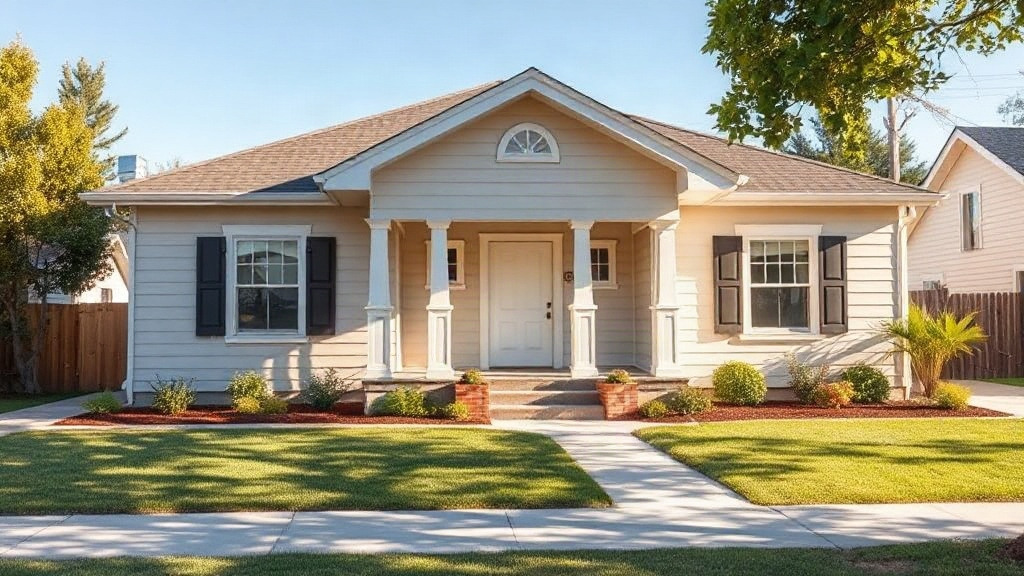
Why Over-Rehabbing Kills Profits
Over-rehabbing happens when investors spend more on renovations than necessary to achieve the target After Repair Value (ARV). It’s a common mistake, especially for new fix & flippers who want every property to look like a showpiece. The problem is that buyers in your market may not pay extra for luxury finishes or over-the-top upgrades. Every dollar spent beyond what the market supports eats directly into your profit margin.
Want to skip the spreadsheet? FlipSmrt pulls comps, estimates ARV and rehab, and runs the deal math from just an address. Try your first analysis free.
Take this example: You’re flipping a mid-market property in a neighborhood where comparable homes sell for $250,000. Instead of installing standard $2 per square foot laminate flooring, you opt for $8 per square foot hardwood because it "looks better." For a 1,500-square-foot home, that decision alone adds $9,000 to your rehab costs. However, buyers in this price range aren’t looking for high-end finishes and won’t value the hardwood enough to push the ARV higher. You’ve just spent $9,000 without increasing the resale price by even a dollar.
Another common over-rehab mistake is upgrading kitchens or bathrooms beyond the market standard. Stainless steel appliances, quartz countertops, and custom cabinetry might impress buyers in a $500,000 market, but they’re overkill for a $200,000 property. If the local comps show that homes with basic finishes sell just as well, spending an extra $15,000 on high-end upgrades won’t yield a higher ARV. That unnecessary expense directly reduces your profit potential.
Over-rehabbing often stems from emotional decisions or a desire to “over-deliver.” But successful fix & flippers know that profitability depends on sticking to the numbers. The goal is to match the quality of your renovations to what buyers in the area expect. Anything beyond that is wasted money.
The takeaway? Always analyze the comps in your target market and tailor your rehab budget accordingly. Let the ARV dictate your renovation level, not personal taste or ambition. This is the key to maximizing your fix & flip profits.
The 70% Rule: Your Profit Guardrail
The 70% rule is a simple yet powerful formula that helps fix & flippers determine the Maximum Allowable Offer (MAO) on a property. It ensures you leave enough room for rehab costs, holding costs, and a healthy profit margin without overpaying. The formula is straightforward: MAO = (ARV x 0.70) - repair costs. By capping your offer at this amount, you protect yourself from squeezing margins or taking on unnecessary risk.
Here’s how it works with a real example. Let’s say the After Repair Value (ARV) of a property is $300,000, and the estimated rehab costs are $50,000. Using the 70% rule, you would first multiply the ARV by 0.70, which gives you $210,000. From this, subtract the $50,000 repair costs. That leaves you with a MAO of $160,000: ($300,000 x 0.70) - $50,000 = $160,000. This means you should not pay more than $160,000 to purchase the property if you want to stay on track for a profitable flip.
Why 70%? The 0.70 multiplier accounts for two critical things: transaction and holding costs (like agent fees, closing costs, and loan interest) and your desired profit. Typically, these costs and profit goals together should take up about 30% of the ARV, leaving 70% for purchase and rehab. Sticking to this rule ensures you have enough cushion to handle unexpected expenses or market fluctuations while still hitting your target returns.
While it’s a reliable starting point, the 70% rule isn’t foolproof. For example, in high-demand markets, you may need to adjust your multiplier slightly higher to remain competitive. Conversely, in lower-value markets, a more conservative multiplier (like 0.65) might be safer. But for most deals, the 70% rule is your go-to framework for avoiding overpaying and protecting your profitability.
Always run the numbers carefully. Use the 70% rule to set your MAO, and cross-check it against other factors like neighborhood trends, holding timelines, and financing terms. With this guardrail in place, you’ll avoid emotional decision-making and focus on deals that truly make financial sense.
How to Estimate Repairs Without Guesswork
Creating an accurate rehab budget is essential for any fix & flip deal. Underestimating repairs can destroy profits, while overestimating might cause you to pass on a good deal. The key is to rely on a systematic approach, not guesswork. Start by assessing the property’s condition and the scope of work required. For example, is it a full gut renovation, or does it just need cosmetic updates like new paint, flooring, and fixtures? This will determine the cost per square foot.
Let’s walk through a realistic example. Imagine you’re analyzing a 1,500-square-foot home that primarily needs cosmetic updates. Based on local contractor rates, you estimate $30 per square foot for the rehab. Multiply the square footage by the cost per square foot: 1,500 sq. ft. x $30 = $45,000. This $45,000 budget should include all necessary line items like painting, flooring, light fixtures, and minor kitchen and bathroom updates. If the property needs more extensive work (e.g., roof replacement, HVAC upgrades), your cost per square foot will naturally increase. Adjust your estimate accordingly.
Using tools like FlipSmrt can make this process much faster and more accurate. Instead of manually calculating line items, FlipSmrt generates a detailed rehab budget based on the property’s condition and your inputs. For instance, if you input the address of the 1,500-square-foot property and specify cosmetic rehab, FlipSmrt will break down the $45,000 into line items like $10,000 for flooring, $5,000 for paint, $8,000 for kitchen updates, and so on. This level of detail helps you avoid surprises and ensures nothing critical is overlooked.
When estimating repairs, always include a contingency buffer, typically 10-15% of the total budget. For our $45,000 example, a 10% buffer adds $4,500, bringing the total to $49,500. Unexpected issues often arise once work begins, and having a contingency ensures you don’t blow your numbers. With a clear, accurate budget, you can confidently calculate your Maximum Allowable Offer (MAO) and decide if the deal is worth pursuing.
In summary, estimating repairs without guesswork comes down to using a systematic cost-per-square-foot approach and leveraging tools like FlipSmrt for detailed line-item budgets. The result is a more precise rehab estimate that protects your profit margins and keeps your flip on track.
Run these numbers on a real deal in seconds
FlipSmrt turns an address into ARV, a rehab budget, and your Maximum Allowable Offer automatically.
Analyze a Property FreeNuances: When the 70% Rule May Not Apply
The 70% rule is a reliable guideline for most fix-and-flip deals, but there are situations where it might need adjustment. One common edge case is luxury properties. High-end homes often have a lower buyer pool and longer days on market, making them riskier investments. Additionally, repair costs for luxury properties tend to scale disproportionately. For example, a $1.5 million property may require high-end finishes and custom work that inflate rehab budgets beyond the standard 30% margin. In these cases, investors often reduce the 70% multiplier to 65% or lower to account for the added risk and ensure a sufficient profit margin.
Another scenario is rapidly appreciating markets. In a hot market where property values are climbing quickly, the ARV you calculate today could be outdated in a few months. For instance, if comps show a $300,000 ARV but the market is appreciating 10% annually, the ARV in six months might realistically approach $315,000. In such cases, the 70% rule might feel overly restrictive. However, don't assume appreciation will bail out a bad deal. Instead, update your ARV based on the most recent comparable sales and re-run your numbers conservatively.
Alternative exit strategies can also impact the applicability of the 70% rule. For example, if you plan to BRRRR (Buy, Rehab, Rent, Refinance, Repeat) rather than flip, you might focus less on the immediate profit margin and more on your long-term cash flow and equity. Here, metrics like the cash-on-cash return or cap rate take precedence over strict adherence to the 70% rule. A property with good rental potential might justify a higher purchase price even if it doesn't meet the typical fix-and-flip formula.
The takeaway is that while the 70% rule is a valuable benchmark, it isn't one-size-fits-all. Evaluate the specifics of the property, the market conditions, and your exit strategy. Adjust your analysis to reflect the unique risks and opportunities of each deal.
Common Mistakes That Undermine Fix & Flips
Even with solid deal math upfront, certain missteps can quietly erode your fix & flip profits. These common errors often stem from overconfidence or oversight during the process. Understanding and avoiding them can make the difference between a successful flip and one that barely breaks even.
Underestimating holding costs is a frequent culprit. Holding costs include property taxes, insurance, utilities, and loan interest while the property is being renovated and marketed. For example, if your project takes six months instead of the planned three, your holding costs could double. On a $250,000 property with $1,500/month in holding costs, that adds $4,500 in unexpected expenses—not including the opportunity cost of tying up your capital longer than anticipated. Always build a buffer for delays to avoid this trap.
Another mistake is overestimating the ARV (After Repair Value). If you project the ARV too high, you might overpay on the front end, leaving little wiggle room for unexpected costs or market shifts. Say you estimate the ARV at $350,000 but the market only supports $325,000. That $25,000 gap could wipe out most of your projected profit. Always rely on accurate comps (comparable sales) from similar properties to validate your ARV before making an offer.
Ignoring buyer preferences can also sabotage your flip. Renovating a home without considering what local buyers actually want often leads to wasted money. For instance, adding luxury finishes to a starter home in a working-class neighborhood could price it out of the market. Instead, research the area to determine what features buyers value most, and tailor your rehab to meet those expectations efficiently.
Finally, poor exit timing can unravel your profits. Holding a property too long during a market slowdown or listing it during a low-demand season can lead to price cuts and prolonged carrying costs. For example, listing in December might mean fewer buyers and lower offers compared to spring. Whenever possible, aim to complete and list flips during peak buying seasons to maximize exposure and sale price.
By addressing these common pitfalls—holding costs, ARV accuracy, buyer preferences, and timing—you can protect your margins and ensure your hard work translates into actual profits.
Fix & Flip FAQ: Quick Answers to Key Questions
What’s a good profit margin for a flip?
Most investors aim for a minimum profit margin of 10-15% of the ARV. For example, if the ARV is $300,000, your target net profit should be at least $30,000 to $45,000 after all costs. The key is to factor in all expenses, including purchase price, rehab costs, holding costs, closing costs, and selling expenses. Using the 70% rule will help ensure the deal has enough margin to meet your profit goals.
How can I avoid over-rehabbing?
Focus on improvements that align with the property’s target buyer and neighborhood. For example, a mid-range kitchen remodel might make sense in a $250,000 neighborhood, but installing high-end finishes like quartz countertops and custom cabinets could be overkill. Always prioritize fixes that directly increase value, like addressing structural issues or outdated systems, and avoid costly upgrades that don’t match the market. FlipSmrt’s rehab budget tool can help you stick to a realistic scope.
How do I know if I’m overpaying for a property?
Start with the 70% rule: calculate (ARV x 0.70) - repair costs to determine your Maximum Allowable Offer (MAO). If the seller’s price exceeds your MAO, you’re overpaying. For example, if the ARV is $200,000 and repairs are $40,000, your MAO is $100,000. Paying more than that leaves little room for profit. Use comparable sales data to verify the ARV, and don’t let emotions push you to bid higher than the numbers justify.
What’s the best way to estimate repair costs?
Break the rehab into line-item categories (e.g., flooring, paint, roof) and assign realistic costs to each. For quick estimates, use a price-per-square-foot approach based on local averages. For instance, cosmetic rehabs might cost $20-$30 per square foot, while full-scale renovations could run $50+ per square foot. Tools like FlipSmrt provide detailed, line-item budgets to ensure accuracy and prevent surprises.
How long does a typical fix & flip take?
The average timeline for a fix & flip is 4-6 months from purchase to sale. This includes 1-2 months for rehab, 1 month for listing and selling, and 1-2 months for closing. Delays often occur due to permitting issues, contractor schedules, or unforeseen repairs. To stay on track, plan a realistic timeline upfront, monitor progress closely, and build in a buffer for unexpected delays.
Ready to analyze your next deal?
Get instant ARV, renovation estimates, and full deal math. Your first analysis is on us.
Start Free Analysis