
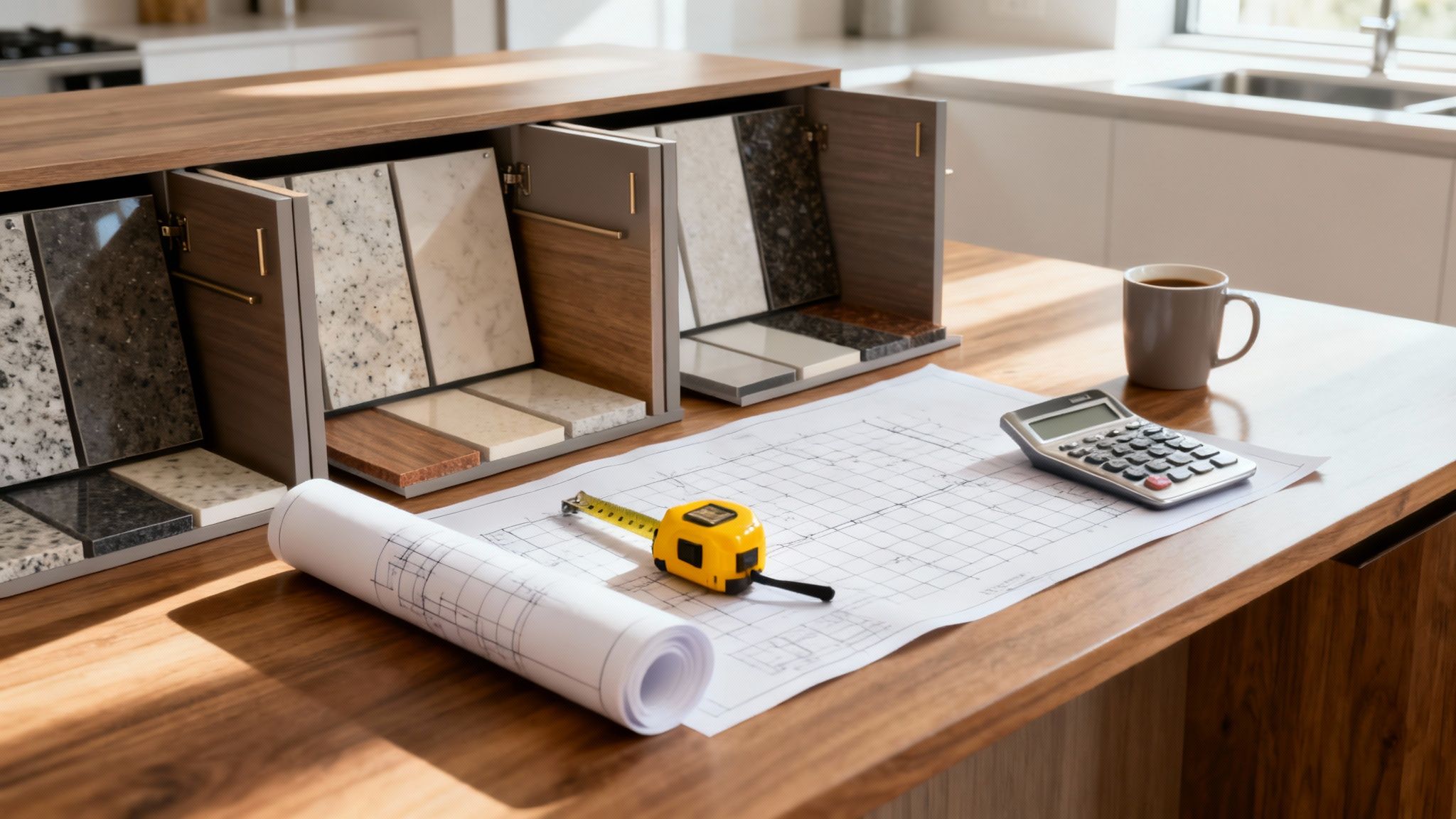
So, you're looking at a new home or planning to update your current one, and the kitchen is on your mind. The first question that pops into your head is probably, "What's this actually going to cost me?" It's the big one, and while the answer is always "it depends," we can definitely break down the typical price tiers to give you a solid starting point for your budget.
Think of it like buying a car. You've got your reliable base model, a fully-loaded mid-range option with all the popular features, and the high-end luxury vehicle. Each serves a different need and, of course, comes with a very different price tag. Kitchen upgrades work the same way, generally falling into a few distinct categories based on how deep you want to go.
Nationally, the average cost to upgrade a kitchen falls somewhere between $15,000 and $50,000 for most mid-range projects. If you're just looking for a simple cosmetic refresh—think paint, new hardware, and maybe a new faucet—you can often get it done for under $10,000. On the flip side, a major, high-end gut renovation with custom everything can easily soar past $80,000.
Kitchen Upgrade Costs at a Glance
To give you a clearer picture, here's a quick breakdown of what you can generally expect to pay for different levels of work. This table should help you match your project's scope to a realistic budget range.
| Upgrade Level | Typical Cost Range (National Average) | Common Scope of Work |
|---|---|---|
| Cosmetic Refresh | $7,000 - $15,000 | Painting cabinets, new hardware, updating lighting, new faucet, backsplash refresh. |
| Mid-Range Upgrade | $15,000 - $50,000 | New semi-custom cabinets, granite/quartz countertops, new appliances, flooring, sink. |
| Major Remodel | $50,000 - $80,000 | Altering layout, moving plumbing/electrical, new custom cabinets, higher-end appliances. |
| High-End Overhaul | $80,000+ | Custom everything, luxury appliances (Sub-Zero, Wolf), stone slabs, architectural changes. |
These numbers provide a solid baseline, but keep in mind that factors like your location, material choices, and labor rates will cause them to shift.
Defining the Different Levels of Upgrades
To set realistic expectations, it helps to see how the industry defines these project levels. Digging into the data, you can see these cost tiers aren't just guesses; they're based on thousands of real-world projects.
According to the 2024 Cost vs. Value data, a minor mid-range kitchen remodel averages $28,458. A major mid-range remodel comes in at an average of $82,793, with high-end custom work easily pushing into six figures. These are the kinds of numbers that give you a solid baseline before you even start looking at tile samples.
Understanding these benchmarks is crucial, whether you're renovating your forever home or flipping a property for profit. While these are US figures, you'll find similar cost structures in other markets; for instance, the average cost of kitchen renovation in Australia shows parallel breakdowns for labor and materials.
Quick Takeaway: The scope of your project is the single biggest cost driver. The most effective way to keep your budget in check is to stick with your kitchen's existing layout and avoid moving plumbing or electrical lines.
Now that we have a financial snapshot, let's dive deeper and break down exactly where that money goes, from the cabinets and countertops to the labor that puts it all together.
Breaking Down Your Kitchen Budget Item by Item
Knowing the average cost of a kitchen upgrade is a good starting point. But to truly control your budget, you need to know exactly where every dollar is going.
Think of your total renovation budget as a pie. Each slice—cabinets, countertops, labor, appliances—represents a different cost center. The size of those slices can shrink or expand dramatically based on the choices you make. So, let's cut into that pie and see what a typical breakdown looks like. This will show you which items eat up the most cash and where you have the most leverage to save.
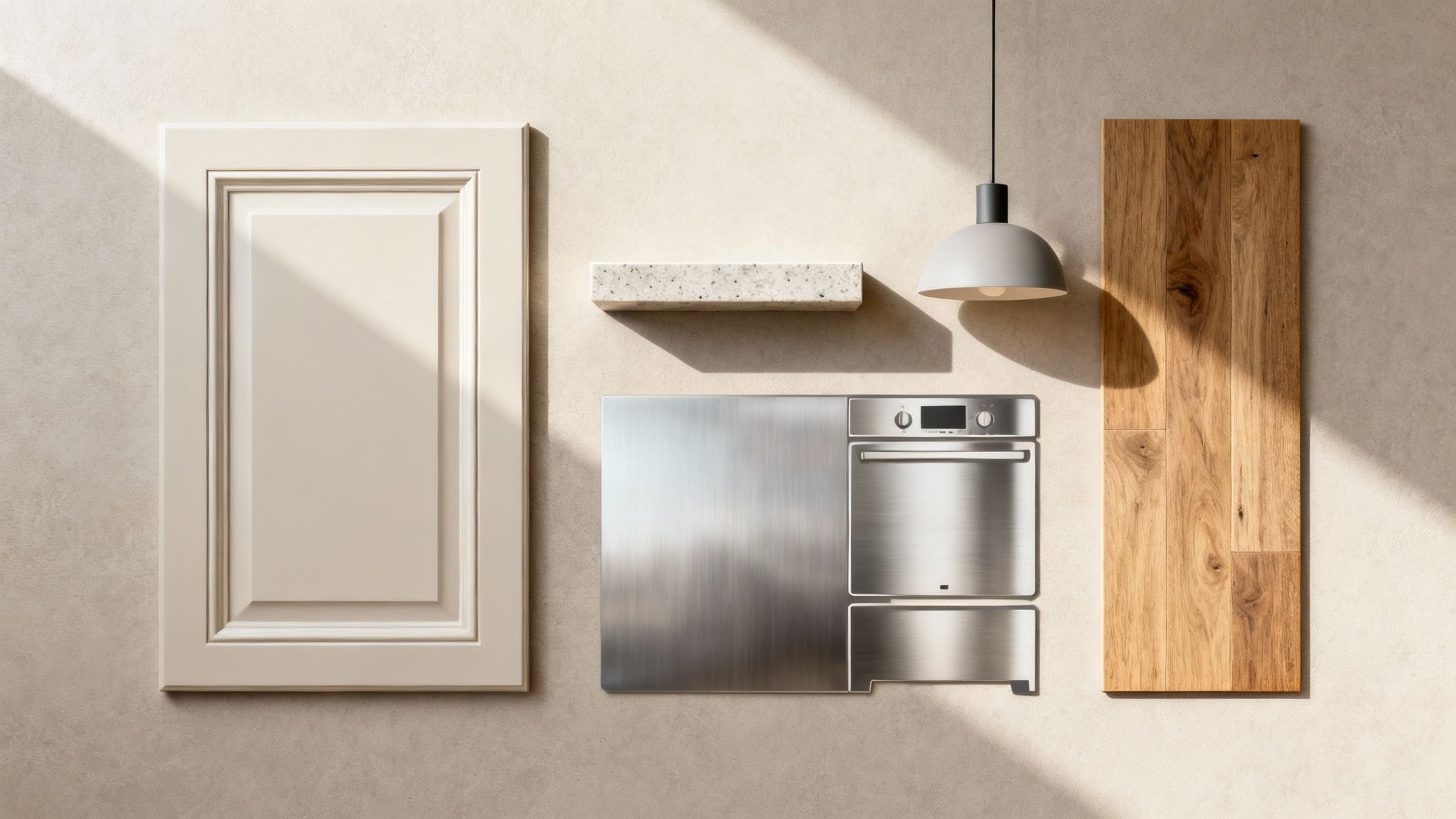
Cabinets: The Biggest Slice of the Budget
In almost every kitchen remodel, cabinets are the single largest line item. They typically consume 30% to 35% of the total budget, and for good reason—they define the kitchen's entire layout, functionality, and aesthetic vibe.
Your costs here will vary wildly depending on which route you take:
- Stock Cabinets: These are your most affordable, off-the-shelf options. They come in standard sizes with limited styles but are perfect for a quick, budget-friendly refresh.
- Semi-Custom Cabinets: A fantastic middle ground. They offer more flexibility in size, style, and finishes than stock options without the premium price tag of going full custom.
- Custom Cabinets: Built from scratch to your exact specs. You get unlimited design possibilities, but you'll pay a premium for that level of personalization.
A popular cost-saving move is refacing or painting your existing cabinets. You get a fresh new look for a fraction of what full replacement costs.
Countertops and Appliances: The Workhorses
Next up are the functional and visual workhorses of your kitchen: countertops and appliances. Together, they make up another huge chunk of your spending.
Countertops often account for about 15% of the budget. The material you choose is everything here. Laminate is the most economical, while quartz and granite are the popular, durable mid-range champs. High-end materials like marble or quartzite will push your costs higher.
Appliances can easily eat up 20% of your total cost. A basic set might run you a few thousand dollars, but if you're looking at high-end, pro-grade models from brands like Sub-Zero or Wolf, that number can soar past $15,000.
Expert Tip: To keep appliance costs in check, always look for bundle deals. Retailers often give you a hefty discount when you buy three or more major appliances from the same brand at once.
Labor: The Unseen but Essential Cost
Never forget the people who actually bring your vision to life. Labor typically accounts for a massive 25% to 40% of the total project cost. This covers everything from demolition and installation to plumbing, electrical work, and painting.
While you can save money by DIY-ing tasks like painting or demo, skilled trades like electrical and plumbing are best left to licensed pros. It’s a matter of safety and code compliance. Getting a detailed cost breakdown from your contractor is a non-negotiable step. For a deeper dive into this, check out our guide on how to estimate renovation costs.
Finishing Touches: Flooring, Lighting, and Backsplash
The final pieces of the budget puzzle are the finishing touches that pull the whole room together. These costs can seem small individually, but they add up quickly.
- Flooring: This can range from affordable vinyl or laminate to more expensive hardwood or tile. Material costs make a huge difference; for example, a quick comparison of porcelain vs. ceramic tile costs can reveal significant savings opportunities.
- Lighting: A good lighting plan is critical and includes ambient (like pot lights), task (under-cabinet), and accent lighting (pendants).
- Backsplash: Tile is the go-to here. Prices can be as low as a few dollars per square foot for basic subway tile or over $100 for intricate, custom mosaic designs.
By understanding how these line items fit together, you can make strategic decisions that align your dream kitchen with your financial reality.
How Your Location Impacts Renovation Costs
While national averages give you a decent ballpark for kitchen upgrade costs, they only tell part of the story. The hard truth is, where you live is one of the single biggest factors driving your final bill.
The exact same mid-range kitchen remodel can cost thousands—or even tens of thousands—of dollars more in one city compared to another.
Think of it like the price of a house. You know a two-bedroom home in San Francisco costs something entirely different than one in Omaha, Nebraska. Kitchen renovations follow the exact same economic rules. This huge price swing boils down to two simple local factors: labor rates and material costs.
Why Geography Dictates Your Budget
The cost of living in an area has a direct ripple effect on what you'll pay for skilled labor. In high-cost urban centers, contractors, plumbers, and electricians have to charge more just to cover their own overhead. This is the single biggest reason for regional price differences.
On top of that, the cost and availability of materials can change based on your region. Being close to a major port or manufacturing hub can lower the shipping costs for big-ticket items like cabinets and countertops. If you're further away, those higher transportation costs get passed right on to you.
- High-Cost Areas (e.g., Coastal Cities): Expect to pay a premium for everything. Demand for contractors is usually sky-high, and their operating costs are steep.
- Mid-Cost Areas (e.g., Suburban and Midwest Cities): Costs here tend to line up with the national averages. You'll find a healthy, competitive market for labor without the extreme price tags of a major metro.
- Low-Cost Areas (e.g., Rural and Southern Regions): These areas generally have the most affordable labor rates, which can dramatically lower the total cost of your kitchen project.
Real-World Price Differences
To see just how wild these swings can be, let's look at the average cost to upgrade a kitchen in different markets. Designers interviewed by House Beautiful laid out some stark contrasts. In parts of Southern California, a small kitchen remodel now often requires a budget of $75,000–$100,000, and medium-sized kitchens start somewhere around $150,000.
Meanwhile, remodelers in lower-cost areas like North Carolina are quoting completely different numbers for similar jobs. Over there, a small kitchen remodel is more likely to be in the $15,000–$30,000 range. A mid-range project typically lands between $35,000 and $60,000. That’s a potential six-figure price difference for the same scope of work, all based on the zip code. You can find more details on these regional renovation costs to see how the market dynamics play out.
Key Takeaway: Always, always use local cost data when building your budget. National averages are a fine starting point, but getting real quotes from local contractors is the only way to get an accurate financial picture for your project.
Setting Realistic Expectations for Your Market
Understanding this geographic factor is the key to setting a realistic budget and avoiding sticker shock. Before you get your heart set on a number you saw online, do a little local digging first.
Talk to neighbors who have recently remodeled. Ask local real estate agents about typical renovation costs in your area. Most importantly, get multiple, detailed quotes from licensed local contractors. This homework will ensure your financial plan is grounded in the reality of your market, not a national statistic that doesn't apply to you.
Understanding the Return on Your Kitchen Investment
A kitchen upgrade is more than just a home improvement project—it’s a direct investment in your property's value. It’s easy to get fixated on the upfront cost, but a smart renovation actually pays you back. Let's shift our focus from just cost to actual return and explore how to calculate and maximize your Return on Investment (ROI).
Thinking about ROI means looking at your renovation through a financial lens. It’s the measure of how much of your spending you’ll get back from the increased home value when it's time to sell. A well-planned kitchen upgrade doesn't just create a beautiful space; it adds tangible, long-term worth to your property.
The Financial Payback of a Kitchen Upgrade
Not all kitchen upgrades are created equal when it comes to financial returns. Some projects offer a much better payback than others, and the data consistently shows that minor, cosmetic updates tend to deliver the highest ROI.
Why is this? A minor refresh—think painting cabinets, installing a new backsplash, and updating hardware—costs less but makes a massive visual impact. Buyers see a modern, well-maintained kitchen and are willing to pay more for it, giving you a strong return for every dollar spent.
On the other hand, a full-scale luxury remodel might not pay you back dollar-for-dollar. While a high-end kitchen is an incredible feature, its massive cost means you'll likely only recoup a percentage of your initial investment, often around 50% to 60%.
A minor mid-range kitchen remodel in the Pacific region, for example, can recoup around 90.4% of its cost upon resale. This makes it one of the highest-value home improvements you can undertake.
The importance of the kitchen is reflected in global demand. Market research shows the global kitchen remodel market, led by North America with a value of about $20.1 billion in 2024, is set for serious growth. Projections show the market could climb to roughly $35.2 billion by 2033, which tells you just how much value homeowners and investors continue to place on these upgrades. You can dive deeper into these global kitchen remodel market trends to see how the industry is evolving.
Smart Upgrades for Maximum ROI
To make your investment work for you, focus on upgrades that appeal to the widest range of potential buyers without getting too personal or over-customizing. The goal is to create a clean, functional, and modern space that feels timeless.
Here are a few high-ROI projects to consider:
- Cabinet Refacing or Painting: This delivers the look of brand-new cabinets for a fraction of the cost, offering a huge visual return.
- New Countertops: Swapping dated laminate for a modern material like quartz or granite is a powerful and very noticeable upgrade.
- Updated Appliances: A matching set of energy-efficient stainless steel appliances is a major selling point for almost every buyer.
- Modern Lighting: Replacing old, dim fixtures with bright LED pot lights and stylish pendants can completely transform the feel of the room.
How to Calculate Your Kitchen ROI
Calculating your ROI is straightforward and absolutely essential for making smart spending decisions. The basic formula helps you see the financial gain from your investment in black and white. For a detailed walkthrough of the calculations, check out our complete guide on how to calculate ROI for real estate.
The formula is simple:
(Net Profit / Total Investment Cost) x 100 = ROI
Let’s break it down with a real-world example:
- Initial Renovation Cost: You spend $25,000 on a mid-range kitchen remodel.
- Increase in Home Value: Your real estate agent confirms the new kitchen added $22,000 to your home's resale value.
- Calculate:($22,000 / $25,000) x 100 = 88%
In this scenario, your kitchen remodel delivered an impressive 88% ROI. By understanding this from the start, you can avoid overspending on features that won't pay off when it’s time to sell.
Visualizing Your Budget with Three Real-World Scenarios
Abstract numbers and percentages are useful, but seeing how a budget actually plays out in the real world is what makes everything click. To bring the average cost to upgrade a kitchen to life, let's walk through three distinct renovation stories. Each one follows a different homeowner with unique goals, priorities, and—most importantly—a different budget.
We'll start with a savvy first-time homebuyer's cosmetic refresh, move to a growing family’s functional mid-range remodel, and wrap up with a high-end upgrade for a "forever" kitchen. These examples will show you exactly how specific choices—like refinishing cabinets versus replacing them—directly impact the final price tag.
Make no mistake, kitchen renovations are big business, and the market is only getting bigger. It's a clear sign of how much value homeowners place on this space.

The data paints a clear picture: a global market already valued at over $20 billion, with solid growth expected to push it toward $35 billion by 2033. This isn't just a trend; it's a long-term investment homeowners are committed to.
To show how these budgets break down based on goals, here's a quick comparison of spending priorities across different project scopes.
Sample Kitchen Upgrade Budgets by Goal
The table below illustrates how different goals—from a simple cosmetic update to a full-gut luxury remodel—shift where the money goes. Notice how labor becomes a much larger percentage as the complexity of the project increases.
| Cost Category | Scenario 1 Budget (Budget Refresh) | Scenario 2 Budget (Mid-Range Remodel) | Scenario 3 Budget (High-End Upgrade) |
|---|---|---|---|
| Cabinets | 35% (Painting) | 37% (Semi-Custom) | 37% (Fully Custom) |
| Countertops | 17% (Butcher Block) | 18% (Quartz) | 13% (Porcelain Slabs) |
| Appliances | 0% (Kept Originals) | 16% (Mid-Range Suite) | 21% (Pro-Grade) |
| Labor & Installation | 25% (Painter, Plumber) | 20% (GC, Trades) | 19% (GC, Structural) |
| Finishes & Fixtures | 11% (Hardware, Faucet) | 5% (Lighting, Backsplash) | 5% (Custom Lighting) |
| Flooring | 0% (Kept Originals) | 4% (LVP) | 5% (Hardwood) |
| Total Budget | ~$8,000 | ~$40,000 | ~$95,000 |
As you can see, the "big ticket" items like cabinets and appliances consistently take up the largest chunks, but their quality and cost scale dramatically with the overall budget.
Scenario 1: The Budget-Friendly Cosmetic Refresh
Meet Alex, a new homeowner who bought a starter home with "good bones" but a seriously dated, dark kitchen. With a tight budget of $8,000, the goal was simple: get the biggest visual bang for the buck. Moving walls or changing the layout was completely off the table.
Alex's strategy was all about smart, high-impact updates. Instead of ripping out the sturdy but tired oak cabinets, a professional painter was hired to sand, prime, and spray them a modern light gray for $2,500. That one move instantly brightened the entire space.
The old laminate countertops were swapped for a new, stylish butcher block from a big-box store, costing just $1,200. For the backsplash, Alex went with classic white subway tile, a timeless and affordable option that ran $600 installed.
- Goal: Modernize and brighten a dated kitchen on a shoestring budget.
- Key Moves: Painting existing cabinets, an affordable countertop swap, and a classic tile backsplash.
- Final Touches: New matte black cabinet hardware ($200), a sleek new faucet ($250), and updated pendant lights over the sink ($300) pulled the whole look together.
By focusing purely on cosmetic changes and keeping the existing footprint, Alex pulled off a stunning transformation for just under $5,500—coming in well under budget.
Scenario 2: The Balanced Mid-Range Remodel
Next up, let's look at Maria and Ben. With two young kids, their cramped, inefficient kitchen just wasn't working. Their $40,000 budget had to improve function as much as form. The top priority? Adding a functional island for meal prep and casual family dinners.
This meant getting a bit more invasive. They smartly kept the main plumbing locations to save money but did take down a non-load-bearing wall to open the kitchen to the dining area. Boom—instant space for an island.
Their biggest line item was semi-custom shaker-style cabinets, which came to $14,000. They chose durable, low-maintenance quartz countertops for both the perimeter and the new island, totaling $7,000. A new suite of mid-range, energy-efficient stainless steel appliances added another $6,000.
Pro Tip: In a mid-range remodel, always protect your "work triangle"—the path between the sink, stove, and refrigerator. Keeping this flow efficient is the key to a functional kitchen, even if you aren't doing a full gut job.
The rest of their budget went to essentials like new LVP (luxury vinyl plank) flooring, hiring an electrician to add island outlets, and installing modern recessed lighting. After all labor costs, their project landed right around $38,000.
Scenario 3: The High-End Dream Kitchen Upgrade
Finally, let's look at Sarah's project. After saving for years, she was ready to build her absolute dream kitchen with a budget of $95,000. The vision was a chef-quality space with premium materials, custom features, and a completely new, open-concept layout.
This was a full-gut renovation, starting from the studs. The project kicked off by removing a load-bearing wall, which required an engineer and significant structural work. Sarah invested heavily in fully custom cabinetry loaded with specialized storage, like pull-out spice racks and appliance garages, costing $35,000.
For appliances, she didn't hold back, selecting a professional-grade gas range, a built-in refrigerator, and a high-performance range hood that together cost over $20,000. For countertops, she chose dramatic, large-format porcelain slabs with a waterfall edge on the island—a $12,000 showstopper.
Here’s a quick snapshot of where the big money went:
- Structural Changes:$15,000 right off the top for engineering and wall removal.
- Luxury Finishes: Custom cabinets, pro-grade appliances, and high-end countertops were the top three expenses by a mile.
- Skilled Labor: A huge chunk of the budget went to a general contractor to manage the complex web of plumbers, electricians, and specialized installers.
Sarah’s kitchen is a perfect example of how the average cost to upgrade a kitchen skyrockets when custom work, structural changes, and luxury materials become the priority, creating a truly one-of-a-kind space.
Your Kitchen Upgrade FAQs Answered
Once you have a handle on the budget, a few practical questions always come up. Here are quick answers to some of the most common concerns for home buyers and owners planning a kitchen project.
How do I finance a kitchen upgrade?
For new home buyers, one of the best options is a renovation loan, which bundles the purchase price and the cost of upgrades into a single mortgage. Existing homeowners often use a home equity loan, a Home Equity Line of Credit (HELOC), or a cash-out refinance. These let you borrow against the value you've already built in your home, typically at a lower interest rate than a personal loan. For smaller projects under $10,000, paying with cash you’ve saved is often the simplest path.
How long does a typical kitchen remodel take?
The timeline depends entirely on the scope of work. A simple cosmetic refresh (like painting and new hardware) might only take 1-2 weeks. A more common mid-range remodel involving new cabinets, counters, and appliances typically takes 4-8 weeks. If you’re planning a major overhaul that includes moving walls or changing plumbing and electrical layouts, be prepared for the project to last 3 months or longer. Always build a time buffer into your plan.
What's the best way to save money on a kitchen upgrade?
The smartest way to save money is to keep your kitchen’s existing layout. Avoiding the cost of moving plumbing, gas, and electrical lines is the single biggest budget-saver. Other practical tips include:
- Refinish, don't replace: Professionally painting or refacing existing cabinets can make them look new for a fraction of the cost.
- Shop for appliance bundles: Retailers often offer significant discounts when you buy three or more appliances from the same brand.
- Choose smart materials: Opt for high-quality, durable materials that offer a high-end look without the premium price, like quartz instead of marble or luxury vinyl plank (LVP) flooring instead of hardwood.
Should I hire a general contractor for my kitchen project?
If your project involves more than one or two simple tasks (like just painting), hiring a general contractor (GC) is highly recommended. A good GC acts as the project manager, coordinating all the different professionals (plumbers, electricians, installers), pulling necessary permits, ensuring work meets building codes, and keeping the project on schedule. While it adds to the cost, a GC's expertise can save you from expensive mistakes, delays, and major headaches.
Ready to stop guessing and start analyzing? Flip Smart gives you the power to evaluate any property in seconds. Get precise renovation cost estimates, after-repair values, and profit projections to make your next investment your best one. Analyze your first deal for free at https://flipsmrt.com.