
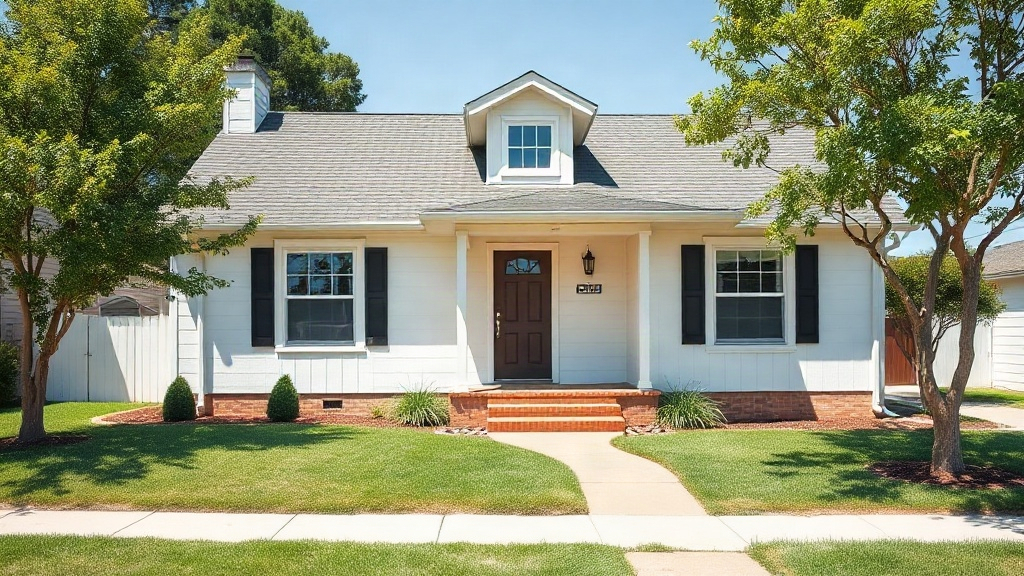
Understanding the 70% Rule: A Fix & Flip Essential
The 70% rule is a cornerstone of fix & flip investing. It provides a quick, reliable way to calculate your Maximum Allowable Offer (MAO) on a property, ensuring the deal leaves room for profit. The principle is simple: your total investment in the property (purchase price plus repair costs) should not exceed 70% of its After Repair Value (ARV). This buffer accounts for expenses like rehab, holding costs, and selling fees, while still leaving room for a reasonable profit.
Want to skip the spreadsheet? FlipSmrt pulls comps, estimates ARV and rehab, and runs the deal math from just an address. Try your first analysis free.
The formula for the 70% rule is straightforward: MAO = (ARV x 0.70) - repair costs. Here’s how it works. First, estimate the property’s ARV by comparing it to similar, recently sold homes in the area. Then multiply the ARV by 0.70 to calculate 70% of that value. From this number, subtract the estimated repair costs to arrive at your MAO—the maximum you should offer for the property.
Let’s break this down with an example. Imagine you’re evaluating a property with an ARV of $300,000 and estimated repair costs of $50,000. Using the formula: MAO = ($300,000 x 0.70) - $50,000. First, calculate 70% of the ARV: $300,000 x 0.70 = $210,000. Then subtract the repair costs: $210,000 - $50,000 = $160,000. In this case, your MAO would be $160,000. Offering more than this could shrink your margins or even lead to a loss after all costs are factored in.
The 70% rule is not just about crunching numbers; it’s about protecting your profit margin. Fix & flip projects come with many variable costs, such as unexpected repairs, financing fees, and market fluctuations. By capping your purchase price at 70% of the ARV minus repairs, you build in a safety net to cover these risks. This approach keeps your deal profitable, even if costs run slightly over budget or the property sells for less than expected.
While the 70% rule is not a one-size-fits-all solution (some markets may require adjustments), it’s an essential starting point for evaluating deals. By sticking to this formula, you ensure that your fix & flip projects are built on sound financial foundations, minimizing risk and maximizing potential returns.
Worked Example: Calculating Maximum Allowable Offer (MAO)
The Maximum Allowable Offer (MAO) is a critical number for any fix & flip investor. It tells you the highest price you can pay for a property while still leaving room for profit after repairs, holding costs, and resale. To calculate MAO, the 70% rule provides a quick and reliable formula: MAO = (ARV x 0.70) - repair costs. Let’s break this down with a concrete example.
Imagine you’re analyzing a property with an After Repair Value (ARV) of $300,000. After inspecting the property and consulting with contractors, you estimate the repair costs will total $50,000. Using the 70% rule, your MAO calculation looks like this:
- Step 1: Multiply ARV by 70%. $300,000 x 0.70 = $210,000.
- Step 2: Subtract the repair costs. $210,000 - $50,000 = $160,000.
Your MAO for this property is $160,000. This means you should not pay more than $160,000 for the property if you want to maintain a safe profit margin. The 70% rule accounts for other costs like closing fees, holding expenses, and a cushion for unexpected overruns, ensuring you still walk away with a profit after the flip.
Here’s why sticking to the MAO is so important: if you overpay, your profit shrinks significantly. For instance, paying $170,000 instead of $160,000 would cut directly into your profit by $10,000. That’s before considering potential surprises during renovation. Staying disciplined with your MAO ensures you’re not taking on unnecessary risk.
Remember, the 70% rule is a starting point, not the full picture. In competitive markets or unique situations, you may need to adjust, but always calculate your MAO first. It’s the foundation of a profitable deal.
Estimating Profit: Beyond the 70% Rule
The 70% rule is a great starting point for evaluating a deal, but true profit estimation requires a closer look at all costs involved. A fix and flip isn't just about the purchase price and rehab budget. To get a realistic profit figure, you also need to account for closing costs, holding costs, and selling fees. These expenses can add up quickly and, if overlooked, turn a seemingly great deal into a breakeven—or worse.
Let’s break this down with an example. Assume you're purchasing a property for $160,000 and planning a $50,000 rehab. You estimate an After Repair Value (ARV) of $300,000. Using the 70% rule, your numbers check out, but now it’s time to factor in additional costs. Closing costs on the purchase, holding costs during the rehab, and selling fees (like agent commissions and transfer taxes) often total around 8-10% of the ARV. For simplicity, let’s assume these costs combined are $25,000.
Your profit calculation would look like this:
- Sale price (ARV): $300,000
- Minus purchase price: $160,000
- Minus rehab costs: $50,000
- Minus additional costs: $25,000
This leaves you with a projected profit of $65,000 ($300,000 - $160,000 - $50,000 - $25,000). While this looks promising, it’s important to include a buffer for unexpected rehab overruns or market changes. A 10% contingency in the rehab budget, for example, would reduce profit by $5,000, leaving you with $60,000. The clearer your cost estimates, the more prepared you’ll be to evaluate whether the deal is worth pursuing.
The takeaway here is simple: the 70% rule helps set guardrails, but accurate profit estimation comes down to understanding all the costs. Always run the full numbers to confirm your deal pencils out as profitably as it seems at first glance.
Run these numbers on a real deal in seconds
FlipSmrt turns an address into ARV, a rehab budget, and your Maximum Allowable Offer automatically.
Analyze a Property FreeNuances and Edge Cases: When the 70% Rule Needs Adjusting
The 70% rule is a reliable baseline for most fix & flip deals, but it doesn't always apply universally. In certain markets or property types, rigidly sticking to 70% of ARV minus repairs can lead to lost opportunities or miscalculations. Recognizing when and how to adjust the rule is vital for maximizing profitability while mitigating risk.
High-end markets are a prime example where the 70% rule often needs tweaking. In areas with properties selling for $1 million or more, buyers may accept slimmer margins because demand is strong and holding costs are proportionally higher. For instance, instead of using 70% of ARV, an investor might calculate MAO at 75% or even 80% of ARV. On a $1.2 million ARV property with $150,000 in repairs, using 75% ARV yields an MAO of $750,000 ($1,200,000 x 0.75 - $150,000). This higher percentage reflects the smaller margin expectation in upscale markets, where profit per deal is often measured in absolute dollars rather than percentage returns.
At the opposite end of the spectrum, ultra-low-cost properties can make the 70% rule overly conservative. For example, if a home has an ARV of $90,000 and requires $20,000 in repairs, the standard formula would cap the MAO at $43,000 ($90,000 x 0.70 - $20,000). However, in lower-cost neighborhoods, repair costs often represent a larger percentage of the ARV, and buyers may adjust upward to 75-80% ARV to remain competitive. In this case, using 75% ARV gives a more realistic MAO of $47,500.
It's also important to factor in local demand and inventory levels. In hot markets with bidding wars, sticking dogmatically to the 70% rule can result in being consistently outbid. Conversely, in markets with slower sales cycles or declining prices, investors might lower their ARV multiplier to 65% or less to account for increased risk. The key is tailoring the formula to the specific deal and market conditions while ensuring the numbers still leave room for profit.
Adjusting the 70% rule doesn't mean abandoning discipline. It means recognizing that real estate is not one-size-fits-all. By understanding the nuances of your market and refining the formula to reflect those realities, you can make smarter, more competitive offers without compromising your bottom line.
Avoiding Common Fix & Flip Mistakes: Over-Rehabbing and Poor Timing
Two of the costliest mistakes in a fix & flip project are over-rehabbing the property and mistiming the sale. Both can eat into your profit margin and even turn a seemingly solid deal into a financial loss. Understanding how to avoid these pitfalls is critical to running a profitable project.
Over-rehabbing happens when you spend too much on upgrades that don’t significantly increase the After Repair Value (ARV). For example, installing high-end quartz countertops and custom cabinetry in a neighborhood where most homes sell with basic laminate counters won’t yield a higher sale price. Buyers compare your property to similar homes in the area, so exceeding the local standard for finishes drains your budget without boosting your ARV. To avoid this, research comparable properties (comps) before finalizing your renovation scope. Focus on improvements that align with the comps, such as fresh paint, updated flooring, or mid-range kitchen and bathroom upgrades. Keep your renovation budget tight by sticking to what the market expects.
Poor timing is another trap that can derail your flip. Holding onto a property too long often results in added costs like extra mortgage payments, property taxes, and utilities. Worse, if the market cools during your holding period, your ARV could drop. For instance, a property you expect to sell for $300,000 might only fetch $280,000 after a three-month market downturn. To mitigate this, set realistic timelines for completing renovations and list the property as soon as it’s ready. Monitor local market trends closely. If you see signs of slowing demand, consider adjusting your pricing strategy or accelerating your timeline to sell before conditions worsen.
By carefully managing your rehab scope and timing, you can avoid unnecessary expenses and protect your profit. Always work backward from the ARV and timeline to ensure every decision supports the bottom line. When in doubt, let the numbers guide you.
FAQ: Quick Answers to Fix & Flip Strategy Questions
What if repair costs go over budget? Always include a contingency buffer of 10-20% in your rehab estimate to account for unforeseen expenses. If costs still exceed this buffer, you may need to adjust your profit expectations. For future deals, scrutinize your initial repair estimates and identify where you underestimated to avoid repeating the mistake.
How do I find ARV comps? Focus on recently sold properties in the same neighborhood that are similar in size, layout, and condition to your planned post-rehab property. Ideally, look for sales within the last 3-6 months and within a 0.5-mile radius. Tools like MLS, public records, or platforms like FlipSmrt can help you identify the most accurate comps quickly.
Is the 70% rule relevant in hot markets? In hot markets with rising property values, investors sometimes adjust the rule to 75% or even 80%. However, this increases your risk and narrows your profit margin. If you modify the rule, ensure you have solid data on ARV trends and buyer demand to justify the higher risk.
How do I handle a property that isn’t selling post-rehab? First, evaluate whether the issue is price, marketing, or both. If buyers perceive it as overpriced, consider lowering the asking price slightly to generate interest. If the price is fair but the listing is stale, refresh the marketing with new photos, staging, or targeted advertising. Holding costs can quickly erode profits, so act quickly to resolve the problem.
Can I skip a detailed rehab estimate if I’m experienced? No. Even seasoned investors need detailed rehab numbers to ensure their deal math is accurate. Skipping this step increases the likelihood of unexpected costs wiping out your profit. Use a systematic approach or a tool like FlipSmrt to break down the renovation budget line by line every time.
Ready to analyze your next deal?
Get instant ARV, renovation estimates, and full deal math. Your first analysis is on us.
Start Free Analysis